
How to Create a Phone-Free Bedtime Routine for Better Sleep and Digital Wellness
The glow of the smartphone screen has become the modern fireplace, but instead of providing warmth and relaxation, it often leaves us wired, anxious, and sleep-deprived. As we navigate the digital landscape of 2026, the boundary between our professional lives, social obligations, and private rest has blurred more than ever. For many, the last thing they see before closing their eyes isn’t a loved one or a book, but a high-definition stream of news, emails, and social media notifications. This habitual “doomscrolling” is a silent thief of mental health and restorative sleep.
Transitioning to a phone-free bedtime routine isn’t just about getting more hours of shut-eye; it’s about reclaiming the sanctity of your evening and protecting your cognitive health. By intentionally removing digital distractions from your bedroom, you allow your brain to enter its natural “wind-down” state. This guide will provide a comprehensive, science-backed roadmap to help you break the digital tether and build a restorative evening ritual that lasts.
—
1. The Science of Why Your Phone is Ruining Your Sleep
To truly commit to a phone-free bedtime, it is essential to understand the biological mechanisms at play. Your smartphone is a marvel of engineering, but it is fundamentally at odds with your circadian rhythm—the internal clock that regulates your sleep-wake cycle.
#
Blue Light and Melatonin Suppression
The screens on our devices emit high concentrations of blue light. In the natural world, blue light is most prevalent during the day, signaling to the brain that it is time to be alert and focused. When you stare at your phone at 11:00 PM, your brain perceives this light as sunlight. Consequently, it suppresses the production of melatonin, the hormone responsible for making you feel sleepy. Research indicates that even a few minutes of screen exposure can delay melatonin onset by hours, leading to “sleep onset latency”—the technical term for lying awake wishing you could fall asleep.
#
Dopamine Loops and Cognitive Stimulation
Beyond the light itself, the content we consume is designed to be addictive. Social media platforms use “variable reward” systems—the same mechanism used in slot machines—to keep us scrolling. Every “like,” comment, or interesting headline triggers a micro-dose of dopamine. This keeps your brain in a state of high arousal and “search” mode, which is the exact opposite of the “relaxation” mode required for deep sleep. When you check your email or news feed, you are essentially inviting the entire world—and all its stressors—into your bed.
—
2. Setting Up Your Environment: Building a “No-Phone Zone”
Success in digital wellness is rarely about willpower alone; it is about environment design. If your phone is on your nightstand, you will eventually reach for it. To create a sustainable phone-free routine, you must physically alter your surroundings.
#
The Charging Station Relocation
The most effective step you can take is to charge your phone in a completely different room. Choose the kitchen, the hallway, or the living room as the designated “phone home.” By placing a physical distance between yourself and your device, you eliminate the possibility of mindless reaching during the night. If you must have your phone nearby for emergency calls, place it across the room on a dresser where you cannot reach it from the bed.
#
Reclaiming the Nightstand
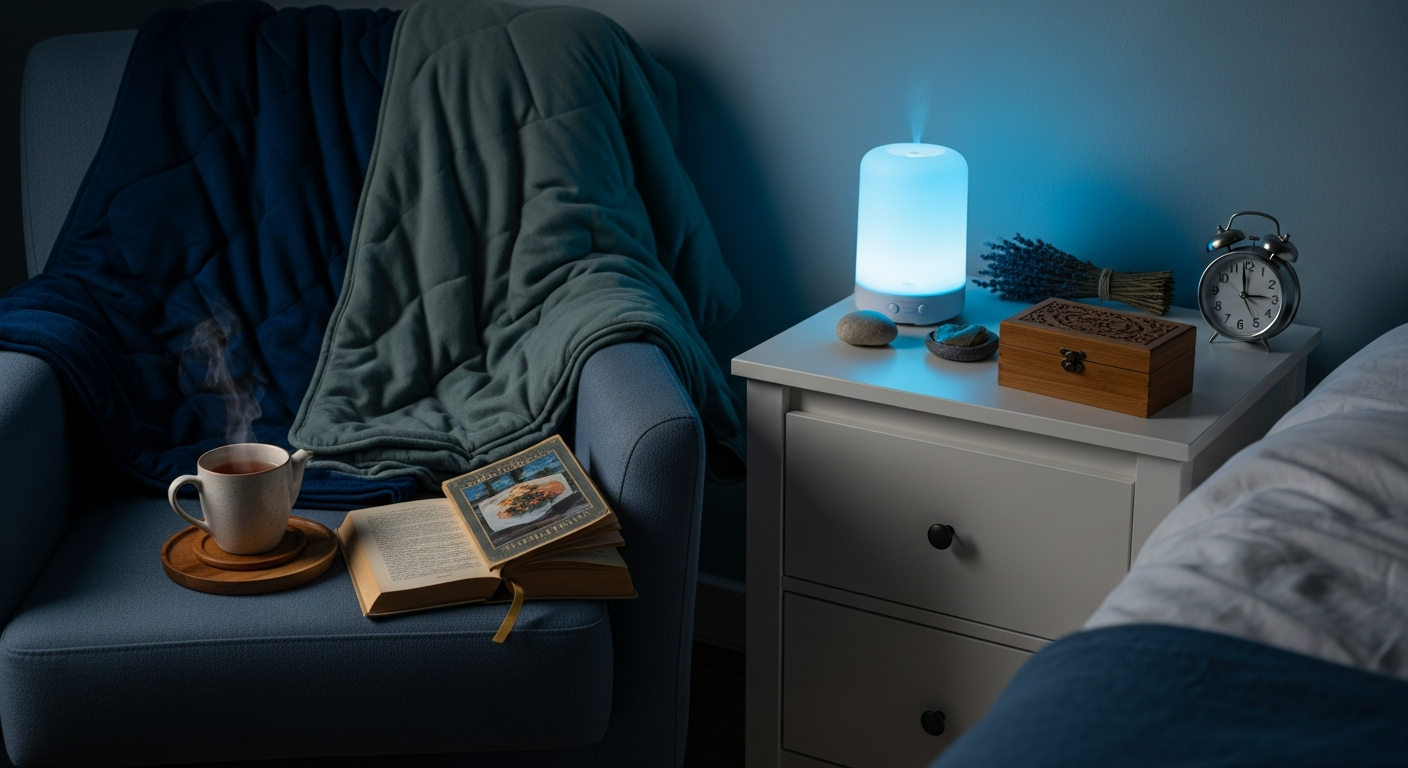
Once the phone is gone, your nightstand will feel empty. Fill it with “analog” tools that encourage relaxation. A physical alarm clock is your first essential purchase. Relying on your phone for an alarm is a trap; it ensures that the phone is the last thing you touch at night and the first thing you grab in the morning. Replace the phone with a glass of water, a high-quality candle or essential oil diffuser (like lavender), and a stack of physical books or journals.
—
3. A Step-by-Step Guide to the “Digital Sunset”
You cannot expect to go from high-speed scrolling to deep sleep in five minutes. Your nervous system requires a transition period. We recommend a “Digital Sunset” approach, which involves a gradual withdrawal from technology as the evening progresses.
#
The 90-Minute Rule
Ideally, your phone-free routine should begin 60 to 90 minutes before you intend to sleep.
* **T-Minus 90 Minutes:** Finish your last check of emails and social media. Put the phone on “Do Not Disturb” or “Sleep Mode.”
* **T-Minus 60 Minutes:** Move the phone to its charging station in another room. This is your “hard cutoff.”
* **T-Minus 30 Minutes:** Dim the lights in your home. This signals to your pineal gland that it is time to start producing melatonin.
#
Handling the “Phantom Vibration”
In the first week of this routine, you may experience “phantom vibration syndrome”—the sensation that your phone is buzzing even when it isn’t near you. You might also feel a sense of urgency to check “one last thing.” Acknowledge these feelings as signs of digital dependency and remind yourself that nothing happening on the internet at 10:00 PM is more important than your health.
—
4. Screen-Free Alternatives to Unwind Your Mind
The biggest challenge people face when ditching their phones is the question: “What do I do now?” If you don’t have a plan, you will default to your old habits. Here are several screen-free activities that promote parasympathetic nervous system activation (the “rest and digest” state).
#
Deep Reading
Reading physical books or e-ink readers (without backlights) is one of the best ways to prepare for sleep. Fiction, in particular, allows the brain to enter a “flow state” that distracts from daily stressors. Avoid “hustle-culture” business books or heavy non-fiction that might trigger problem-solving thoughts; opt for biographies, poetry, or novels.
#
Journaling and “Brain Dumping”
If you find that your mind races with “to-do” lists the moment your head hits the pillow, journaling is your solution. Spend ten minutes writing down everything on your mind—tasks for tomorrow, worries, or things you’re grateful for. This “externalizes” the thoughts, moving them from your active memory onto the paper, which allows the brain to “close the file” for the night.
#
Gentle Movement and Meditation
Engaging in light stretching or Yin Yoga can release physical tension stored in the body throughout the day. Follow this with five to ten minutes of breathwork or meditation. Focusing on the sensation of your breath helps ground you in the present moment, lowering your heart rate and preparing your body for a restorative night of rest.
—
5. Overcoming Resistance and Managing “Tech FOMO”
The Fear Of Missing Out (FOMO) is a powerful psychological barrier. You might worry about missing an emergency call, a breaking news story, or an important social update. In 2026, the “always-on” culture is intense, but setting boundaries is a form of self-respect.
#
Emergency Access
If you are worried about family emergencies, most modern smartphones allow you to set “Emergency Bypass” for specific contacts. This ensures that if a designated person calls you twice in a row, the phone will ring even if it’s on silent in the other room. Knowing this safety net exists can significantly reduce the anxiety of being “disconnected.”
#
Redefining Your Relationship with Information
Ask yourself: *How often has a late-night news notification improved my life?* Usually, it only serves to increase cortisol levels. Realize that the world will still be there in the morning. By choosing to disconnect, you aren’t “missing out”—you are “opting in” to your own mental clarity and physical longevity.
—
6. The Long-Term Benefits: What Happens When You Reclaim Your Evenings
Consistency is key. After about 14 to 21 days of a phone-free bedtime routine, you will begin to notice profound changes in your quality of life.
#
Improved Sleep Architecture
Without the interference of blue light and dopamine spikes, your body can move through the natural stages of sleep more efficiently. You will likely find that you experience more REM sleep (crucial for emotional processing) and Deep Sleep (crucial for physical repair). You’ll wake up feeling refreshed rather than “groggy.”
#
Enhanced Cognitive Function
Digital wellness directly impacts your “Executive Function.” When you sleep better and reduce nighttime anxiety, your focus, memory, and decision-making skills improve during the day. You’ll find yourself less reliant on caffeine and more capable of handling workplace stress.
#
Better Relationships
If you share a bed with a partner, a phone-free routine can transform your relationship. Replacing “side-by-side scrolling” with conversation, physical touch, or even shared reading fosters a deeper emotional connection. The bedroom becomes a sanctuary for intimacy rather than a satellite office or a media hub.
—
FAQ: Frequently Asked Questions about Phone-Free Bedtime
#
1. What if I use my phone for a white noise app or guided meditation?
While these tools are helpful, they often lead to “app-hopping.” If you need white noise, consider purchasing a dedicated white noise machine or a standalone Bluetooth speaker that you can control without looking at a screen. If you prefer guided meditations, try to download them and set them to play automatically so you don’t have to engage with the UI (User Interface) right before sleep.
#
2. Can I use a “Blue Light Filter” or “Night Mode” instead of putting the phone away?
“Night Mode” (which shifts the screen to warmer tones) is a helpful tool, but it is not a cure-all. It reduces blue light, but it does nothing to stop the cognitive stimulation and dopamine loops associated with using apps. A “warmer” screen still provides enough light and engagement to keep your brain awake.
#
3. How do I handle the boredom in the first few days?
Boredom is actually a prerequisite for sleep. Our brains need to “be bored” to drift off. Instead of fighting it, lean into it. View that quiet, “boring” time as a luxury. If you’re really struggling, use that time for a very low-stimulation hobby like knitting, sketching, or listening to a slow-paced podcast on a smart speaker.
#
4. Is it okay to use an E-reader (like a Kindle)?
Yes, provided it is a dedicated E-reader with an E-ink display (not a tablet like an iPad). E-ink mimics the look of paper and usually has a very low, warm front-light that is much gentler on the eyes than a smartphone’s LED screen. Just ensure the Wi-Fi is off so you aren’t tempted to browse the web.
#
5. What if I need my phone for my morning routine or to track my sleep?
Many people use their phones to track sleep metrics. However, the negative impact of having the phone by your bed usually outweighs the benefit of the data. Consider wearable sleep trackers (like a ring or watch) that sync to your phone in the morning, allowing you to keep the device in another room overnight.
—
Conclusion: Reclaiming Your Rest in 2026
Creating a phone-free bedtime routine is one of the most radical and effective acts of self-care you can perform in our hyper-connected world. It requires a shift in mindset—viewing your evening not as “lost time” where you could be productive or entertained, but as “sacred time” for recovery and reflection.
As we move forward into 2026, the ability to disconnect will become a superpower. By moving your phone out of the bedroom, setting a “Digital Sunset,” and embracing analog alternatives, you are giving your brain the environment it needs to thrive. Start tonight. Put your phone in the kitchen, pick up a book, and rediscover the profound peace of a truly disconnected night’s sleep. Your mind and body will thank you.