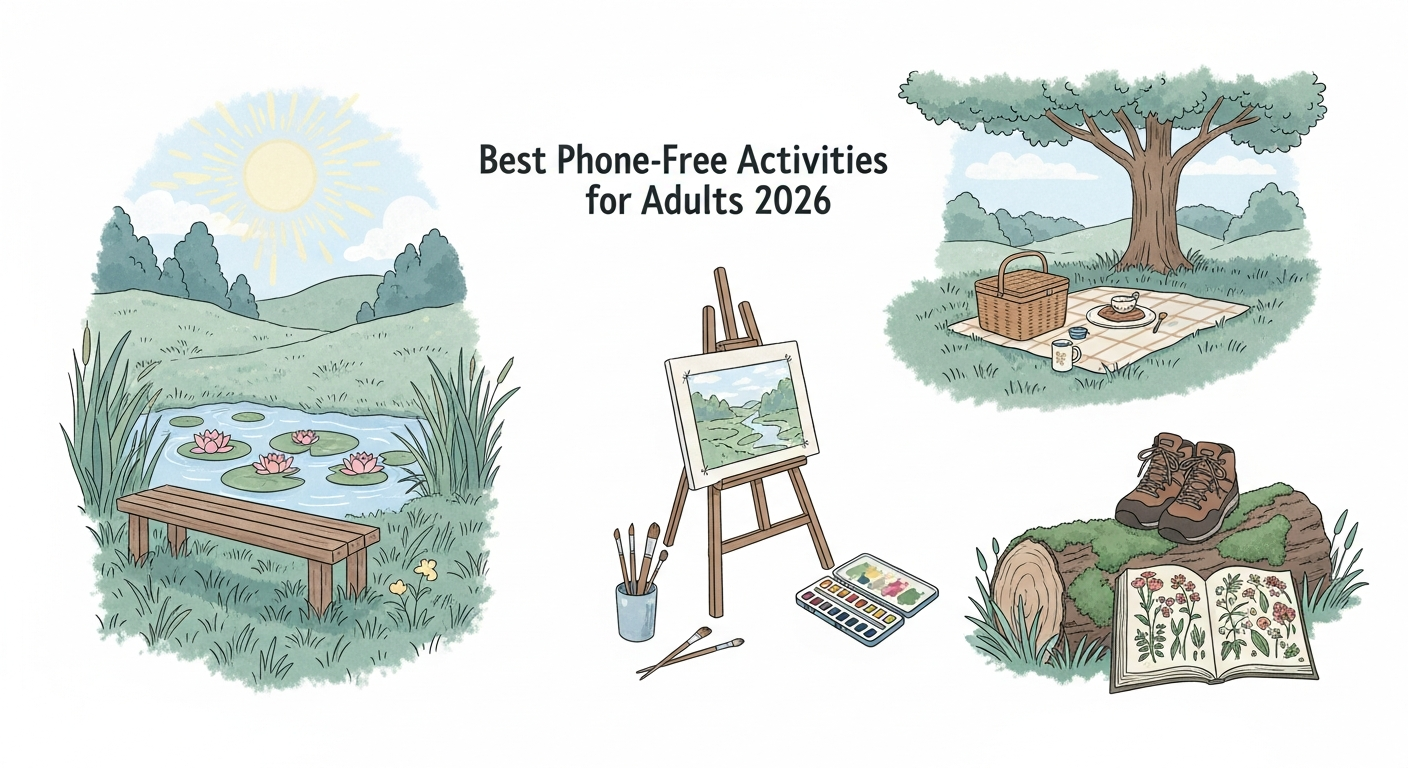
Best Phone-Free Activities for Adults 2026: Reclaim Your Focus and Wellness
By 2026, the digital landscape has become more immersive than ever, with augmented reality and hyper-personalized algorithms vying for every second of our attention. Consequently, the “Digital Detox” movement has evolved from a niche trend into a survival strategy for the modern adult. We are living in an era where “presence” is the new luxury. Constant notifications and the compulsion to doomscroll have led to record levels of cognitive fatigue and diminished attention spans. However, a counter-culture of analog intentionality is rising. People are rediscovering the profound joy of activities that require tactile engagement, physical presence, and—most importantly—a powered-down device. This guide explores the best phone-free activities for adults in 2026, designed to help you break the cycle of addiction, rewire your brain for deep focus, and rediscover the vibrant world that exists beyond the glass screen.
1. The Renaissance of Tactile Creativity: Pottery and Woodworking
In an increasingly virtual world, the craving for something tangible has never been stronger. Hands-on creative hobbies are among the most effective ways to combat phone addiction because they physically prevent you from checking your device. You cannot swipe a screen when your hands are covered in wet clay or sawdust.
#
The Flow State of Pottery
Pottery has seen a massive resurgence in 2026 as the ultimate “slow hobby.” Working with a pottery wheel requires a specific type of concentration known as “flow.” This state of optimal experience occurs when you are fully immersed in a task, losing track of time and self-consciousness. For adults struggling with the fragmented attention caused by social media, the meditative rhythm of centering clay offers a cognitive reset. The result isn’t just a physical object like a bowl or a vase; it is a calmer nervous system.
#
Woodworking and Restoration
Similarly, woodworking and furniture restoration offer a sense of agency that digital life often lacks. In 2026, many adults are turning to “upcycling”—finding discarded wooden pieces and restoring them to their former glory. This activity requires patience, precision, and a multi-sensory engagement that a smartphone simply cannot replicate. The smell of cedar, the vibration of the sander, and the visual progress of a smoothing grain provide a dopamine hit that is far more sustainable than the fleeting “like” on a photo.
2. Nature Immersion: Beyond the Basic Hike
While walking in a park is beneficial, the 2026 approach to nature-based wellness involves deeper, more intentional immersion. We are seeing a shift toward “Forest Bathing” (Shinrin-yoku) and “Micro-adventures” as primary tools for digital wellness.
#
The Science of Forest Bathing
Forest bathing isn’t just a walk; it’s a sensory practice. Research increasingly shows that phytoncides—organic compounds released by trees—can lower cortisol levels and boost immune function. In 2026, guided forest bathing sessions have become a popular phone-free activity for corporate professionals looking to decompress. By leaving the phone in the car (or a lockbox), you allow your parasympathetic nervous system to take over, reversing the “fight or flight” mode triggered by constant digital pings.
#
Micro-Adventures and Navigation
Another growing trend is the “analog adventure.” This involves taking short, 24-hour trips into the wilderness using paper maps instead of GPS. The act of navigating via landmarks and topographical maps engages the hippocampus—the part of the brain responsible for spatial memory, which often atrophies when we over-rely on turn-by-turn digital directions. Whether it’s kayaking a local river or camping in a nearby state park, these micro-adventures force you to engage with your environment in a high-stakes, rewarding way that no app can simulate.
3. Intellectual Deep-Dives: The “Paper Renaissance”
The year 2026 marks a significant turning point in how we consume information. After years of bite-sized content and AI-generated summaries, there is a collective yearning for depth. This has birthed the “Paper Renaissance,” where physical books and long-form journaling have become status symbols of a disciplined mind.
#
The Return of the Physical Book
Reading a physical book is one of the best ways to rebuild a shattered attention span. When you read on a device, the temptation to jump to another tab is always present. A physical book, however, is a “closed ecosystem.” In 2026, “Silent Reading Parties” have become a popular social phenomenon. Groups of adults gather in cafes or libraries to read their respective books in total silence for two hours, with all phones placed in a communal basket at the door. This activity fosters a sense of community while protecting individual focus.
#
Intentional Journaling and Morning Pages
Beyond reading, the act of long-form writing is a powerful tool for digital wellness. Many are adopting the “Morning Pages” habit—writing three pages of longhand, stream-of-consciousness thoughts every morning. This practice acts as a “brain dump,” clearing out the mental clutter that often leads us to reach for our phones as a distraction. By externalizing your anxieties on paper, you gain a level of clarity that scrolling through a feed of other people’s lives could never provide.
4. The Analog Social Club: Face-to-Face Connection
One of the most damaging effects of phone addiction is the erosion of genuine social skills. In 2026, people are fighting back by creating “Phone-Free Zones” in their social lives. The goal is to move away from “performative socializing” (taking photos of the food/event) and back toward “experienced socializing.”
#
Board Game Nights and Strategy
Board games have evolved significantly, with 2026 seeing a surge in complex, cooperative strategy games that can take hours to complete. These games require intense focus, verbal communication, and collective problem-solving. Hosting a board game night with a strict “no-phones-on-the-table” rule allows adults to practice social cues and deep listening—skills that often wither in the world of texting and voice notes.
#
Community Sports and Movement
Pickleball remains a titan in 2026, but other community-based sports like padel and adult dodgeball leagues are also booming. These activities provide the “holy trinity” of digital wellness: physical exercise, social interaction, and a total lack of screens. Engaging in a fast-paced sport requires your full visual and physical attention, making it impossible to check your notifications. The endorphin rush from physical victory or even a shared loss provides a healthy, natural alternative to the artificial hits of dopamine provided by social media.
5. Heritage Crafts and Niche Skill Acquisition
As AI handles more of our cognitive and creative tasks in 2026, many adults are finding solace in “heritage crafts”—skills that were common a century ago but are now considered rare. Learning a niche, difficult skill is an incredible way to build cognitive resilience.
#
Analog Photography
Ironically, the best way to enjoy photography in 2026 is by ditching the smartphone. Film photography is seeing a massive surge among adults. The limitation of having only 24 or 36 frames per roll forces the photographer to be present and intentional. You cannot see the photo immediately; you have to wait for it to be developed. This “delayed gratification” is the perfect antidote to the instant-gratification culture of 2026.
#
Culinary Arts and Fermentation
Cooking has moved beyond basic meal prep and into the realm of “culinary projects.” Fermentation—making your own sourdough, kombucha, or kimchi—is a popular phone-free hobby because it requires a relationship with time. These processes cannot be rushed or automated. Engaging in the kitchen, focusing on the knife skills, the heat of the stove, and the chemistry of flavors, provides a grounding experience that connects you to the physical world through your senses of taste and smell.
6. Strategies for a Sustainable Digital Detox Routine
Knowing which activities to do is only half the battle; the other half is creating the environment to actually do them. In 2026, “Digital Architecture” is the practice of designing your life to minimize screen temptation.
#
The “Dumb Phone” Transition
A major trend in 2026 is the use of “minimalist phones” or “dumb phones” for weekend use. These devices allow for calls and texts but lack browsers and social media apps. Switching your SIM card to a minimalist device on Friday evening can open up 48 hours of uninterrupted time for the activities mentioned above.
#
Creating a “Tech-Free Sanctuary”
Designate at least one room in your home—ideally the bedroom or a reading nook—as a permanent tech-free zone. Use an analog alarm clock instead of your phone. By removing the device from your physical proximity, you eliminate the “choice” of whether or not to use it, significantly reducing decision fatigue. When the phone is not an option, the brain naturally looks for other forms of stimulation, making it much easier to pick up a book or a hobby.
FAQ: Navigating Digital Wellness in 2026
**Q: Is it really possible to go completely phone-free in 2026?**
A: While a 100% phone-free life is difficult due to work and logistical requirements, “pockets of absence” are entirely achievable. The goal is not total elimination, but regaining agency over when and how you use the device.
**Q: I have a very short attention span. Which activity should I start with?**
A: Start with high-engagement physical activities like a sport or pottery. These provide immediate sensory feedback, which is easier for a dopamine-addicted brain to process than the delayed rewards of reading a dense book.
**Q: How do I handle the “FOMO” (Fear Of Missing Out) when I’m offline?**
A: Shift your perspective to “JOMO” (Joy Of Missing Out). Recognize that by missing out on digital noise, you are “tuning in” to your actual life. Most “breaking news” or social updates are irrelevant within 24 hours.
**Q: Can phone-free activities really improve my mental health?**
A: Yes. Studies in 2026 continue to show that reducing screen time lowers anxiety, improves sleep quality, and increases “prosocial” behavior. Analog activities stimulate parts of the brain that remain dormant during passive screen consumption.
**Q: What if my friends and family always reach me via phone?**
A: Set boundaries and communicate them. Tell your inner circle, “I am going offline every Sunday between 10 AM and 4 PM.” People generally respect these boundaries once they are clearly defined, and you might even inspire them to join you.
Conclusion
Reclaiming your life from the grip of a smartphone in 2026 is an act of rebellion. It is a choice to value your time, your focus, and your mental health over the interests of the attention economy. Whether you choose the tactile satisfaction of pottery, the intellectual depth of a physical book, or the rugged challenge of an analog adventure, the key is consistency. These phone-free activities are not just “hobbies”; they are essential practices for maintaining your humanity in a hyper-digital age. By stepping away from the screen, you aren’t just turning off a device—you are turning on your life. Start small, stay intentional, and rediscover the profound beauty of being fully present in 2026.