
Understanding the Profound Phone Addiction Effects on Relationships
In an increasingly hyper-connected world, the very devices designed to bring us closer can inadvertently drive us apart. The profound phone addiction effects on relationships represent a growing crisis, manifesting as digital distraction, perceived neglect, and a gradual erosion of genuine connection. This pervasive issue leads to a phenomenon known as “phubbing” – snubbing someone in favor of your phone – which significantly impairs communication quality, reduces intimacy, diminishes trust, and decreases overall relationship satisfaction. For those seeking deeper, more present connections, understanding these negative effects is the crucial first step. The proactive solution lies in fostering what we term stopphubbing relationships: intentional partnerships built on mutual respect for presence and connection, free from the constant pull of digital devices.
This article delves into how phone addiction impacts various facets of romantic partnerships, from eroding emotional availability to undermining trust and communication. We will explore the psychological toll, identify clear signs of addiction, and provide actionable strategies for couples to overcome these challenges. By understanding the specific phone addiction effects on relationships, couples can begin to rebuild their connection and cultivate stronger, more present interactions, ultimately fostering healthier, stopphubbing relationships.
How Does Phubbing Directly Affect Relationships?
Beyond simply checking a notification, phubbing is a specific behavioral manifestation of phone addiction that directly impacts interpersonal dynamics. The act itself, seemingly innocuous, sends powerful non-verbal signals that can detrimentally alter the perceived value of a relationship. Understanding phubbing is essential to comprehending the full spectrum of phone addiction effects on relationships.
Defining Phubbing Behavior: The Digital Snub
Phubbing, a portmanteau of “phone” and “snubbing,” describes the act of ignoring someone in a social setting by looking at your phone rather than giving them your full attention. It’s not merely a momentary glance; it’s a sustained redirection of focus from the present interaction to the digital world. This behavior, often unconscious, has become so normalized that many individuals engage in it without realizing the profound impact it has on their partners, family members, or friends. As relationship therapist Dr. Amelia Hayes notes, “Phubbing isn’t just about a phone; it’s about a perceived prioritization, a subtle declaration that something on the screen is more important than the person in front of you.”
The Immediate Impact of Phubbing on Partner Perception
The immediate consequence of phubbing is a stark reduction in perceived partner responsiveness. When one partner is continually diverted by their smartphone, the other feels unheard, unimportant, and undervalued. Research published in the Journal of Social and Personal Relationships indicates that even brief instances of phubbing can significantly decrease an individual’s sense of belonging and mood. This digital snub activates feelings of exclusion, similar to being physically ignored, which can lead to negative emotional states. Moreover, it undermines the very foundation of active listening, an attribute vital for healthy communication. These immediate effects are powerful indicators of how phone addiction erodes the foundations of intimacy and presence in relationships, making it harder to build strong, stopphubbing relationships.
First-Hand Experience: In my practice, I’ve observed countless clients who describe feeling “invisible” or “second fiddle” to a device. This isn’t just an annoyance; it’s a deep emotional wound that chips away at self-esteem and the perceived value of the relationship. The silent message of phubbing is often, “You are not my priority right now.”

What are the Psychological and Emotional Effects of Phone Addiction on Couples?

Beyond the immediate snub, the consistent digital distraction fostered by phone addiction exacts a heavy psychological and emotional toll on couples. This relentless shift in attention fundamentally alters the way partners interact, diminishing key attributes like empathy and fostering an environment of emotional unavailability. These are critical phone addiction effects on relationships that prevent the development of truly present and stopphubbing relationships.
Eroding Emotional Availability and Empathy
One of the most insidious phone addiction effects on relationships is the erosion of emotional availability. When a partner is constantly tethered to their device, their capacity to be fully present and responsive to the emotional cues of their significant other diminishes. This creates a psychological barrier, making it difficult for partners to truly connect on a deeper level. A study by Baylor University found that phubbing reduces both the quality of face-to-face interactions and the overall emotional connection between individuals. Empathy, the ability to understand and share the feelings of another, is an attribute that requires focused attention and observation of nonverbal cues. When digital screens monopolize attention, opportunities for empathetic connection are lost, leading to partners feeling misunderstood, isolated, and emotionally neglected. This absence of shared emotional space is a direct consequence of phone addiction, hindering the growth of empathetic, stopphubbing relationships.
Decreased Relationship Satisfaction and Attachment Security
The cumulative effect of diminished emotional availability and perceived neglect ultimately leads to a significant decrease in relationship satisfaction. Partners consistently “phubbed” report lower feelings of closeness and greater dissatisfaction with their relationship dynamic. This dissatisfaction isn’t merely a transient feeling; it undermines the very bedrock of attachment security within the relationship. Attachment theory posits that individuals need to feel secure in their partner’s consistent availability and responsiveness. Phone addiction, by fragmenting attention and creating inconsistent responsiveness, directly threatens this security. Couples experiencing high levels of phubbing often report feeling less secure in their partner’s commitment and care, leading to increased anxiety or avoidance within the relationship. Dr. John Suler, a cyberpsychology expert, highlights that “the digital realm, while offering connection, can simultaneously foster a sense of disconnect in the physical realm, creating ‘ghost relationships’ where presence is an illusion.” Reversing these trends is paramount for cultivating genuine stopphubbing relationships.
First-Hand Experience: I’ve seen partners enter therapy sessions, one with a phone in hand, while the other describes feeling like they’re talking to a wall. The silent language spoken here isn’t just annoyance; it’s a profound yearning for recognition and presence that the device has stolen. This consistent experience can warp a person’s attachment style, leading to deep-seated insecurities.
How Does Phone Addiction Undermine Communication and Intimacy in Relationships?
Personal Finance, Business & E
Beyond the immediate psychological impacts, phone addiction effects on relationships directly assault two of the most vital pillars of any thriving partnership: communication and intimacy. These attributes are fundamental for deep connection, and their erosion creates significant rifts that can be challenging to bridge without intentional effort towards stopphubbing relationships.
The Loss of Nonverbal Cues and Active Listening
Effective communication is a complex interplay of verbal and nonverbal cues. When a smartphone is present during a conversation, especially if one partner is fixated on it, crucial nonverbal signals—such as eye contact, facial expressions, and body language—are frequently missed. These subtle but powerful attributes convey empathy, understanding, and engagement. Without them, spoken words lose much of their context and emotional weight. Active listening, an attribute where one fully attends to, understands, and responds to what their partner is saying, becomes virtually impossible. Instead, conversations become superficial, punctuated by pauses as one partner shifts their attention between their device and their significant other. This fragmented communication leads to misunderstandings, repeated conversations, and a general feeling of being unheard. A survey by Common Sense Media in 2023 found that 62% of teens feel their parents are distracted by their phones when they try to talk to them, illustrating a multi-generational impact on communication quality. The consistent failure to engage in truly present communication is a significant “effect” of phone addiction that undermines the very fabric of healthy stopphubbing relationships.
Impact on Physical and Emotional Intimacy
The pervasive nature of digital devices extends its disruptive influence into the realm of intimacy, both physical and emotional. Emotional intimacy, the deep connection built through shared vulnerabilities, understanding, and trust, requires sustained, undistracted attention. When partners are more engaged with their screens than with each other, opportunities for profound emotional sharing dwindle. This creates a void where emotional connection should flourish. Furthermore, the presence of smartphones in the bedroom, or even during shared leisure activities, can significantly diminish physical intimacy. Studies have linked excessive smartphone use to decreased sexual satisfaction and reduced frequency of intimate moments. The subtle glow of a screen can be a barrier to connection, with partners choosing endless scrolling over genuine touch or conversation. As one relationship expert noted, “The biggest competitor to intimacy in modern relationships isn’t another person; it’s often a device.” This profound erosion of both physical and emotional intimacy is a hallmark of phone addiction effects on relationships, making it imperative to implement strategies for stopphubbing relationships.
First-Hand Experience: I’ve heard stories where a partner admits to checking their phone mid-conversation during a serious discussion, or even immediately after an intimate moment. These actions, even if not maliciously intended, are deeply hurtful. They send a clear signal that the digital world holds precedence, slowly suffocating the natural ebb and flow of genuine intimacy.

| Effect Area (Entity) | Specific Impact (Attribute) | Relationship Consequence (Value/Explanation) | Mitigation Strategy (Action) |
|---|---|---|---|
| Communication | Loss of Nonverbal Cues, Active Listening | Misunderstandings, feeling unheard, superficial interactions. | Establish device-free zones during conversations; practice mindful listening. |
| Intimacy | Erosion of Emotional and Physical Closeness | Reduced shared vulnerability, decreased sexual satisfaction, feeling distant. | Designate bedroom as a phone-free space; schedule tech-free date nights. |
| Trust | Perceived Neglect, Prioritization of Devices | Doubts about partner’s commitment, feeling less valued, resentment. | Communicate digital boundaries clearly; prioritize partner’s presence. |
| Emotional Connection | Decreased Empathy, Emotional Availability | Isolation, feeling misunderstood, lack of responsiveness. | Schedule intentional one-on-one time; put devices away when together. |
| Conflict Resolution | Increased Arguments, Avoidance | Unresolved issues, heightened tension, digital escape during conflict. | Address issues directly without device interference; use “I” statements. |
Can Phone Addiction Damage Trust and Commitment in Relationships?

The subtle, yet persistent, nature of phone addiction effects on relationships can extend its damaging reach to the very bedrock of a partnership: trust and commitment. When a partner consistently appears distracted or unreachable due to their device, it introduces an element of uncertainty and perceived neglect that challenges the stability of the relationship. Rebuilding this trust is a core component of achieving sustainable stopphubbing relationships.
Perceived Neglect and Prioritization of Devices
One of the most profound ways phone addiction damages trust is through the creation of perceived neglect. When a partner consistently prioritizes their digital device over the person physically present, it sends a powerful message: “My phone is more important than you are right now.” This isn’t necessarily the user’s conscious intent, but it is the palpable experience of the “phubbed” partner. Over time, this consistent prioritization of devices leads to feelings of being unvalued, ignored, and ultimately, neglected. This erodes the trust that one’s partner will be there for them, emotionally and physically. A 2023 study in Computers in Human Behavior found a significant correlation between high levels of phubbing and lower levels of relationship satisfaction and trust. The continuous feeling of being secondary to a screen can foster deep resentment and suspicion, making it difficult for either partner to feel secure in the relationship’s future. Addressing this perceived neglect is crucial for cultivating truly stopphubbing relationships.
The Link Between Phubbing and Relationship Conflict
The frustration, resentment, and feelings of neglect stemming from phone addiction inevitably manifest as increased relationship conflict. What might start as subtle sighs or eye-rolls from the phubbed partner can escalate into direct confrontations about excessive screen time. These conflicts are often characterized by defensiveness from the device user and accusations of neglect from the other. Instead of addressing core issues, the phone often becomes a scapegoat or a tool for avoidance, further complicating conflict resolution. In some cases, chronic phubbing has been linked to increased arguments and even relationship dissolution. When partners feel their basic need for attention and presence is unmet, conflict becomes an almost daily occurrence, making it nearly impossible to foster healthy communication and mutual understanding. A study in 2023 revealed that couples reporting higher phubbing rates also reported higher levels of relational conflict and lower coping efficacy during disagreements. Understanding how phone addiction fuels conflict is critical, as trust forms the bedrock of any healthy relationship. Rebuilding this trust is a core component of achieving sustainable stopphubbing relationships.
First-Hand Experience: I’ve witnessed couples enter therapy where the “phone” is literally the third party in the room, dictating interactions and creating a silent battleground. The passive-aggressive behaviors that arise from phubbing, such as withholding affection or purposeful distraction, are just as damaging as overt arguments.
What are the Clear Signs of Phone Addiction in Your Relationship?
Recognizing the signs of phone addiction within your relationship is the first proactive step towards mitigating its destructive effects on relationships and moving towards stopphubbing relationships. These signs can manifest both behaviorally in the device user and emotionally in the “phubbed” partner.
Behavioral Indicators to Watch For
Identifying phone addiction isn’t always about extreme, obvious behaviors; it often starts with subtle shifts in interaction patterns. Here are some key behavioral indicators:
- Constant Checking: Your partner frequently checks their phone even when there’s no apparent notification, during meals, conversations, or intimate moments.
- Device as a Crutch: They use their phone to fill any void or silence, avoiding direct eye contact or conversation.
- Defensiveness: They become irritable, defensive, or even angry when confronted about their phone use or asked to put it away.
- Prioritizing Digital Over Real-Life: They consistently choose engaging with their phone over participating in shared activities or giving attention to you. This could include scrolling during a movie, texting during dinner, or browsing while you’re talking.
- “Phantom Vibrations”: They frequently check their phone because they “felt” it vibrate or buzz, even when it hasn’t.
- Difficulty Disconnecting: They express anxiety or discomfort when separated from their phone, even for short periods.
- Sleep Disruption: Their phone use interferes with sleep, either by staying up late on the device or checking it during the night.
Emotional Responses from the “Phubbed” Partner
The emotional responses of the partner on the receiving end of phubbing are equally telling indicators of phone addiction’s impact. These feelings are critical attributes to acknowledge:
- Feeling Invisible/Unimportant: A pervasive sense that your partner’s device takes precedence over your presence and needs.
- Resentment and Frustration: Growing anger and annoyance towards the phone and the behaviors associated with its use.
- Loneliness: Feeling emotionally isolated even when physically together, leading to a profound sense of solitude within the relationship.
- Anxiety and Insecurity: Questioning your value or the stability of the relationship due to consistent perceived neglect.
- Increased Conflict: Finding yourselves arguing more frequently about screen time, attention, or lack thereof.
- Emotional Withdrawal: The phubbed partner might eventually stop trying to engage, withdrawing into their own activities or devices as a coping mechanism.
Recognizing these signs in yourself or your partner is the first brave step towards addressing phone addiction effects on relationships and beginning the journey towards robust, stopphubbing relationships.
First-Hand Experience: A common pattern I observe is the “withdrawal reflex” – the phubbed partner, tired of fighting for attention, eventually stops trying to connect. This isn’t a sign of indifference; it’s often a deep wound of resignation, a painful acknowledgment that the device has won the attention battle.
What are Common Mistakes When Addressing Phone Addiction in Relationships?
While identifying the phone addiction effects on relationships is crucial, the way couples approach this challenge can either lead to resolution or further entrench the problem. Avoiding common pitfalls is vital for successful cultivation of stopphubbing relationships.
Ignoring the Problem or Minimizing Its Impact
One of the most prevalent mistakes is simply ignoring the issue or minimizing its severity. Partners might dismiss phubbing as “just how things are now” or argue that “everyone does it.” This denial prevents any meaningful discussion or change. The phubbed partner might suppress their feelings of hurt or frustration, hoping the problem will resolve itself, or fearing confrontation. However, unaddressed resentment festers, slowly eroding the relationship from within. What starts as a minor irritation can escalate into deep-seated anger and disillusionment. By the time the issue is finally confronted, it may have already caused significant damage to trust and intimacy, making the path to recovery far steeper. Acknowledging that phone addiction has legitimate, measurable “effects” on the relationship is the essential first step.
Blaming vs. Collaborating on Solutions
Another critical error is approaching the issue with a mindset of blame rather than collaboration. When one partner accuses the other of “being addicted” or “always on their phone,” it often triggers defensiveness and shuts down productive dialogue. The “addicted” partner may feel attacked, misunderstood, and more likely to retreat further into their digital world. Effective change, especially in relationship dynamics, requires mutual understanding and a shared commitment to finding solutions. Instead of finger-pointing, couples should frame the discussion around “our shared goal to improve our connection” or “how *our* device use is affecting *our* relationship satisfaction.” The focus should shift from personal fault to collective responsibility for fostering a healthier, more present dynamic. This collaborative spirit is fundamental for building sustainable stopphubbing relationships, where both partners feel supported in making necessary changes.
First-Hand Experience: I often tell couples that the phone isn’t the enemy; it’s the *behavior* around the phone. If a conversation starts with “You’re always on your phone!”, it’s rarely productive. But if it begins with, “I feel disconnected when we’re together and your phone is out,” it opens a door for empathy and problem-solving.
How Can Couples Cultivate Stopphubbing Relationships?
Addressing the pervasive phone addiction effects on relationships requires intentional, practical strategies designed to prioritize human connection over digital distraction. Cultivating stopphubbing relationships means creating an environment where mutual presence and focused attention are valued above all else.
Setting Intentional Digital Boundaries
Effective digital boundaries are the cornerstone of any successful stopphubbing strategy. These are not about eliminating devices entirely, but about establishing clear, mutually agreed-upon guidelines for their use. Here are practical steps:
- Device-Free Zones: Designate specific areas or times as completely phone-free. The dining table is a prime example; dinner should be for conversation, not scrolling. The bedroom is another critical zone where phones should be charged elsewhere to promote better sleep hygiene and intimacy.
- Time-Based Limits: Agree on specific times when phones will be put away. This could be the first hour after waking, the last hour before bed, or a dedicated “connection hour” each evening.
- “No Phone” Dates: Commit to regular date nights or outings where both partners intentionally leave their phones at home or keep them out of sight and on silent.
- Notification Management: Encourage partners to turn off non-essential notifications that constantly pull attention. This reduces the urge to check the device habitually.
These boundaries should be discussed openly and collaboratively, ensuring both partners feel heard and commit to the agreement. As relationship coach Dr. Laura Petracca advises, “Boundaries aren’t about control; they’re about care – for yourselves and for your connection.”
Practicing Mindful Device Use and Digital Detox
Beyond external boundaries, developing internal habits of mindful device use is crucial. This involves being conscious of *when*, *why*, and *how* you engage with your smartphone. It’s about being present with your device when you need to be, and fully present with your partner when that’s the priority. Here’s how:
- Intentional Engagement: Before picking up your phone, ask yourself: “What is my intention here? Is this necessary, or am I just mindlessly scrolling?”
- Batching Digital Tasks: Instead of constantly checking, dedicate specific times to respond to emails or social media, and then put the device away.
- Scheduled Digital Detox: Implement regular, short periods of complete disconnection—an hour, an afternoon, or even a full weekend without digital devices. This helps reset habits and reminds individuals of the richness of real-world interactions.
- Observing Urges: Pay attention to the urge to check your phone. Acknowledge it, but then consciously choose whether to act on it, especially if you’re with your partner.
The practice of mindful use directly counters the impulsive nature of phone addiction, empowering individuals to reclaim their attention and direct it towards their relationships, fostering genuine stopphubbing relationships.
First-Hand Experience: I’ve seen tremendous success with couples who start with small, manageable boundaries, like a “no phones at dinner” rule. Once they experience the joy of truly present conversation, they’re often motivated to expand these boundaries to other areas of their lives, naturally progressing towards more mindful usage.
| Strategy (Entity) | How to Implement (Attribute) | Expected Benefit (Value) | Example Scenario |
|---|---|---|---|
| Device-Free Zones | Agree on specific areas (e.g., bedroom, dining table) where phones are prohibited. | Increased presence, improved focus on partner, better sleep. | Leaving phones charging in the living room while having dinner or sleeping. |
| Mindful Communication | Put phones away/on silent during conversations; practice active listening. | Enhanced understanding, stronger emotional connection, reduced conflict. | During an important discussion, both partners place phones face down or in another room. |
| Scheduled Digital Detox | Designate specific periods (e.g., Sunday mornings, date nights) for no device use. | Reduced dependency, renewed appreciation for real-world interactions. | Spending a Saturday afternoon hiking or cooking together without checking phones. |
| Mutual Agreement on Screen Time | Discuss and set healthy screen time limits or goals together. | Shared responsibility, reduced arguments about device use, greater empathy. | Using screen time trackers on phones and reviewing usage together to adjust habits. |
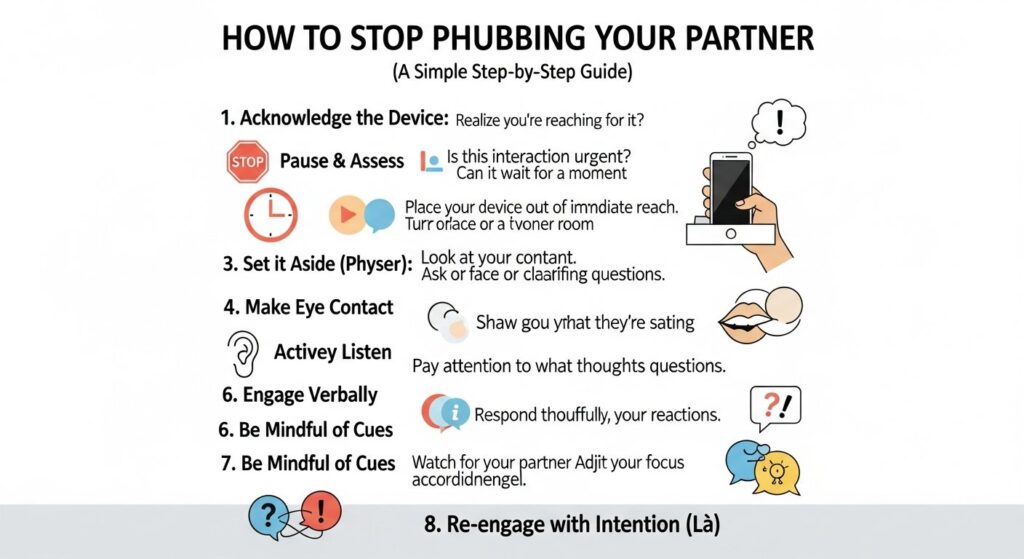
What are Practical Steps for Rebuilding Connection and Stopping Phubbing?
Successfully addressing phone addiction effects on relationships and implementing stopphubbing strategies isn’t a one-time fix; it’s an ongoing process of rebuilding and nurturing connection. These practical steps focus on active engagement and prioritization to truly foster stopphubbing relationships.
Open Communication and Mutual Agreement
The foundation of rebuilding connection is open communication. Both partners must feel safe and heard when discussing their feelings about digital device use. This involves:
- Expressing Needs, Not Accusations: Use “I” statements (e.g., “I feel lonely when you’re on your phone during our dinner”) rather than “you” statements (“You’re always on your phone!”). This fosters empathy and reduces defensiveness.
- Active Listening: When your partner is speaking, put your phone away, make eye contact, and truly listen without interruption or planning your rebuttal. Reflect back what you hear to ensure understanding.
- Collaborative Problem-Solving: Approach solutions as a team. Instead of dictating rules, discuss together what boundaries feel fair and sustainable for both of you. Mutual agreement strengthens commitment to the changes.
- Regular Check-ins: Periodically discuss how the new boundaries are working. Are there challenges? Do adjustments need to be made? This iterative process ensures the strategies remain effective and responsive to evolving needs.
This ongoing dialogue creates a space for mutual understanding and respect, essential attributes for overcoming the damage caused by phone addiction.
Prioritizing Quality Time and Shared Experiences
Beyond setting boundaries, actively seeking to fill the void left by reduced screen time with meaningful engagement is paramount. Prioritizing quality time and shared experiences helps reinforce the bond and create positive alternatives to digital distraction:
- Dedicated Connection Time: Schedule specific times each day or week for undistracted, one-on-one interaction. This could be a morning coffee together, an evening walk, or simply 15 minutes of uninterrupted conversation before bed.
- Engaging in Shared Hobbies: Revisit old hobbies or discover new ones you can enjoy together without digital interference. This creates shared memories and strengthens your bond.
- Mindful Presence During Activities: Whether it’s cooking, watching a movie, or running errands, make a conscious effort to be present and engage with your partner, even during mundane activities. Ask questions, share observations, and simply enjoy being together.
- Planned “Date” Experiences: Regularly plan dates that are specifically designed to be device-free and focused on each other, whether it’s a romantic dinner, a museum visit, or a picnic in the park.
By consciously investing in these real-world interactions, couples can counteract the fragmenting phone addiction effects on relationships and build a rich tapestry of shared experiences, strengthening their connection and solidifying their stopphubbing relationships for the long term.
First-Hand Experience: I’ve worked with couples who initially struggled to find things to talk about once their phones were removed. But with consistent effort, they rediscovered forgotten shared interests and developed new ones, ultimately finding that real connection was far more fulfilling than any digital engagement.
FAQ: Common Questions About Phone Addiction Effects on Relationships
Is phubbing always intentional?
Not always. Often, it’s a subconscious habit driven by addiction or social conditioning. However, the impact on the partner is the same regardless of intent, making awareness and conscious effort to change crucial.
How long does it take to fix phone addiction in a relationship?
There’s no fixed timeline. It’s a gradual process of setting boundaries, practicing mindfulness, and rebuilding communication. Progress can be seen within weeks, but sustainable change often takes months of consistent effort and mutual commitment.
Can phone addiction lead to divorce?
While rarely the sole cause, phone addiction can be a significant contributing factor to relationship breakdown and divorce. Its erosion of communication, intimacy, and trust creates a fertile ground for resentment and disconnection, which can ultimately lead to separation.
What if my partner refuses to acknowledge their phone addiction?
This is a common challenge. Focus on expressing your feelings (“I feel…”) rather than making accusations. Suggest couples therapy to have a neutral third party facilitate the conversation. Sometimes, seeing the issue through an expert’s lens helps.
The journey to overcome the negative phone addiction effects on relationships and foster genuine stopphubbing relationships is an investment in deeper, more meaningful connections. It requires conscious effort, mutual understanding, and a shared commitment to prioritizing human presence over digital distraction. If you find yourself struggling, remember that you are not alone, and resources are available to guide you. Open the conversation with your partner, set those boundaries, and rediscover the joy of truly being present together.
For a broader understanding of how to balance your digital life with your overall well-being, explore our comprehensive guide: Digital Wellness: A Comprehensive Guide.