
Mastering Non-Violent Communication: Techniques for Deeper Connection in Relationships
By Stopphubbing Team | Published: June 23, 2024 | Last updated: June 23, 2024
What is Non-Violent Communication? The Foundation of Compassionate Connection
At its heart, Non-Violent Communication (NVC), often referred to as Compassionate Communication, is a powerful framework for human interaction that emphasizes empathy, honesty, and mutual respect. Developed by clinical psychologist Dr. Marshall B. Rosenberg in the 1960s, NVC is more than just a set of techniques; it’s a profound shift in mindset that encourages us to connect with our own humanity and the humanity of others. Rosenberg’s work was born out of a desire to find a way for people to resolve conflicts peacefully and build relationships based on understanding rather than coercion or judgment.
The core premise of NVC is that all human beings share universal needs, and that most conflicts arise not from evil intent, but from tragic expressions of unmet needs. Traditional communication often involves judgment, blame, criticism, and demands – forms of “violent” communication that create defensiveness, resentment, and distance. NVC, in contrast, guides us away from these destructive patterns by focusing on four key areas: observing what is happening without evaluation, identifying the feelings awakened by those observations, connecting those feelings to universal human needs, and finally, making clear, actionable requests.
NVC doesn’t ask us to be “nice” or suppress anger; rather, it provides a structured method to express ourselves authentically and hear others empathetically, even in emotionally charged situations. It empowers individuals to articulate what they truly need in a way that increases the likelihood of those needs being met, while simultaneously fostering understanding and compassion for others. This approach helps de-escalate conflicts, build trust, and ultimately forge deeper, more meaningful connections, making it an invaluable tool for navigating the complexities of modern relationships.
The Four Pillars of Non-Violent Communication Techniques: Observations, Feelings, Needs, Requests

The NVC model is built upon four interconnected components that provide a clear pathway for honest and empathetic communication. Understanding and practicing these four pillars are fundamental to mastering non-violent communication techniques for transformative dialogue. Each step encourages self-awareness and empathy, allowing us to express ourselves authentically while also creating space for understanding others.
1. Observations (Without Evaluation)
The first component of NVC is making clear, objective observations without mixing them with evaluations or judgments. This means describing what you see, hear, or remember in a way that can be agreed upon by anyone present, much like a camera recording an event. Our natural tendency is to immediately interpret, judge, or analyze, which often leads to defensiveness in the listener. When we blend observation with evaluation, the other person is more likely to hear criticism rather than a factual statement, shutting down the possibility for genuine connection.
- Harmful Example: “You are always late and inconsiderate.” (Evaluation)
- NVC Example: “When you arrived 20 minutes after our agreed meeting time…” (Observation)
- Harmful Example: “You never help around the house.” (Evaluation)
- NVC Example: “I noticed the dirty dishes piled in the sink, and the laundry basket is overflowing.” (Observation)
Practical Tip: Practice describing situations using factual language, focusing on what you actually saw or heard, rather than what you thought or interpreted. Imagine you are a neutral journalist reporting an event.
2. Feelings (Distinguished from Thoughts)
The second component involves identifying and expressing your feelings in response to your observations. This step requires emotional literacy and the ability to differentiate between genuine feelings and thoughts or interpretations disguised as feelings. For example, “I feel like you don’t care” is a thought or interpretation about the other person’s actions, not a feeling. True feelings describe your internal emotional state – joy, sadness, fear, anger, relief, frustration, peace, etc.
Expressing vulnerability by sharing your true feelings fosters empathy and connection. It allows others to understand the impact of their actions on you without feeling accused.
- Harmful Example: “I feel that you should have known better.” (Thought/Judgment)
- NVC Example: “I feel frustrated and a little disheartened…” (Feeling)
- Harmful Example: “I feel manipulated when you say that.” (Thought/Judgment)
- NVC Example: “I feel confused and a bit uneasy…” (Feeling)
Practical Tip: Expand your emotional vocabulary. Keep a list of feeling words (e.g., sad, happy, anxious, curious, weary, elated, worried) and practice using them to describe your internal state accurately. Avoid phrases like “I feel like…” or “I feel that…” which usually precede thoughts.
3. Needs (Universal Human Needs)
Focusing on needs helps to de-personalize the situation. Instead of “You make me angry,” it becomes “I feel angry because my need for respect/consideration is not being met.” This shift transforms the dynamic from an accusation to an invitation for understanding and collaboration.
- Harmful Example: “You never listen to me, and it makes me furious.” (Blame)
- NVC Example: “I feel furious because my need for understanding and to be heard is not being met.” (Need)
- Harmful Example: “I’m upset because you left me alone with all the work.” (Blame)
- NVC Example: “I feel overwhelmed because I have a need for support and balance in our shared responsibilities.” (Need)
Practical Tip: Reflect on what values or life-serving qualities are important to you in a given situation. What core human need is truly at stake when you feel a certain way? Familiarize yourself with lists of universal human needs to broaden your perspective.
4. Requests (Clear, Actionable, Doable)
The final component is making a clear, specific, and actionable request that, if met, would help satisfy your identified need. A request differs significantly from a demand; a true request is open to a “no” without resentment or punishment. Demands often imply a consequence if not fulfilled, while requests offer an invitation for collaboration and contribution.
Requests should be positive (stating what you do want, not what you don’t want), specific, and present-moment focused. They should be observable actions that the other person can concretely understand and choose to fulfill. Vague requests like “I want you to be more responsible” are difficult to act upon; “Would you be willing to take out the trash tonight?” is clear and actionable.
- Harmful Example: “Stop being so messy!” (Demand/Vague)
- NVC Example: “Would you be willing to put your clothes in the hamper and rinse your dishes after you use them, so I can feel more comfortable in our shared space?” (Request tied to need for order/peace)
- Harmful Example: “I just want you to understand me!” (Vague/Unclear action)
- NVC Example: “Would you be willing to tell me what you heard me say, so I can feel understood?” (Request for specific action to meet need for understanding)
Practical Tip: When making a request, ask yourself: Is it specific? Is it positive? Is it an action the other person can realistically take? Am I truly open to a “no” without feeling punitive?
By systematically moving through these four components – Observations, Feelings, Needs, Requests – you can transform challenging interactions into opportunities for deeper connection and mutual understanding. This framework provides concrete non-violent communication techniques to foster empathy and resolve conflict constructively.
Implementing Non-Violent Communication Techniques in Daily Interactions
Integrating Non-Violent Communication into your daily life requires consistent practice and a commitment to shifting old communication habits. Here are some practical steps and actionable non-violent communication techniques to help you apply the OFNR (Observations, Feelings, Needs, Requests) framework effectively in everyday scenarios.
1. Practice Self-Empathy First
Before you can effectively communicate with others using NVC, it’s crucial to practice self-empathy. This involves applying the OFNR framework to your own internal dialogue. When you experience a strong emotion, pause and ask yourself:
- Observation: What specifically happened that triggered this feeling? (e.g., “I just received an email that felt critical.”)
- Feeling: What am I feeling right now? (e.g., “I feel defensive and a little hurt.”)
- Need: What need of mine is unmet? (e.g., “My need for appreciation and respect feels unmet.”)
- Request (to self or others later): What could I do, or what could I ask for, to meet this need? (e.g., “I need to take a few deep breaths before responding,” or “I need to clarify what was meant by that email.”)
This internal practice helps you understand your own triggers and needs, making you more resilient and less reactive in external conversations. It’s like putting on your own oxygen mask before helping others.
2. Master Active and Empathic Listening
NVC is as much about listening as it is about speaking. Empathic listening goes beyond simply hearing words; it means attempting to understand the other person’s observations, feelings, and underlying needs, even if they aren’t using NVC language.
- Reflect Feelings and Needs: Paraphrase what you hear the other person saying, focusing on their potential feelings and needs. “It sounds like you’re feeling frustrated because you need more support with the project, is that right?”
- Withhold Judgment: Resist the urge to interpret, advise, or console. Simply focus on understanding.
- Check for Understanding: Ask clarifying questions. “Are you saying…?” or “Did I understand correctly that you feel… because you need…?”
Example: Your partner says, “I can’t believe you forgot to pick up the dry cleaning again! This is ridiculous!”
* Empathic Listening Response: “It sounds like you’re feeling really annoyed and perhaps overwhelmed because you needed that dry cleaning for an important meeting, and you might have a need for reliability from me, is that what’s going on?” This shifts the conversation from accusation to understanding.
3. Use “I” Statements for Ownership
When expressing yourself, always lead with “I” statements. This ensures you take ownership of your feelings and needs, rather than placing blame on the other person. Instead of “You make me angry,” say “I feel angry.” This subtle but powerful shift prevents the listener from feeling attacked and makes them more receptive to hearing what you have to say.
- Instead of: “You never tell me what’s going on, and it makes me feel shut out.”
- Try: “When I don’t hear updates about your day, I feel a sense of disconnection because I have a need for closeness and sharing.”
4. Focus on Specific, Doable Requests
Vague requests lead to confusion and unmet needs. Ensure your requests are specific, positive, and actionable. They should describe what you do want, not what you don’t want.
- Instead of: “I want you to be more helpful around the house.”
- Try: “Would you be willing to load the dishwasher tonight and take out the recycling tomorrow morning, so I can feel more supported?”
Actionable Tip: Before making a request, mentally rehearse it using the OFNR structure. What is the observation? How do I feel? What need is alive in me? What specific action could help meet that need? This internal preparation helps you deliver your message with clarity and intention.
Navigating Conflict with Non-Violent Communication: From Blame to Understanding

Conflict is an inevitable part of any human relationship. However, the way we navigate conflict determines whether it erodes connection or strengthens it. Non-Violent Communication provides powerful non-violent communication techniques to transform conflict from a battle of wills into an opportunity for deeper understanding and mutual growth. Instead of focusing on who is “right” or “wrong,” NVC shifts the focus to identifying and meeting underlying needs.
1. De-escalating with Empathy
When conflict arises, our instinct is often to defend ourselves or attack back. NVC teaches us to pause and prioritize empathy. If the other person is expressing themselves with anger or blame, try to hear their underlying feelings and needs, rather than reacting to their words. This is often called “giraffe ears” (referencing the giraffe as the NVC mascot due to its large heart and long neck, symbolizing far-sightedness and compassionate communication).
“When someone is speaking to you in anger, they are often screaming about an unmet need. If you can hear that need, rather than their angry words, you can respond with compassion rather than defensiveness.” – Dr. Marshall Rosenberg
Example: Your colleague snaps, “You completely messed up that report! Now I have to fix it all!”
* NVC Response (Empathic Guess): “It sounds like you’re feeling really frustrated and maybe overwhelmed because you have a need for accuracy and efficiency in your work, and perhaps you’re needing support to get this done on time. Is that what’s happening?”
This approach often disarms the other person, as they feel heard and understood, which is usually their primary need in that moment.
2. Identifying Underlying Needs in Conflict
The core of NVC conflict resolution lies in identifying the unmet needs on both sides. When two people are arguing, they are often both trying to get important needs met, but through ineffective strategies. By naming the universal needs, we move away from personal attacks and towards a shared human experience.
Scenario: A couple arguing about money.
* Surface Level: “You spend too much!” vs. “You’re too cheap!”
* NVC Needs: “I’m feeling anxious when I see our bank balance because I have a strong need for financial security and stability for our future.” (Partner A)
* “I feel suffocated when we always talk about saving, because I have a need for enjoyment and celebrating our hard work, and also autonomy in how I spend some money.” (Partner B)
By identifying these deeper needs (security vs. enjoyment/autonomy), the conversation shifts from blame to a collaborative search for strategies that could meet both needs.
3. Utilizing “Time-Outs” with NVC Principles
Sometimes, emotions run too high to engage constructively. NVC encourages recognizing when a “time-out” is necessary, but with a compassionate framework.
- State Your Need: “I’m feeling really overwhelmed right now, and I have a need for calm before we can continue this conversation. Would you be willing to take a break for 30 minutes and reconvene then?”
- Set a Clear Re-engagement Time: Avoid open-ended “let’s talk later” which can feel dismissive.
- Process Internally: Use the time-out for self-empathy (OFNR for yourself) to calm down and clarify your own feelings and needs before returning to the discussion.
4. Collaborative Problem-Solving Through Requests
Once both parties feel heard and their needs are understood, the final step is to make requests that aim for mutual need satisfaction. This isn’t about compromise (where everyone gives something up) but about creative solutions where everyone’s most important needs are met as much as possible.
Continuing the money scenario:
* Request (Partner A): “Would you be willing to sit down once a week to review our budget and plan some of our spending together, so I can feel more secure about our finances?”
* Request (Partner B): “And would you be willing to identify a small discretionary fund each month that we can both spend without needing to consult each other, so I can feel a sense of autonomy and freedom?”
The goal is to brainstorm solutions until one is found that genuinely addresses the core needs of both individuals. This transforms conflict into a powerful catalyst for innovative solutions and strengthens the relational bond, demonstrating the profound efficacy of non-violent communication techniques.
NVC in a Digital World: Bridging Connection Gaps and Battling Phubbing
In an age dominated by screens and instant gratification, the principles of Non-Violent Communication are more vital than ever. Digital relationships, from text messages to video calls, often suffer from a lack of non-verbal cues, making misunderstandings more frequent and empathy harder to convey. Moreover, the pervasive issue of “phubbing” (phone snubbing) – where individuals prioritize their digital devices over in-person interaction – poses a significant threat to authentic connection. Non-violent communication techniques offer a powerful antidote to these modern challenges.
1. Clarifying Intent and Impact in Text-Based Communication
Text messages, emails, and social media comments notoriously lack tone, body language, and immediate feedback, often leading to misinterpretation. NVC encourages us to be exceptionally clear about our observations, feelings, and needs when communicating digitally.
- Instead of: Sending a terse, “Are you coming or not?”
- Try: “When I haven’t received a response to my last two messages about our plans for tonight (observation), I’m starting to feel a bit anxious (feeling) because I have a need for clarity and to plan my evening (need). Would you be willing to send a quick text confirming your plans by 5 PM? (request).”
When you receive a digital message that feels critical or confusing, apply empathic listening principles before reacting. Ask for clarification: “When I read your message ‘That’s not good enough,’ I’m feeling confused and a bit discouraged (feeling) because I have a need for understanding (need). Would you be willing to explain what specifically wasn’t good enough, so I can learn?”
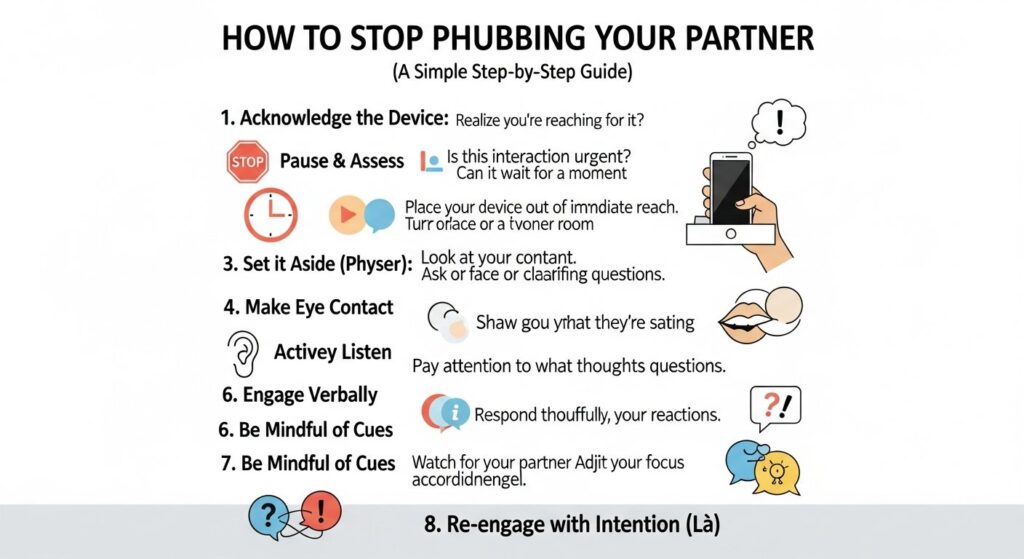
2. Addressing Phubbing with Empathy and Clear Requests
Phubbing is a common source of disconnection in relationships. Instead of reacting with passive aggression or silent resentment, NVC provides a framework to address it directly and constructively.
- Harmful Reaction: Rolling your eyes or withdrawing when your partner checks their phone mid-conversation.
- NVC Approach: “When I’m sharing something with you and I see you looking at your phone (observation), I feel a bit sad and unheard (feeling) because I have a need for your full presence and connection when we’re talking (need). Would you be willing to put your phone away for the next 15 minutes while we finish our conversation? (request).”
This approach moves beyond blame and helps your partner understand the impact of their action on your feelings and needs, inviting them to respond with compassion rather than defensiveness.
3. Setting Digital Boundaries Using NVC
Establishing healthy boundaries around digital device usage is crucial for mindful living and stronger relationships. NVC helps you articulate these boundaries clearly, based on your needs.
- Harmful Boundary: “Just stop looking at your phone at dinner!” (Demand)
- NVC Boundary: “When we’re having dinner together (observation), I feel much more relaxed and connected (feeling) because I have a need for uninterrupted quality time with you (need). Would you be willing to agree that we’ll both keep our phones out of sight during dinner from now on? (request).”
This proactive use of NVC transforms boundary-setting from a restrictive rule into a collaborative agreement that serves everyone’s needs for connection and presence. By consciously applying these non-violent communication techniques, we can bridge the digital divide, foster greater understanding, and ensure that our devices enhance, rather than hinder, our deepest relationships.
Cultivating a Lifelong Practice: Overcoming Challenges and Sustaining NVC
Embracing Non-Violent Communication is a journey, not a destination. It involves unlearning decades of ingrained communication patterns and consistently choosing empathy, vulnerability, and clarity. While the rewards are profound – deeper connections, reduced conflict, and greater self-awareness – the path to mastering non-violent communication techniques can present its own set of challenges. Understanding these hurdles and developing strategies to overcome them is key to sustaining your NVC practice.
1. Overcoming the Habit of Judgment and Blame
One of the most significant challenges is our deeply ingrained habit of judging, analyzing, and blaming others (and ourselves). We are often taught to label people or actions as “good” or “bad,” rather than observing behaviors and connecting them to needs.
- Strategy: Conscious “translation.” When you find yourself thinking or saying, “They are so irresponsible,” pause and try to translate it into an NVC observation: “They haven’t completed the task by the deadline,” and then connect it to your own feelings and needs: “I feel anxious because I have a need for reliability.”
- Practice: Daily “judgment detox.” For a set period each day, consciously try to observe without evaluating. Notice how challenging this is and how often your mind defaults to judgment.
2. Difficulty Identifying Feelings and Needs
Many of us are out of touch with our emotional landscape and struggle to differentiate between feelings and thoughts. Similarly, recognizing universal human needs can be unfamiliar territory.
- Strategy: Expand your emotional vocabulary. Use a “feelings wheel” or a list of universal needs to help you identify what’s truly going on inside you. Keep it handy as a reference.
- Practice: Regular “feelings and needs check-ins.” Throughout your day, pause and ask yourself: “What am I feeling right now?” and “What needs are alive in me?” Journaling can be a powerful tool for this self-reflection.
3. Resistance from Others
When you start practicing NVC, others in your life might not understand or immediately adopt the approach. They might perceive your NVC language as overly formal, manipulative, or even confusing.
- Strategy: Start small and lead by example. Focus on your own contributions to conversations. When others express themselves in old patterns, continue to listen empathetically, trying to hear their feelings and needs.
- Educate (gently): You might briefly explain your intention. “I’m trying to learn to express myself in a way that helps us understand each other better, and that sometimes means using different words.”
- Manage Expectations: Remember, you can only change yourself. While NVC often inspires others, their willingness to engage is their choice. Your practice of NVC helps you, regardless of their response, by giving you tools for self-empathy and clarity.
4. The Tendency to Use NVC as a “Technique” Rather Than a Way of Being
It’s easy to intellectualize NVC or use it as a formula to “get what you want.” However, true NVC stems from a genuine intention for connection and compassion.
- Strategy: Focus on the underlying intention. Before speaking, ask yourself: “Am I genuinely seeking understanding and connection, or am I trying to manipulate or control the outcome?”
- Practice: Prioritize empathy. Always try to connect with the other person’s feelings and needs before expressing your own. This builds trust and opens the door for genuine dialogue.
Sustaining the Practice:
- Read and Re-read: Keep Dr. Rosenberg’s book, “Nonviolent Communication: A Language of Life,” or other NVC resources close by.
- Seek Support: Join NVC practice groups, attend workshops, or find an NVC-informed therapist or coach. Learning with others can provide invaluable insights and encouragement.
- Be Patient and Compassionate with Yourself: You will make mistakes. You will revert to old patterns. This is normal. Acknowledge it, practice self-empathy, and gently redirect yourself back to the NVC path.
Cultivating NVC is a lifelong commitment to fostering peace, understanding, and connection. By acknowledging and addressing these challenges, you empower yourself to consistently apply these non-violent communication techniques, transforming your relationships and enriching your life.
Conclusion
Mastering Non-Violent Communication is far more than just learning a set of techniques; it’s an invitation to transform the very fabric of your relationships and your internal world. By consciously moving through observations, feelings, needs, and requests, you gain the power to transcend cycles of blame, judgment, and misunderstanding. We’ve explored how NVC provides a robust framework for authentic self-expression, empathetic listening, and collaborative conflict resolution, even in the complex landscape of digital interactions and the pervasive challenge of phubbing. The ability to articulate your deepest needs and hear those of others with compassion lays the groundwork for connections that are not only deeper but also more resilient and fulfilling.
The journey to integrating NVC into your life requires patience, practice, and a willingness to be vulnerable. It demands that we unlearn old habits and embrace a new way of being with ourselves and others. However, the rewards – increased clarity, reduced emotional friction, and a profound sense of mutual respect and understanding – are immeasurable. As you continue to practice these non-violent communication techniques, you’ll find that your relationships become sanctuaries of trust and authentic connection, enriching every aspect of your life.
Are you ready to transform your communication and deepen your connections? Take the first step today. Start by practicing self-empathy, identifying your own feelings and needs, and then gently begin to apply the OFNR framework in your daily conversations. Explore Dr. Marshall Rosenberg’s foundational work or seek out an NVC practice group. Your journey toward more compassionate and connected relationships begins now.
Frequently Asked Questions