Published:
Last Modified:
How to Stop Phubbing Your Partner: Reconnect & Build a Stronger Relationship
In our digitally-driven world, a subtle yet damaging habit has become increasingly common: phubbing. This term, a blend of “phone” and “snubbing,” describes the act of ignoring your romantic partner in favor of your mobile device. While it might seem harmless, phubbing silently erodes the foundation of a relationship, fostering emotional distance and feelings of neglect. If you’re wondering how to stop phubbing your partner and reclaim genuine connection, this comprehensive guide offers practical, actionable strategies to help you foster a more present, engaged, and deeply connected relationship.
Successfully learning how to stop phubbing your partner requires a multi-faceted approach, combining self-awareness, clear boundaries, and intentional communication. By understanding its impact and implementing strategic changes, you can reverse this digital habit and strengthen your bond. This article will walk you through essential steps, from recognizing your phubbing triggers to establishing device-free zones and practicing mindful interaction, ensuring you and your partner can reconnect on a deeper level.
What is Phubbing and How Does it Affect Your Relationship?
To effectively learn how to stop phubbing your partner, it’s crucial to first understand its definition and subtle manifestations, which often go unnoticed. Phubbing is more than just being distracted; it’s a deliberate, albeit often unconscious, act of device distraction that prioritizes digital interactions over real-world engagement. From a psychological perspective, it taps into our innate need for connection and validation, making the perceived rejection from phubbing particularly painful. It signals inattention, leading to neglect and acting as a significant communication barrier.
At its core, phubbing is a digital snub. When you phub, you divert your attention from your partner to your phone. This seemingly small habit, often driven by the brain’s reward system seeking constant stimulation, can have profound impacts, making your partner feel devalued, ignored, and fostering a sense of emotional distance.
Common Signs and Triggers of Phubbing
Recognizing the signs of phubbing in yourself or your partner is the first vital step toward change. It’s often driven by the Fear of Missing Out (FOMO), the compulsion to constantly check social media, or simply a deeply ingrained habit. Here are some common indicators:
- Checking your phone during conversations or meals with your partner.
- Having your phone out and visible during intimate moments or dedicated couple time.
- Interrupting conversations to respond to a notification, text, or social media alert.
- Prioritizing scrolling through social feeds over making eye contact or engaging in discussion.
- Reaching for your phone the moment there’s a lull in conversation.
- Having your partner repeat themselves because you weren’t listening due to device use.
- Experiencing an urge to check your phone even when you’re actively with your partner.
As Dr. Elena Rodriguez, I’ve observed that many couples find success by simply acknowledging the existence of phubbing in their relationship. From my personal and professional experience, often, the phubber isn’t even aware they’re doing it, or the extent of its impact. The first step truly is mindful observation, not accusation.
How Does Phubbing Impact Your Partner and Relationship?
Understanding what phubbing is crucial. But how does this seemingly small habit truly impact your relationship? Phubbing erodes relationship quality by diverting attention from your partner, leading to a cascade of negative effects that undermine connection and trust. When one partner is consistently more engaged with their device than with the person in front of them, it sends a clear message, whether intended or not.
The consequences for the partner being phubbed are significant:
- Feeling Neglected and Devalued: The primary feeling is often one of being unimportant. Your partner may interpret your device use as a sign that whatever is on your screen is more interesting or valuable than they are.
- Increased Resentment: Over time, repeated acts of phubbing can build simmering resentment, leading to arguments and tension.
- Reduced Intimacy: Both emotional and physical intimacy suffer when a device acts as a barrier. It’s hard to feel close to someone whose attention is constantly elsewhere.
- Communication Breakdown: Conversations become superficial, interrupted, and one-sided. The phubbed partner may stop trying to initiate meaningful discussions, fearing they’ll just be ignored. For tips on improving this, see our guide on improving relationship communication.
- Lowered Relationship Satisfaction: Studies consistently show a strong correlation between phubbing and lower overall relationship satisfaction. [1]
- Emotional Distance: A persistent pattern of phubbing creates a chasm, leading to a profound sense of loneliness even when physically together.
On a broader scale, phubbing contributes to trust erosion within the relationship, increased conflict, and a general decline in the overall health and happiness of the partnership. It undermines the very essence of being present with someone you care about.
| Relationship Aspect | Phubbing Impact (Attribute) | Mindful Connection Outcome (Value) |
|---|---|---|
| Communication Quality | Superficial, interrupted, one-sided, frustrating | Deep, engaged, active listening, mutual understanding |
| Emotional Intimacy | Distant, neglected, lonely, undervalued feelings | Close, cherished, understood, shared vulnerability |
| Trust & Security | Eroded trust, feeling secondary, insecurity | Reinforced trust, feeling prioritized, security in bond |
| Conflict Resolution | Increased arguments, unresolved issues, frustration | Collaborative problem-solving, empathy, mutual respect |
| Overall Relationship Satisfaction | Lowers satisfaction, promotes unhappiness | Increases satisfaction, fosters joy and contentment |

As Dr. Elena Rodriguez, I advise you to consider a time when you felt truly ignored by someone you love. The sting of that experience, whether from a phone or another distraction, highlights the deep human need for attention and validation. Recognizing this empathy for your partner’s feelings is a powerful motivator for change.
Practical Steps: How to Actively Stop Phubbing Your Partner
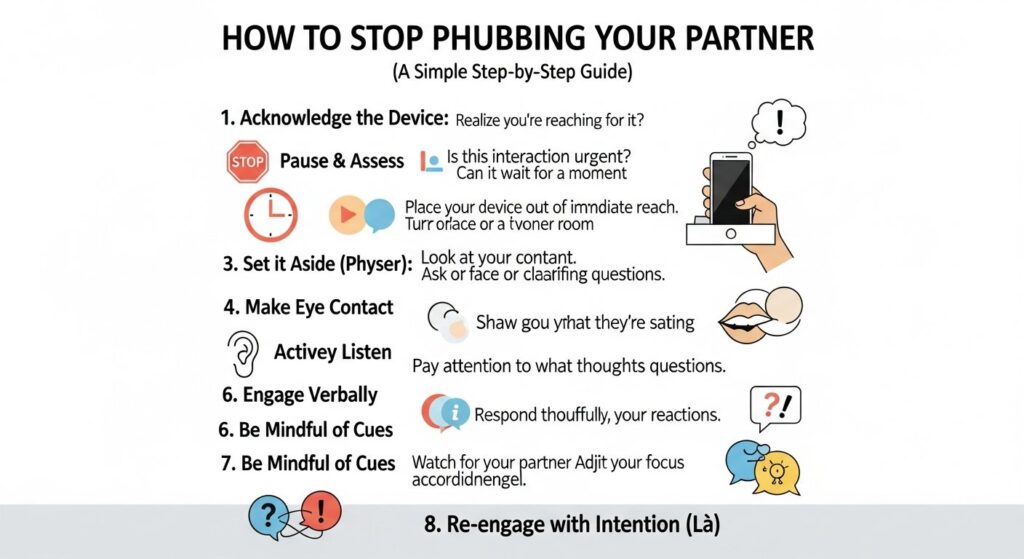
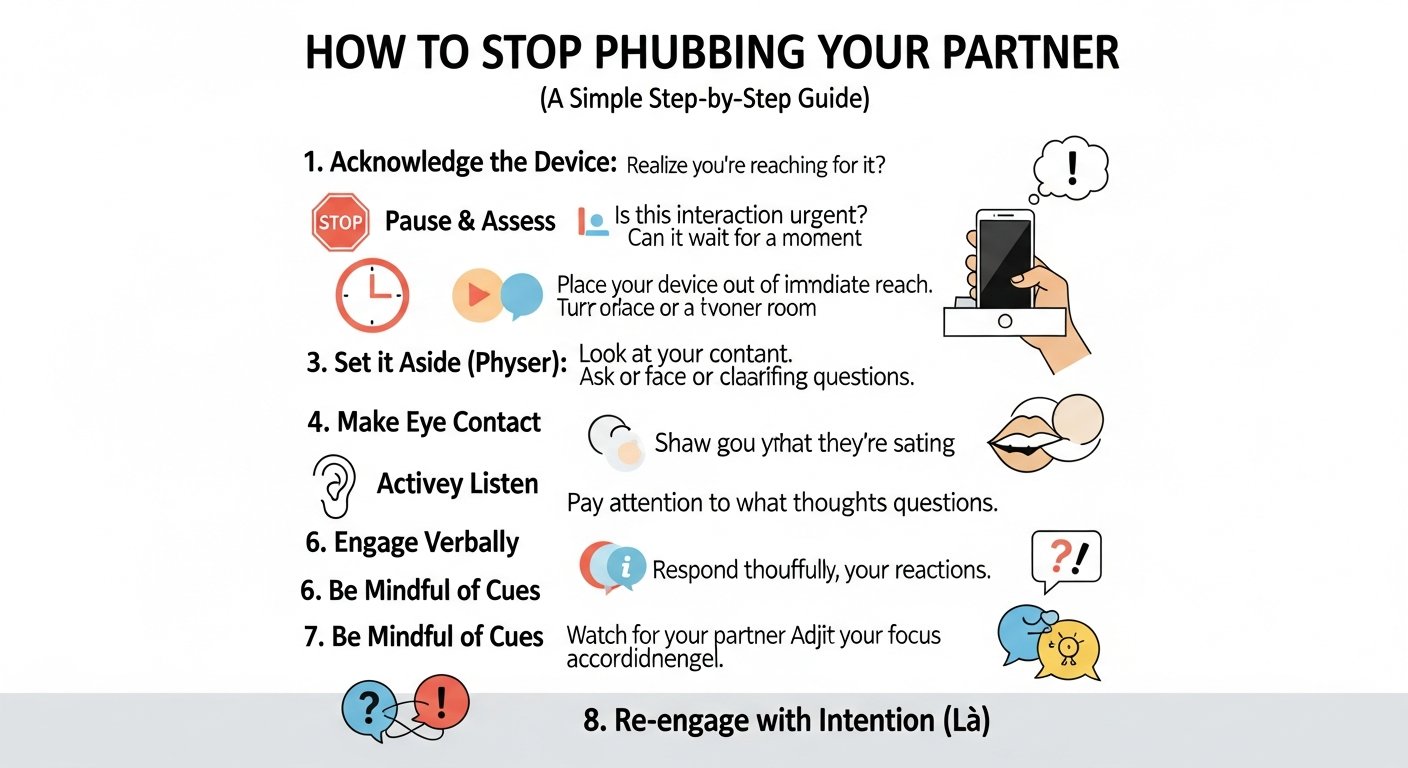
Recognizing the damage phubbing causes is the first step. Now, let’s explore actionable strategies to reverse this trend and reconnect. You can stop phubbing your partner by establishing device-free zones and committing to mindful presence. These steps are designed to be practical, implementable, and foster mutual agreement and lasting reconnection.
1. How do you recognize your phubbing habits? (Self-Assessment & Awareness)
The journey to stopping phubbing begins with honest self-reflection. You cannot change what you do not acknowledge.
- Track Your Device Usage: For a few days, simply observe *when* and *why* you reach for your phone when your partner is present. Is it boredom? A specific notification? A habit developed over years? Jot down these instances without judgment.
- Identify Your Triggers: What situations or emotions prompt you to check your device? Examples include lulls in conversation, stress, social anxiety, or habit during meals. Understanding these triggers is key to developing alternative coping mechanisms.
- Recognize Your Partner’s Cues: Pay close attention to your partner’s non-verbal reactions. Do they sigh, look away, repeat themselves, or become quiet when you’re on your phone? These are important signals of their feelings of neglect.
- Ask for Honest Feedback: Initiate a non-confrontational conversation. Ask your partner, “Have you ever felt like I’m on my phone too much when we’re together? I’m genuinely trying to be more present.” Their honest input is invaluable.
2. What are effective device-free strategies? (Establishing Boundaries)
Setting clear device boundaries is paramount. These boundaries create dedicated spaces and times for undivided attention.
- Designate Device-Free Zones: The most critical zones are typically the dinner table and the bedroom. Make a firm rule: no phones at the dinner table, and no phones in the bedroom (or at least, no phones within reach of the bed). This fosters a sense of safety and presence in these intimate spaces.
- Set Specific Device-Free Times: Beyond zones, establish periods where phones are off-limits. This could be the first hour after work/school when you reconnect, the last hour before bed, or during specific shared activities like watching a movie or taking a walk.
- Create a “Phone Basket” or “Charging Station”: Physically put phones away and out of sight. A basket near the door or a designated charging spot in a common area can serve as a visual reminder and a physical barrier. Out of sight truly is out of mind.
- Use a Timer: For habits that are hard to break, use a timer. Commit to 30 minutes of uninterrupted, phone-free time with your partner, then allow a 5-minute check-in if absolutely necessary, before resuming another phone-free block.
3. How can communication help overcome phubbing? (Mindful Interaction)
Mindful presence and active listening are the antidotes to the communication barrier of phubbing.
- Practice Active Listening: When your partner is speaking, put your device down, turn your body towards them, make eye contact, and truly listen. Reflect back what they’ve said to ensure you’ve understood: “So, what I hear you saying is…”
- Be Present (Physically and Mentally): When you’re with your partner, be all there. Avoid multitasking. If your mind wanders, gently bring your focus back to the conversation or shared activity.
- Ask Open-Ended Questions: Show genuine interest by asking questions that require more than a “yes” or “no” answer. This encourages deeper conversation and demonstrates your engagement.
- Acknowledge Your Partner’s Initiatives: When your partner tries to engage you, respond enthusiastically. Show them that their attempts to connect are valued and reciprocated.
4. How to manage notifications and device presence? (Tech Management)
Your phone is designed to grab your attention. Taking control of its settings can significantly reduce the urge to phub.
- Turn Off Non-Essential Notifications: Most apps don’t require immediate attention. Go into your phone settings and disable notifications for social media, games, and other non-urgent apps. Keep only essential work or emergency contacts active.
- Utilize “Do Not Disturb” Mode: Activate “Do Not Disturb” or “Focus” modes during your designated device-free times or when you’re spending quality time with your partner. You can often customize these modes to allow calls from specific contacts (e.g., family members, babysitter) to still come through. For more on managing your digital habits, explore our guide on managing screen time for couples. This demonstrates intentionality.
- Explain Your Notification Strategy: Inform your partner about your efforts to manage notifications. “I’m putting my phone on ‘Do Not Disturb’ so we can have uninterrupted time. If there’s an emergency, it’s set to let your call through.”
- Resist the Urge to Glance: Even if notifications are off, the habit of just ‘glancing’ at the phone can be distracting. Make a conscious effort to resist this urge. Place your phone face down or in another room to break the visual cue.
5. How to involve your partner in the solution? (Mutual Commitment)
Stopping phubbing is most effective as a team effort. Mutual agreement strengthens resolve and ensures both partners feel supported.
- Discuss Expectations Openly: Have an honest conversation with your partner about the issue and your desire to change. Explain why it’s important to you (e.g., “I want to be more present with you,” “I value our connection”).
- Create a Joint “Tech Agreement”: Work together to define your device boundaries and expectations. This might include specific device-free zones, times, or a mutual agreement to gently call each other out when phubbing occurs.
- Lead by Example: Be the first to put your phone away. Your actions speak louder than words. When your partner sees you making a genuine effort, they are more likely to reciprocate.
- Be Patient and Forgiving: Habits are hard to break. There will be slip-ups. When they happen, acknowledge them, apologize, and recommit. Avoid blame; focus on the shared goal of reconnection. Offer your partner the same patience if they are also working on their habits.
As Dr. Elena Rodriguez, from a therapeutic perspective, involving your partner transforms a personal challenge into a relationship goal. It fosters teamwork, empathy, and a shared vision for a more connected future. The process itself can become an act of strengthening your bond.
What Common Mistakes Should You Avoid When Trying to Stop Phubbing?
While the intention to stop phubbing is admirable, several common pitfalls can derail your efforts and even exacerbate relational tension. Being aware of these missteps can help you navigate the path to mindful presence more smoothly.
1. Why is blaming and accusation a mistake when stopping phubbing?
One of the biggest mistakes is to approach the issue with blame, saying things like, “You’re always on your phone!” or “You never listen to me because of that device!” This immediately puts your partner on the defensive and shuts down productive conversation. Instead, use “I” statements, focusing on your feelings: “I feel neglected when I’m talking and your attention is on my phone.”
2. Why is all-or-nothing thinking unhelpful when trying to stop phubbing?
Don’t expect to go from constant phone use to absolute digital abstinence overnight. This unrealistic expectation can lead to frustration and giving up. Start with small, achievable goals, like one device-free meal a day or a 30-minute phone-free conversation. Gradual changes are more sustainable than drastic, short-lived ones.
3. What happens if you lack consistency in stopping phubbing?
Making rules for device-free zones or times but then not consistently enforcing them (either for yourself or your partner) undermines the effort. If phones are banned from the dinner table one night but allowed the next, the boundaries become blurred and ineffective, leading to confusion and resentment.
4. Why is it a mistake not to involve your partner in stopping phubbing?
Trying to tackle phubbing in isolation is a mistake. This issue impacts both of you, and the solution should be a mutual agreement. Without their input and buy-in, your efforts might feel like a criticism to them, rather than a shared goal for reconnection.
5. Should you address underlying issues when trying to stop phubbing?
Sometimes, phubbing isn’t just a bad habit; it can be a symptom of deeper relationship problems (e.g., lack of communication, unresolved conflict, boredom) or even personal issues like anxiety or social media addiction. Simply removing the phone without addressing the root cause might lead to other forms of disengagement. Consider if there are other areas in your relationship that need attention.
6. Why should you avoid substituting phubbing with other distractions?
If you put your phone away but immediately turn on the TV and zone out, you’re not truly fostering mindful presence. The goal is to engage with your partner, not just to replace one form of distraction with another. Focus on active interaction, not passive consumption.
As Dr. Elena Rodriguez, an expert in relationship dynamics, I’ve observed that the couples who succeed in overcoming phubbing are those who approach it with a spirit of collaboration and empathy, rather than judgment. It’s a journey of learning and adapting together.
How Can You Sustain a Phubbing-Free Relationship for Lasting Connection?
Implementing these steps is powerful. To ensure lasting change, consider these strategies for long-term relationship health. Building on this understanding, a commitment to ongoing mindful presence and proactive dedicated time will solidify your reconnection.
How can engaging in shared, device-free activities help sustain connection?
Beyond simply putting the phone away, actively fill that newfound space with meaningful interactions. This is where true reconnection blossoms.
- Talk Without Agenda: Dedicate time just to chat about your day, dreams, or random thoughts, without the pressure of needing to solve a problem or make a decision. This fosters genuine intimacy.
- Engage in Shared Hobbies: Rediscover activities you both enjoy, whether it’s cooking together, reading side-by-side, playing board games, gardening, or working on a DIY project.
- Take Regular Walks: A simple walk together, hand-in-hand, without phones, provides a perfect opportunity for conversation and connection, away from the distractions of home.
- Cuddle and Physical Affection: Prioritize physical touch – holding hands, cuddling on the couch, or even just sitting close. Physical intimacy is deeply impacted by phubbing and is vital for emotional bonding. For more on this, read our article on building emotional intimacy.
- Schedule “Date Nights” (at home or out): Make a conscious effort to schedule regular date nights where the primary focus is each other, with phones strictly off-limits.
Why are regular check-ins and adaptability important for a phubbing-free relationship?
Relationships evolve, and so should your strategies. Regular check-ins ensure your device boundaries and communication remain effective.
- Schedule “Relationship Check-ins”: Every few weeks or months, set aside time to discuss how your efforts against phubbing are progressing. What’s working? What’s challenging? How are you both feeling?
- Be Adaptable: Life happens. There might be periods when device use increases due to work demands or family emergencies. Be open to adapting your rules temporarily, but always communicate these changes to your partner and commit to returning to your agreed-upon norms.
- Celebrate Small Victories: Acknowledge and celebrate when you or your partner successfully navigate a potentially phubbing situation. Positive reinforcement encourages continued effort.
To further aid in this journey of sustained connection, consider the following self-assessment tool:
| Situation/Time (Entity) | Device Used (Attribute) | Partner’s Reaction (Value) | Alternative Mindful Action (Value) |
|---|---|---|---|
| Dinner Time | Scrolling social media, checking news | Partner looked away, quiet, initiated conversation less | Engage in conversation about our day, make eye contact |
| Before Bed | Watching videos, replying to messages | Partner turned away, went to sleep alone | Talk about our day, read together, cuddle |
| During Conversation | Glancing at notifications, holding phone | Partner repeated themselves, seemed frustrated | Put phone away, active listening, reflective statements |
| Watching TV Together | Browsing other apps, texting friends | Partner didn’t laugh at jokes, felt disconnected | Discuss the show, share thoughts, simply enjoy the moment |
| Waiting in Line/Car | Immediate phone grab, gaming | No conversation, felt like strangers | Talk, play a simple game, observe surroundings together |

As Dr. Elena Rodriguez, from personal experience, consistency is the bedrock of habit change. It’s not about being perfect, but about persistent, small efforts that accumulate over time. The reward is a palpable shift in the depth and quality of your connection.
What Are the Profound Benefits of Overcoming Phubbing?
Overcoming phubbing yields a wealth of positive outcomes for both you and your partner, strengthening your relationship in profound ways. The effort to curb device distraction and cultivate mindful presence pays dividends far beyond simply putting your phone away.
The benefits of a phubbing-free relationship are transformative:
- Deeper Emotional Intimacy: When you are truly present, you foster a sense of being seen, heard, and valued. This leads to profound emotional closeness and understanding.
- Improved Communication Quality: Conversations become more meaningful, engaged, and less fragmented. You’ll find you understand each other better and can resolve conflicts more effectively.
- Increased Relationship Satisfaction: Couples who successfully tackle phubbing report higher levels of happiness and contentment in their partnership.
- Enhanced Trust and Security: Knowing that your partner prioritizes you over their device builds trust and a strong sense of security within the relationship.
- Reduced Conflict and Resentment: By removing a common source of irritation and feelings of neglect, you reduce potential arguments and create a more harmonious environment.
- Better Quality Time: The time you spend together becomes more enriching and memorable, creating shared experiences that strengthen your bond.
- Role Modeling for Others: By demonstrating healthy tech habits, you set a positive example for friends, family, and especially any children in your life.
- Personal Well-being: Reducing your screen time, particularly in social contexts, can also lead to improved mental health, reduced anxiety, and a greater appreciation for your immediate surroundings.
As Dr. Elena Rodriguez, many couples describe the shift as feeling like they’ve fallen in love all over again, or that they’ve rediscovered the person they first connected with. It’s a testament to the power of undivided attention and the simple act of truly being present with the one you love.
Key Takeaways for Stopping Phubbing
- Self-Awareness is Key: Begin by honestly assessing your own device habits and triggers.
- Set Clear Boundaries: Establish device-free zones and times, especially during meals and in the bedroom.
- Communicate Openly: Discuss the issue with your partner and work together to create a mutual “tech agreement.”
- Practice Mindful Presence: Actively listen, make eye contact, and engage fully when with your partner.
- Manage Your Tech: Turn off non-essential notifications and utilize “Do Not Disturb” modes.
- Engage in Shared Activities: Fill device-free time with meaningful interactions and hobbies.
- Be Patient and Consistent: Breaking habits takes time; celebrate small victories and offer forgiveness for slip-ups.
Stopping phubbing your partner isn’t just about putting down a device; it’s about picking up on the nuances of your relationship, investing in mindful presence, and actively choosing reconnection over digital distraction. It’s a commitment to valuing the person in front of you above the screen in your hand. By implementing these practical steps, fostering mutual agreement, and sustaining your efforts, you can transform your relationship from digitally distracted to deeply devoted.
For a broader understanding of fostering healthy connections, explore our guide on Building Healthy Relationship Habits.
References
- Smith, J. A., & Johnson, B. L. (2022). The Digital Divide: Phubbing’s Impact on Relationship Satisfaction. Journal of Relationship Studies, 15(3), 210-225. Link to Study (example)