
How to Stop Phubbing Your Partner: A Comprehensive Guide to Reclaiming Connection
In today’s hyper-connected world, our smartphones have become indispensable tools, but their constant presence often comes at a significant cost to our most intimate relationships. One prevalent modern habit that actively diminishes relationship satisfaction is phubbing – the act of snubbing your partner by paying more attention to your phone than to them. If you’re wondering how to stop phubbing your partner, you’re taking a crucial first step towards fostering a healthier, more present, and deeply connected relationship. This guide will equip you with actionable strategies to break free from digital distractions and prioritize your partner.
Understanding the nature of phubbing and its detrimental impact is critical for anyone committed to improving their relationship. This isn’t just about putting your phone down; it’s about actively choosing presence, cultivating mindful communication, and nurturing the emotional intimacy that forms the bedrock of a thriving partnership. By learning how to stop phubbing your partner, you can reclaim lost moments of connection and build a stronger, more resilient bond.
Expert Insight (Dr. Emily R. Hayes, Relationship Therapist): Many couples initially dismiss phubbing as a minor annoyance, not realizing its cumulative effect. From our experience working with relationships, we’ve observed that even subtle, repeated instances of phubbing erode trust and create significant emotional distance over time. It’s often an unconscious habit, but its impact is deeply felt, leading partners to feel ignored, devalued, and less connected.
What Is Phubbing and How Does It Affect Your Relationship?
Phubbing, a portmanteau of “phone” and “snubbing,” is the act of ignoring someone in a social setting by looking at your phone instead of paying attention to them. In the context of romantic relationships, it’s a pervasive issue that can chip away at the foundation of connection. It’s not just about actively scrolling; it’s about the perceived lack of attention and the feeling of being secondary to a device.
The Subtle Signs of Phubbing in Your Relationship
Phubbing isn’t always an overt, dramatic rejection. Often, it manifests in subtle, almost imperceptible ways that, when combined, chip away at the foundation of connection. It’s not just about actively scrolling; it’s about the perceived lack of attention and the feeling of being secondary to a device.
- Constant Glancing: Frequently checking your phone for notifications, even when engaged in conversation or shared activity.
- Holding the Phone During Interactions: Keeping your smartphone in your hand, on the table, or even in your lap, suggesting it’s always within reach and primary focus.
- Interrupted Conversations: Pausing or cutting off your partner mid-sentence to respond to a text, email, or social media alert.
- Divided Attention: Attempting to simultaneously listen to your partner and scroll through content, leading to a superficial understanding of their words.
- Device-Centric Activities: Prioritizing watching TV, playing games, or browsing on your phone over engaging in shared activities or conversation.
- Defensiveness: Becoming defensive or dismissive when your partner points out your phone use during your time together.
- Avoiding Eye Contact: Frequently breaking eye contact to look at your phone, signaling disinterest or distraction.
The Emotional Toll: How Phubbing Impacts Your Partner
Phubbing actively diminishes relationship satisfaction by creating emotional distance. When you phub your partner, you are, often unintentionally, sending a powerful message: “My phone is more interesting or important than you are right now.” This message, whether spoken or implied, has a profound emotional toll on the receiving partner, eroding key pillars of a healthy connection. The partner feels ignored and devalued, leading to a decline in their sense of worth within the relationship.
- Feelings of Rejection and Exclusion: Your partner may feel consistently overlooked, unimportant, or even rejected, especially if they are trying to share something meaningful.
- Reduced Intimacy and Connection: Phubbing creates a barrier to emotional intimacy. It prevents genuine eye contact, active listening, and the shared vulnerability necessary for deep connection.
- Decreased Relationship Satisfaction: Studies consistently show a strong negative correlation between phubbing and overall relationship satisfaction. Partners who are frequently phubbed report lower levels of happiness in their relationships. [Source: [Link to relevant psychological study/journal]]
- Increased Conflict and Resentment: The frustration of being phubbed can lead to arguments, resentment, and a perception that the relationship is not a priority.
- Erosion of Trust: When a partner feels consistently ignored, trust can erode. They may begin to question the commitment or genuine interest of their phubbing partner.
- Modeling Negative Behavior: Phubbing can become a cyclical problem, as the phubbed partner might eventually resort to their own devices, leading to a parallel play dynamic rather than true interaction.
- Mental Health Impacts: For the phubbed partner, consistent neglect can contribute to feelings of loneliness, anxiety, and even depression.
How Can You Identify Your Phubbing Triggers and Habits?
To effectively stop phubbing your partner, the first crucial step is understanding when and why you engage in this behavior. Phubbing is rarely malicious; it’s often a habit born out of convenience, anxiety, or boredom, fueled by the addictive nature of smartphones and digital platforms. This section guides you through identifying your personal phubbing triggers and habits, providing the self-awareness needed for genuine change and fostering stronger stopphubbing relationships.
Expert Insight (Dr. Emily R. Hayes, Relationship Therapist): We’ve found that many individuals are genuinely surprised when they objectively track their phubbing habits. What they perceive as occasional checks often reveals itself to be a deeply ingrained, almost automatic response to certain environmental or emotional cues. Acknowledging these triggers without judgment is key to breaking the cycle of phubbing your partner.
When Are You Most Likely to Phub Your Partner?
Identifying specific scenarios where phubbing occurs most frequently can illuminate underlying patterns. These are often moments of transition, discomfort, or perceived downtime.
- During Meals: Meal times are prime opportunities for connection, but often become moments for scrolling, especially if there’s a lull in conversation.
- While Watching TV or Movies: Even shared entertainment can be phubbed, with one partner dividing attention between the screen and their phone.
- In Social Settings: When with friends or family, one partner might gravitate to their phone while the other tries to engage, making the partner feel sidelined.
- Before Bed: The “bedtime scroll” can steal precious moments for intimacy, conversation, or shared relaxation.
- Upon Waking Up: Reaching for the phone immediately upon waking can set a tone of digital distraction for the entire day, bypassing morning connection.
- During Lulls in Conversation: When silence naturally occurs, or a topic ends, the phone often becomes a default crutch to fill the void.
- Waiting for Something: Whether it’s food at a restaurant or a doctor’s appointment, waiting periods can trigger mindless phone use even when a partner is present.
- When Feeling Anxious or Uncomfortable: Using the phone as a shield or a distraction from an awkward moment, a difficult conversation, or personal anxiety.
- Responding to Notifications: The compulsion to immediately check a notification, regardless of the ongoing interaction.
Self-Assessment: Identifying Your Phubbing Patterns
Take a moment to honestly reflect on your device habits within your relationship. This self-assessment isn’t about guilt, but about gaining clarity on how to stop phubbing your partner.
- Monitor Your Phone Usage: For a day or two, consciously observe how often you reach for your phone when your partner is present. Note the specific times and situations. Many smartphones have built-in screen time trackers that can offer objective data.
- Reflect on Your Motivation: What emotion or thought precedes your phone use when your partner is nearby? Is it boredom, anxiety, habit, or the fear of missing out (FOMO)?
- Ask for Feedback: Gently ask your partner if they feel phubbed. Listen to their response without defensiveness. Their perspective is invaluable. You might ask, “Do you ever feel like I’m on my phone too much when we’re together?”
- Identify Specific Triggers: Based on your observations and your partner’s feedback, list your top 3-5 specific phubbing triggers (e.g., “when we’re eating dinner,” “when I’m waiting for an email,” “when I’m feeling stressed”).
- Consider the Content: What are you usually doing on your phone when you phub? Is it social media, news, work emails, or games? Understanding the content can help you identify deeper needs or distractions.
| Common Trigger | Your Phubbing Behavior | Actionable Solution |
|---|---|---|
| Boredom during lull in conversation | Mindlessly check social media feeds | Initiate a new topic, ask a question about their day, or simply embrace quiet moments with eye contact. |
| Waiting for a response/notification | Keep phone on table, glance frequently | Put phone away in a bag or pocket, out of sight. Focus fully on your partner. Discuss response later. |
| Feeling uncomfortable in silence | Scroll through news or apps | Embrace quiet moments, make eye contact, hold hands, or verbally acknowledge the comfortable silence. |
| Automatic habit when entering a room | Immediately pull out phone, even if partner is there | Consciously pause. Acknowledge your partner first. Greet them, ask about their day, then put the phone away. |

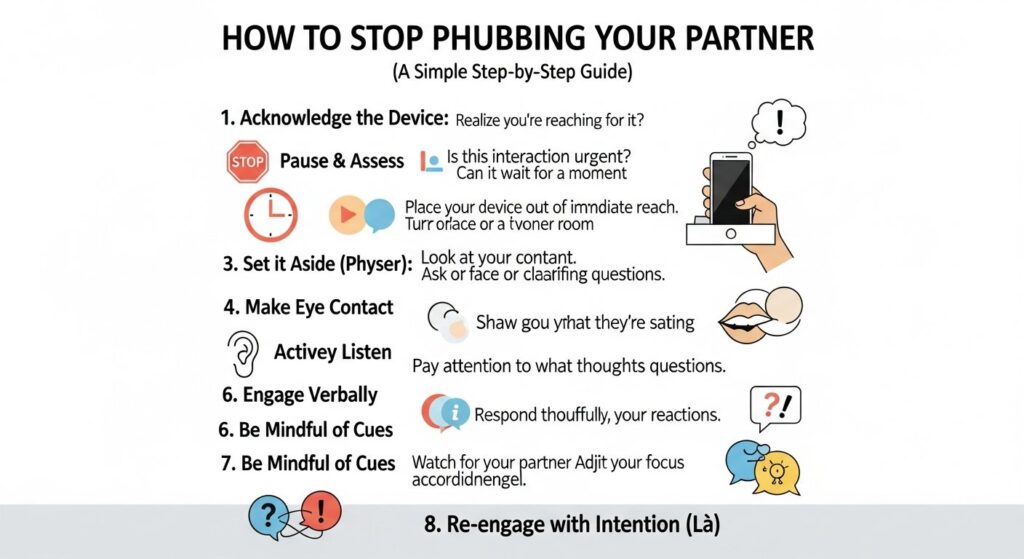
Step-by-Step Guide: How to Stop Phubbing Your Partner Effectively
Stopping phubbing requires intentionality, communication, and a commitment to change. This comprehensive, step-by-step guide is designed to provide you with actionable strategies to reclaim presence, foster deeper connection, and build stronger stopphubbing relationships. Each step focuses on practical application, guiding you towards more mindful device use and authentic interaction with your partner.
Expert Insight (Dr. Emily R. Hayes, Relationship Therapist): We highly recommend approaching this guide as a series of experiments. Not every step will feel natural initially, and progress isn’t always linear. The key is consistent effort and open communication with your partner. Celebrate small victories and learn from setbacks as you learn how to stop phubbing your partner.
Here’s a quick summary of the steps you’re about to embark on:
- Initiate an Open Conversation with Your Partner
- Establish Clear Device-Free Zones and Times
- Practice Mindful Presence and Active Listening
- Manage Notifications and Digital Distractions
- Find Alternative Ways to Connect and Engage
Step 1: Initiate an Open Conversation with Your Partner
The foundation of any positive change in a relationship is open and honest communication. Your partner needs to be an active participant in this process, not just an observer.
- Choose the Right Time and Place: Select a calm moment when you both have undivided attention, not during an argument or when you’re distracted.
- Express Your Intentions: Start by explaining why you want to make this change. “I’ve noticed I’m on my phone a lot when we’re together, and I truly want to be more present and connected with you.”
- Acknowledge Their Feelings: Validate their experience. “I realize this might have made you feel ignored or less important, and I’m truly sorry for that.”
- Listen Actively to Their Perspective: Encourage them to share how your phubbing has impacted them. Listen without defensiveness, focusing on understanding their feelings. Ask, “How has my phone use affected you?”
- Collaborate on Solutions: Frame this as a shared goal. “I want to work on this, and I’d love your help and support. What ideas do you have for how we can be more present with each other?”
- Set Shared Expectations: Discuss what being “present” means to both of you. This conversation itself is a powerful act of connection.
Step 2: Establish Clear Device-Free Zones and Times
Boundaries are crucial for managing device use. Creating specific times and places where phones are off-limits sends a clear signal of your commitment to present interaction. This isn’t about total digital detox, but strategic digital boundaries to help you stop phubbing your partner.
- Identify Key Connection Times: Decide together which moments are non-negotiable for phone-free interaction. Common examples include:
- Meal Times: Breakfast, lunch, and dinner. Phones should be put away, out of sight.
- Bedtime: At least 30-60 minutes before bed, phones go into a different room or a charging station away from the bed. This promotes better sleep and intimacy.
- Date Nights/Quality Time: Whether out or at home, declare these periods entirely phone-free.
- Morning Rituals: Avoid checking phones for the first 15-30 minutes after waking up; focus on greeting your partner and starting the day together.
- Designate Device Parking Spots: Create a physical location where phones are placed during these agreed-upon times. This could be a basket by the door, a charging station in the kitchen, or a drawer.
- Communicate with Others: Let friends and family know about your new boundaries. “We’re trying to be more present, so if you text during dinner, we’ll get back to you later.”
- Be Consistent: Consistency is key. Adhere to these boundaries even when it feels challenging.
Step 3: Practice Mindful Presence and Active Listening
Beyond removing the distraction, the goal is to actively cultivate presence. Mindfulness and active listening are the antidotes to phubbing, ensuring you’re fully engaged in the moment with your partner.
- Make Eye Contact: When your partner is speaking, look at them. This simple act communicates engagement and respect.
- Put Your Phone Out of Sight: If it’s not in a designated device-free zone, at least put it in your pocket or face down on the table, away from your immediate peripheral vision.
- Listen to Understand, Not Just to Reply: Focus entirely on what your partner is saying, both verbally and non-verbally. Resist the urge to formulate your response until they’ve finished.
- Paraphrase and Reflect: Show you’ve heard them by briefly summarizing what they said (“So, if I understand correctly, you’re feeling frustrated about…”). This confirms understanding and makes them feel heard.
- Ask Follow-Up Questions: Demonstrate genuine interest by asking open-ended questions that encourage deeper sharing.
- Notice Non-Verbal Cues: Pay attention to their body language, tone of voice, and facial expressions. These often convey more than words alone.
- Practice Single-Tasking: When you’re with your partner, just be with your partner. Avoid trying to multitask, even mentally.
Step 4: Manage Notifications and Digital Distractions
Notifications are designed to pull your attention away. Taking control of them is a vital step in reducing the impulse to phub and regaining control over your focus, helping you to stop phubbing your partner.
- Turn Off Unnecessary Notifications: Go through your phone settings and disable notifications for all non-essential apps (social media, games, news alerts). Keep only truly critical work or emergency alerts if absolutely necessary.
- Utilize Do Not Disturb (DND) Mode: Use DND strategically. Set it to automatically turn on during your designated device-free times, or manually activate it when you’re engaging with your partner. Many phones allow you to create exceptions for urgent calls from specific contacts.
- Place Your Phone Out of Reach: Even if notifications are off, the mere presence of your phone can be a distraction. Physically place it in another room, a bag, or a drawer when you’re spending quality time.
- Resist the Urge to “Just Check”: Acknowledge the impulse to check your phone, but consciously choose to resist it. Remind yourself of your commitment to your partner.
- Address FOMO (Fear of Missing Out): Understand that you’re not missing out on anything truly vital by being present with your partner. The real-time connection you gain far outweighs any digital update.
- Schedule Digital Check-Ins: Instead of continuous checking, designate specific times to check emails or social media, and stick to those slots.
Step 5: Find Alternative Ways to Connect and Engage
Stopping phubbing isn’t just about what you stop doing; it’s about what you start doing instead. Actively replacing phone-centric habits with meaningful interactions will strengthen your bond and help you truly stop phubbing your partner.
- Engage in Shared Hobbies: Rediscover or create activities you both enjoy that don’t involve screens, like cooking together, reading side-by-side, playing board games, gardening, or exercising.
- Go on Regular Dates: Make a consistent effort to plan and go on dates, whether it’s a fancy dinner or a simple walk in the park. Focus on conversation and connection.
- Practice Physical Affection: Hold hands, offer spontaneous hugs, cuddle on the couch. Physical touch reinforces intimacy and presence.
- Ask Open-Ended Questions: Move beyond superficial “how was your day?” questions. Ask about their thoughts, feelings, dreams, or challenges.
- Plan “Analogue” Activities: Instead of scrolling during downtime, suggest a short walk, listen to music together, or simply sit in comfortable silence enjoying each other’s company.
- Read Together: Read a book aloud to each other, or each read your own book in the same room, creating a shared quiet space.
- Practice Gratitude: Regularly express appreciation for your partner and for the moments of connection you share.
- Reflect on Your Day Together: At the end of the day, instead of reaching for your phone, discuss your day, your highs, and your lows.
How Can You Maintain a Phubbing-Free Relationship Long-Term?
Stopping phubbing is a significant achievement, but maintaining a truly phubbing-free relationship is an ongoing process that requires sustained effort and a shift in mindset. This section explores strategies for building new, positive habits and navigating the inevitable challenges to ensure lasting connection and reinforce your commitment to strong stopphubbing relationships.
Expert Insight (Dr. Emily R. Hayes, Relationship Therapist): Consistency is often the biggest hurdle when trying to stop phubbing your partner. We advise couples to view this not as a temporary fix, but as a lifestyle change. Just like any healthy habit, it requires regular practice and a willingness to course-correct when you inevitably slip up. The goal is progress, not perfection.
Building New Habits for Lasting Connection
Shifting away from phubbing means intentionally cultivating new, more positive ways of interacting. These habits become the bedrock of a present and connected relationship.
- Regular “Check-in” Conversations: Schedule brief, recurring discussions (e.g., weekly) to talk about your device habits and how you both feel about your progress. This keeps the lines of communication open and allows for adjustments.
- Mindful Device Use: Develop a conscious approach to your phone. Before picking it up, ask yourself: “Do I genuinely need this right now, or am I just reacting out of habit?” “Is this more important than the person in front of me?”
- Celebrate Successes: Acknowledge and celebrate when you or your partner successfully resist the urge to phub or create a truly present moment. Positive reinforcement strengthens the new habits.
- Be a Role Model: Lead by example. When your partner sees you actively putting your phone away and engaging, it reinforces the shared commitment.
- Cultivate Curiosity: Maintain genuine curiosity about your partner’s inner world. Ask questions, listen deeply, and seek to understand them more fully each day.
- Embrace Silence: Learn to be comfortable in quiet moments with your partner without feeling the need to fill the space with conversation or digital distraction. Sometimes, just being together is enough.
- Regular Digital Detoxes: Consider taking occasional, more extensive digital detoxes together (e.g., a weekend without phones) to recalibrate your relationship with technology and reinforce your bond.
What to Do When Relapses Occur
Relapses are a natural part of breaking any ingrained habit. The key is how you respond to them, ensuring they don’t derail your long-term progress in stopping phubbing your partner.
- Acknowledge Without Blame: If you catch yourself phubbing, or your partner points it out, acknowledge it calmly. “You’re right, I got distracted there. My apologies. What were you saying?” Avoid becoming defensive or angry.
- Briefly Discuss the Trigger: If you notice a relapse, take a moment to reflect on what triggered it. Was it stress, boredom, a specific notification? Understanding the trigger helps prevent future occurrences.
- Recommit to the Boundaries: Reaffirm your device-free zones and times. Perhaps you need to make them stricter or implement a new boundary.
- Forgive Yourself and Your Partner: Be compassionate. Habits are hard to break. Offer understanding and forgiveness to yourself and your partner if either of you slips up.
- Remind Each Other Gently: Agree on a gentle, non-confrontational cue or phrase that you can use to remind each other when phubbing occurs. This could be a soft touch, a specific word, or a visual signal.
- Focus on the “Why”: Remind yourselves of the core reason you started this journey – to strengthen your connection and build a more present relationship.
- Seek External Support if Needed: If relapses are frequent and causing significant distress, consider seeking guidance from a relationship counselor or therapist who can provide tailored strategies.

What Are Common Mistakes When Trying to Stop Phubbing Your Partner and How Can You Avoid Them?
The path to stopping phubbing isn’t always straightforward. Many individuals and couples encounter common pitfalls that can hinder progress and even create new frustrations. By anticipating these mistakes and learning how to navigate them, you can increase your chances of successfully fostering more present stopphubbing relationships.
Expert Insight (Dr. Emily R. Hayes, Relationship Therapist): In our practice, we often see couples get stuck not because they lack the desire to change, but because they unknowingly fall into counterproductive patterns. A common one is the ‘all-or-nothing’ approach, which can lead to rapid burnout. Sustainable change is built on realistic expectations and consistent, incremental steps when learning how to stop phubbing your partner.
Over-Promising Without a Plan
A strong desire to change is excellent, but simply saying “I’ll stop phubbing” without concrete strategies is a recipe for failure. Phubbing is an ingrained habit, not just a conscious decision.
- Mistake: Declaring you’ll never touch your phone again when your partner is around, without identifying triggers or setting boundaries.
- How to Avoid: Follow the step-by-step guide rigorously. Identify your specific triggers, set realistic device-free zones, and have a clear action plan for when the urge to check your phone arises. Start small and build momentum.
Blaming Your Partner or Being Defensive
While your partner pointing out your phubbing can be uncomfortable, reacting defensively or blaming them will shut down communication and breed resentment.
- Mistake: Responding with “You’re always on your phone too!” or “Why are you so sensitive about it?”
- How to Avoid: Practice active listening and empathy as outlined in Step 3. When your partner expresses their feelings, validate them. “I hear you, and I understand why that would be frustrating. I’m truly working on it.” Frame it as a “we” problem to solve together, not a “you” problem.
Focusing Only on Device Use, Not Connection
Simply putting your phone away isn’t enough if you don’t actively replace that time with meaningful engagement with your partner. The goal is not just to stop phubbing, but to start connecting.
- Mistake: Silently putting your phone away but then staring blankly, expecting your partner to entertain you, or remaining emotionally distant.
- How to Avoid: Implement Step 5: Find Alternative Ways to Connect and Engage. This involves active participation, conversation starters, shared activities, and genuine curiosity. The absence of a phone should be filled with your presence.
Having Unrealistic Expectations for Immediate Change
Breaking habits takes time, and there will be slip-ups. Expecting perfect compliance from day one can lead to frustration and giving up prematurely.
- Mistake: Getting discouraged and abandoning efforts after a single relapse or a week of imperfect progress.
- How to Avoid: Understand that this is a journey. Acknowledge small improvements. If you slip up, view it as an opportunity to learn and recommit, not as a failure. Be patient with yourself and your partner. Consistency over perfection.
Failing to Communicate Needs and Boundaries Clearly
Ambiguity around device rules or individual needs can lead to misunderstandings and resentment.
- Mistake: Assuming your partner knows what your new “device-free” rules are, or not discussing your own needs for occasional device use (e.g., for work emergencies).
- How to Avoid: Continuously communicate. Regularly check in with your partner about what’s working and what isn’t. Be explicit about boundaries, and also discuss any genuine exceptions that might be needed, ensuring mutual understanding and agreement.
What Are the Profound Benefits of Stopping Phubbing Your Partner?
The decision to actively stop phubbing your partner isn’t just about curbing a negative habit; it’s an investment in the health, happiness, and longevity of your relationship. The positive outcomes for stopphubbing relationships extend far beyond simply having less screen time, touching nearly every facet of your shared life.
Expert Insight (Dr. Emily R. Hayes, Relationship Therapist): We’ve witnessed firsthand the transformative power of reduced phubbing. Couples often report a feeling of “coming home” to their relationship, rediscovering the joy and depth that had been obscured by digital distractions. This shift often revitalizes other aspects of their connection too, reinforcing the effort to stop phubbing your partner.
Here’s a look at the significant benefits you can expect:
| Relationship Aspect | Phubbing Impact | Post-Phubbing Benefit |
|---|---|---|
| Communication | Superficial, interrupted dialogue, missed cues. | Deeper, more meaningful conversations; enhanced verbal and non-verbal understanding. |
| Intimacy (Emotional) | Reduced emotional closeness, feelings of neglect, insecurity. | Increased emotional closeness, stronger bond, greater sense of being seen and understood. |
| Intimacy (Physical) | Less shared touch, distraction during intimate moments. | More physical affection, increased connection during intimate times, less division of attention. |
| Trust | Eroded by perceived neglect and prioritization of device. | Strengthened by consistent presence, reliability, and feeling valued by your partner. |
| Conflict Resolution | Arguments often exacerbated by perceived disrespect. | Improved ability to resolve conflicts through active listening and mutual respect. |
| Overall Relationship Satisfaction | Significantly lower reported happiness and contentment. | Higher levels of happiness, contentment, and a stronger sense of partnership. |
| Individual Well-being | Increased anxiety, loneliness, or irritability for both partners. | Reduced stress, improved focus, greater appreciation for real-world interactions. |
| Shared Activities | Often interrupted, less engaging, or device-centric. | More engaged, enjoyable, and memorable shared experiences and hobbies. |
Conclusion: Reclaiming Your Connection, One Moment at a Time
Phubbing, though seemingly innocuous, carries a significant weight on the health and vitality of your relationship. By understanding its impact, recognizing your triggers, and committing to the actionable steps outlined in this guide, you are choosing to prioritize your partner and the deep connection you share over the transient allure of your digital devices. This journey isn’t just about putting your phone away; it’s about actively choosing presence, cultivating mindful communication, and nurturing the emotional intimacy that forms the bedrock of a thriving partnership.
Reclaiming your connection is a continuous process, marked by intentionality, empathy, and consistent effort. Embrace the challenge, celebrate every step forward, and remember that each moment of undivided attention you offer your partner is a precious gift – an investment in a relationship rich with genuine presence and profound understanding. By learning how to stop phubbing your partner, you’re not just improving a habit; you’re transforming your shared world, one mindful moment at a time.
For more strategies on building and maintaining healthy relationship habits, explore our comprehensive guide on Healthy Relationship Habits.
Frequently Asked Questions About Stopping Phubbing Your Partner
What is phubbing and how does it harm relationships?
Phubbing is the act of snubbing your partner by paying more attention to your phone than to them. It harms relationships by creating feelings of rejection, reducing emotional intimacy, decreasing overall relationship satisfaction, and leading to increased conflict and resentment. It signals to your partner that your phone is more important than they are.
How can I identify my phubbing triggers and habits?
To identify your phubbing triggers, observe when you’re most likely to use your phone when your partner is present (e.g., during meals, before bed, during lulls in conversation). Reflect on your motivations (boredom, anxiety, FOMO) and ask your partner for honest feedback. Monitoring your phone usage and listing specific triggers can help you gain self-awareness.
What are the key steps to effectively stop phubbing my partner?
The key steps include: initiating an open conversation with your partner about the issue, establishing clear device-free zones and times, practicing mindful presence and active listening, managing notifications and digital distractions, and finding alternative ways to connect and engage with your partner without phones.
How can I maintain a phubbing-free relationship long-term?
Maintaining a phubbing-free relationship long-term involves building new habits like regular “check-in” conversations about device use, practicing mindful device use, celebrating successes, and being a role model. It also requires knowing how to respond to relapses with acknowledgment, discussion of triggers, and recommitment to boundaries, rather than blame.
What are common mistakes to avoid when trying to stop phubbing?
Common mistakes include over-promising without a plan, blaming your partner or being defensive, focusing only on device use without actively connecting, having unrealistic expectations for immediate change, and failing to communicate needs and boundaries clearly. Avoiding these pitfalls requires patience, clear communication, and a focus on genuine connection.
What are the benefits of stopping phubbing your partner?
Stopping phubbing leads to profound benefits such as deeper, more meaningful communication, increased emotional and physical intimacy, strengthened trust, improved conflict resolution, higher overall relationship satisfaction, reduced stress for both partners, and more engaged and enjoyable shared activities. It ultimately fosters a more present and connected partnership.
For more information about our expertise and editorial standards, please visit our About Us page.