Reclaiming Your Rest: A Practical Guide to Better Sleep by Reducing Phone Use
The Invisible Thief of Sleep: How Your Phone Undermines Rest
Before we dive into solutions, it’s crucial to understand why our phones are such potent disruptors of sleep. It’s not just about the distraction; there’s a complex interplay of physiological and psychological factors at play.
The Blue Light Blues: Disrupting Your Body’s Natural Rhythms
One of the most well-documented culprits is the blue light emitted by our screens. While blue light is naturally present in sunlight and helps us stay alert during the day, exposure to it in the evening hours sends a confusing signal to our brains. Our bodies have an internal clock, known as the circadian rhythm, which regulates our sleep-wake cycle. A key hormone in this process is melatonin, often called the “sleep hormone,” which production increases as darkness falls, signaling to our bodies that it’s time to wind down.
When you expose your eyes to the blue light from your phone, tablet, or computer screen in the evening, your brain interprets it as daytime. This suppresses the release of melatonin, delaying its production and making it significantly harder to fall asleep. Even short bursts of screen time can have a measurable impact. Think of it like trying to convince your body it’s midnight when a bright sun is shining directly into your eyes – it simply won’t produce the sleep signals it needs.
Cognitive Overload and Emotional Arousal: The Brain on High Alert
Beyond blue light, the content we consume on our phones keeps our minds buzzing. Scrolling through social media, catching up on news, responding to emails, or even watching an engaging video all demand cognitive attention. Our brains are designed to process information, and when we feed them a constant stream of novel, stimulating, or even anxiety-inducing content right before bed, we activate systems meant for alertness, not rest.
The Dopamine Feedback Loop: The Addiction of Alerts
Our smartphones are masterfully designed to be addictive. Every notification, like, comment, or message delivers a small hit of dopamine, a neurotransmitter associated with pleasure and reward. This creates a powerful feedback loop: your brain learns to anticipate these rewards, making it incredibly difficult to resist checking your phone, even when you know you should be sleeping.
This “fear of missing out” (FOMO) keeps us tethered to our devices, constantly checking for updates. We worry that something important might happen, or that we’ll be excluded from a conversation or event. This psychological pull is incredibly strong and can override our best intentions for a good night’s sleep, leading to late-night scrolling that robs us of precious hours.
Physical Discomfort: A Less Obvious Culprit
While less discussed, the physical act of using your phone in bed can also contribute to poor sleep. Holding your phone in awkward positions can lead to neck strain, back pain, and eye fatigue. Staring at a small screen in the dark can cause eye strain and headaches. These physical discomforts, though seemingly minor, can make it harder to relax and find a comfortable sleeping position.
Understanding these mechanisms is the first step towards breaking free. It’s not about moral judgment; it’s about acknowledging the powerful impact these devices have on our biology and psychology.
Assessing Your Digital Bedtime Habits: Are You a “Night Scroller”?
Before you can make changes, you need to understand your current habits. Many of us are “night scrollers” without even realizing the full extent of our phone use. Let’s take an honest look at your digital bedtime routine.
Ask yourself the following questions, perhaps even keeping a brief journal for a few nights:
- When do you typically stop using your phone before bed? Is it 5 minutes, 30 minutes, or do you fall asleep with it in your hand?
- What specific activities do you engage in on your phone right before sleep? (e.g., social media, news, email, games, videos, online shopping, messaging apps).
- How often do you pick up your phone after you’ve already settled into bed, intending to go to sleep?
- Do you find yourself reaching for your phone immediately upon waking, even before getting out of bed?
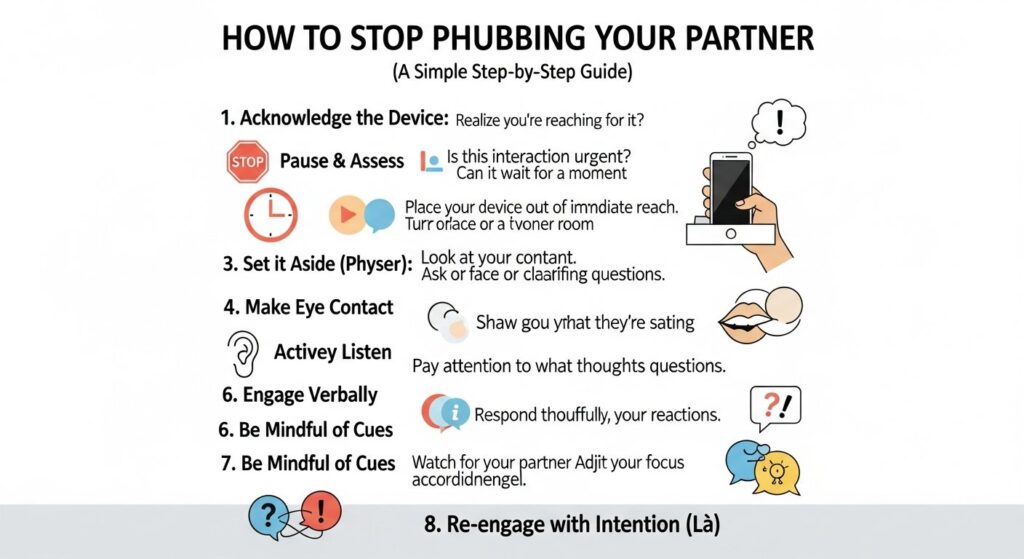
- Are you experiencing “phubbing” in your own bedroom? That is, are you or your partner paying more attention to a phone than to each other in the evening?
- How does your phone use make you feel? Energized, anxious, connected, or drained?
- How often do you wake up in the middle of the night and reach for your phone to “check something”?
Be honest with yourself, without judgment. The goal here is awareness, not shame. You might be surprised by what you uncover. For example, you might realize that a quick check of an email often spirals into 20 minutes of browsing, or that your intention to “just check the weather” turns into an hour on TikTok.
If you share a bed, observe your partner’s habits too. Are you both silently scrolling side-by-side, missing out on opportunities for connection and intimacy? This shared digital habit can erode not just sleep quality but also relationship quality – a core concern for Stop Phubbing. Recognizing these patterns is the essential foundation for implementing meaningful change.
Crafting a Sanctuary: Practical Strategies for a Phone-Free Bedroom
Now that you understand the “why” and have assessed your current habits, it’s time for the “how.” These practical, actionable strategies are designed to help you reclaim your bedroom as a sanctuary for rest, free from the digital distractions of your phone.
1. The “Digital Sunset” Rule: Set a Firm Cut-Off Time
This is perhaps the most impactful strategy. Establish a non-negotiable time when all screen-based device use ceases. Aim for at least 60-90 minutes before your intended bedtime. For example, if you want to be asleep by 10 PM, your digital sunset might be 8:30 PM. This gives your brain ample time to wind down, stop suppressing melatonin, and shift into a relaxed state. Consistency is key here. Treat this time as sacred.
2. The Charging Station Exile: Banish Your Phone from the Bedroom
If your phone is in your bedroom, the temptation to check it will be overwhelming. The simplest solution is to remove it entirely. Create a designated charging station outside your bedroom – in the living room, kitchen, or hallway. This physical distance creates a powerful barrier against late-night scrolling and early-morning checks. It also frees your bedroom from the subtle glow and constant notifications that signal “on-call” status.
3. Reintroduce the Alarm Clock: Ditch Your Phone as Your Morning Wake-Up
One of the primary reasons people keep their phones in the bedroom is to use them as an alarm. Invest in a simple, inexpensive alarm clock. This small purchase is a powerful step towards digital independence at night. Not only does it remove the excuse for keeping your phone by your bedside, but it also prevents the immediate morning ritual of checking emails, news, or social media before you’ve even fully woken up, which can set a stressful tone for the day.
4. Master “Do Not Disturb” (DND) Mode
If removing your phone entirely feels too drastic initially, or if you need to be reachable for genuine emergencies (e.g., caring for elderly parents, on-call work), learn to use your phone’s “Do Not Disturb” (DND) feature effectively.
- Schedule DND: Set it to automatically activate during your digital sunset period and throughout the night.
- Emergency Bypass: Most DND modes allow you to whitelist specific contacts (e.g., family members) or allow calls to come through if someone calls multiple times within a short period. This offers peace of mind without constant interruptions.
- Grey Scale Mode: Many smartphones offer a “grayscale” or “monochrome” display option. While it won’t block blue light, it makes the screen far less appealing and stimulating, reducing the psychological draw of colorful apps.
5. Create Physical Barriers: Out of Sight, Out of Mind
- Drawer or Box: Put your phone in a bedside drawer or a decorative box. The extra effort required to retrieve it can be just enough to break the impulse.
- “Phone Bed”: Create a designated “bed” for your phone in another room. This ritualistic act signals the end of its active use for the evening.
6. Set Clear Expectations with Loved Ones
If you’re typically responsive to late-night messages, let friends and family know about your new digital boundaries. A simple message like, “I’m turning off my phone for the night at 9 PM to improve my sleep, so I’ll get back to you in the morning!” can manage expectations and reduce your own anxiety about being unresponsive. This also fosters healthier communication norms that respect personal time.
Implementing these strategies might feel challenging at first, especially if you’re accustomed to constant connectivity. However, each small step you take to create distance between yourself and your device before bed is a significant investment in your sleep quality and overall well-being.
Beyond the Screen: Cultivating a Restorative Bedtime Routine
Removing your phone from the bedroom is a critical first step, but it creates a void. This is an opportunity, not a deprivation. By replacing phone time with calming, enjoyable activities, you can build a powerful new bedtime routine that actively promotes relaxation and prepares your body and mind for deep, restorative sleep.
1. Embrace the Power of Physical Books
Reading a physical book is perhaps the quintessential pre-sleep activity. Unlike screens, paper books don’t emit blue light, and the act of reading engages your mind in a focused, yet often less stimulating, way. Choose fiction, poetry, or non-fiction that is interesting but not overly demanding or emotionally intense. The tactile experience of holding a book, turning pages, and focusing on a narrative can be incredibly soothing and a wonderful escape from daily stressors.
2. Mindful Movement: Gentle Stretching or Yoga
Engage in 10-15 minutes of gentle stretching or restorative yoga. This isn’t about an intense workout, but rather about releasing physical tension, improving circulation, and connecting with your body. Focus on slow, deliberate movements and deep breathing. This practice signals to your body that it’s time to slow down and prepare for rest, helping to calm a restless mind and release any stored stress.
3. Relaxation Techniques: Meditation and Deep Breathing
Incorporating mindfulness or meditation into your routine can significantly calm your nervous system.
- Deep Breathing: Practice diaphragmatic breathing (belly breathing). Inhale slowly through your nose, letting your belly expand, then exhale slowly through your mouth, feeling your belly contract. Repeat for 5-10 minutes. This simple technique activates your parasympathetic nervous system, the “rest and digest” system.
- Guided Meditation: Use a guided meditation app before your digital sunset time, or consider using a non-screen-based device (like a smart speaker) for audio-only meditations once your phone is put away. Focus on body scans or visualizations that promote relaxation.
- Progressive Muscle Relaxation: Tense and then relax different muscle groups throughout your body, starting from your toes and working your way up to your head. This helps you become aware of and release physical tension.
4. The Warm Bath or Shower Ritual
5. Journaling: Empty Your Mind Onto Paper
If your mind tends to race with thoughts, worries, or to-do lists before bed, journaling can be a powerful antidote. Spend 10-15 minutes writing down anything that’s on your mind. This could be a list of tasks for tomorrow, reflections on your day, or simply free-flowing thoughts. Getting these thoughts out of your head and onto paper can prevent them from swirling around and keeping you awake. It’s a mindful way to process and clear your mental space.
6. Connect with Loved Ones (In Person!)
If you share your living space with a partner or family, use this time to connect authentically, without screens. Engage in meaningful conversation, share about your day, or simply enjoy quiet companionship. This reinforces human connection, a core value of Stop Phubbing, and can be deeply satisfying and calming, fostering intimacy and reducing feelings of isolation that can sometimes accompany excessive screen time.
The key is to experiment and find what resonates with you. The goal is to create a peaceful, intentional transition from the day’s activities to restful sleep, replacing the often-unconscious habit of phone scrolling with conscious, calming rituals.
Sustaining Your Sleep Revolution: Overcoming Challenges and Building Habits
Making changes to long-ingrained habits isn’t always easy. You’ll likely face challenges, but with persistence, self-compassion, and a few strategic approaches, you can sustain your sleep revolution.
1. Anticipate and Plan for the Urge to Check
The initial days of reducing phone use before bed might bring strong urges to check your device. This is normal. Your brain has been conditioned to seek that dopamine hit.
- The “Just Five More Minutes” Rule: If you feel an overwhelming urge, tell yourself, “I’ll just wait five more minutes.” Often, the urge will pass. If it doesn’t, try again.
- Have a Backup Activity: What will you do instead? Have a book, a journal, or a meditation ready to go. Redirecting your attention is more effective than simply trying to suppress the urge.
- Mindful Observation: Acknowledge the urge without judgment. “I’m feeling the urge to check my phone now. That’s interesting. I’ll notice it, but I won’t act on it.”
2. Address Your Fear of Missing Out (FOMO)
FOMO is a real psychological phenomenon. Remind yourself that the vast majority of what happens online can wait until morning. Very little is truly urgent in the digital realm, and for genuine emergencies, you’ve set up your DND mode. Reframe FOMO as JOMO – the “Joy of Missing Out” – on the stress, anxiety, and sleep deprivation that comes with constant connectivity. Embrace the peace of being offline.
3. Get Partner Buy-In (If Applicable)
If you share your life or your bed with someone, their habits can significantly impact yours.
- Communicate Openly: Explain why you’re making these changes (e.g., “I’m really struggling with sleep, and I think my phone is a big part of it. I’d love your support in trying to create a phone-free bedroom.”).
- Lead by Example: Even if your partner isn’t ready to fully commit, start with your own habits. Your improved mood and sleep might inspire them.
- Set Shared Boundaries: Perhaps agree on a “no phones in the bed” rule, even if devices are still in the room. Or designate certain evenings as “screen-free connection nights.”
4. Embrace Small Steps and Celebrate Wins
You don’t have to go from 100% phone use to 0% overnight. Start small. Perhaps you commit to 30 minutes phone-free before bed for three nights a week. Once that feels comfortable, extend it. Every small step is a victory. Celebrate these wins to reinforce positive behavior and build momentum.
5. Practice Self-Compassion and Persistence
There will be nights when you slip up. You might find yourself scrolling unexpectedly, or you might forget to put your phone away. Don’t beat yourself up. One night of less-than-ideal sleep doesn’t erase all your progress. Simply acknowledge it, learn from it (What was the trigger? What can you do differently next time?), and recommit to your goals the next evening. Consistency over perfection is the aim. Building new habits takes time, typically several weeks to months for them to become ingrained. Be patient and kind to yourself throughout the process.
By understanding the challenges and equipping yourself with strategies to navigate them, you’re not just reducing phone use; you’re actively cultivating resilience, self-awareness, and a deeper commitment to your own well-being. This journey isn’t just about better sleep; it’s about reclaiming your evenings, your peace of mind, and your presence in the current moment.
Embrace the Gift of Rest
Reducing phone use before bed is more than just a digital detox; it’s an investment in your physical health, mental clarity, and emotional well-being. It’s about consciously choosing restorative rest over endless scrolling, authentic connection over digital distraction, and presence over performance. The journey to better sleep by reducing phone use might present its challenges, but the rewards are immeasurable: waking up feeling truly refreshed, increased focus throughout your day, improved mood, and deeper, more meaningful connections with the people who matter most.
At Stop Phubbing, we champion mindful living in the smartphone age. Begin today by implementing one or two of these strategies. Experiment, be patient with yourself, and celebrate every step forward. Reclaim your evenings, transform your bedroom into a peaceful sanctuary, and rediscover the profound gift of truly restorative sleep. Your mind and body will thank you.