
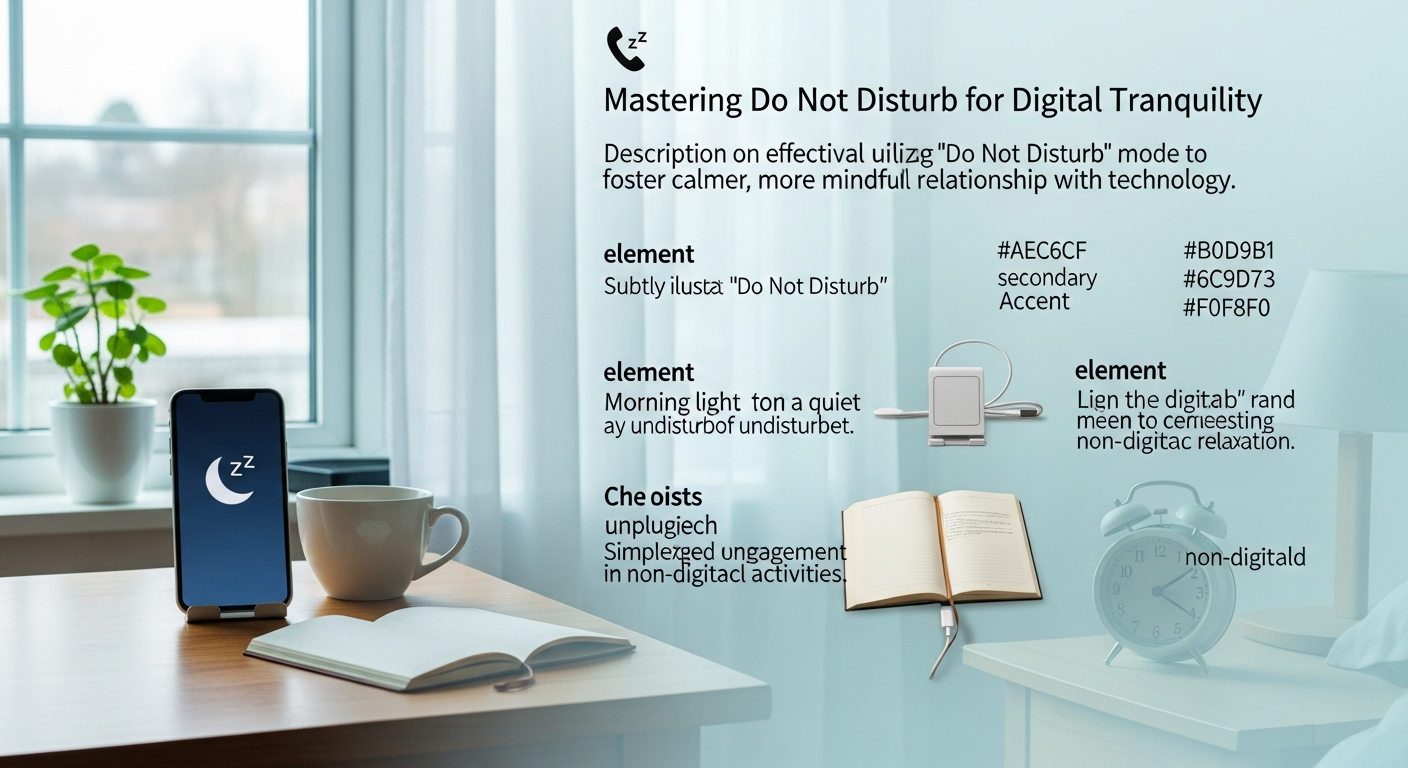
Mastering Focus: How to Use Do Not Disturb Mode Effectively for Digital Wellness
In our hyper-connected era, our smartphones have transitioned from helpful tools to demanding masters. The average person checks their phone dozens of times a day, often prompted by a relentless stream of pings, vibrations, and glowing banners. This constant state of “alertness” is a primary driver of modern anxiety, fragmented attention spans, and what many experts call digital burnout. To reclaim our time and mental clarity, we must move beyond passive consumption and take active control of our notification environments.
The “Do Not Disturb” (DND) feature is no longer just a button to silence your ringer at the movie theater; in 2026, it has evolved into a sophisticated suite of digital wellness tools designed to protect our focus. Using DND effectively isn’t about isolating yourself from the world; it’s about setting intentional boundaries so you can show up more fully for your work, your family, and yourself. This guide will walk you through the nuances of mastering DND mode to break the cycle of phone addiction and foster a healthier relationship with technology.
—
1. The Science of Focus: Why Your Brain Needs Silence
To understand how to use Do Not Disturb mode effectively, we first have to understand the cost of an interruption. Research into “task-switching” suggests that it can take the human brain up to 23 minutes to return to a state of deep focus after being interrupted by a single notification. Even if you don’t pick up the phone, the mere sound of a chime creates a “cognitive itch” that pulls resources away from your primary task.
When your phone is constantly active, your brain stays in a state of high cortisol—the stress hormone. Every notification triggers a tiny hit of dopamine (the “reward” chemical), which reinforces the habit of checking your screen. This creates a loop of phone addiction that erodes your ability to think deeply or engage in “flow states.” By effectively using DND mode, you are essentially building a digital fortress around your concentration. You aren’t just silencing a device; you are lowering your baseline stress levels and allowing your prefrontal cortex—the part of the brain responsible for logic and long-term planning—to take back control from the impulsive, notification-seeking amygdala.
2. Moving Beyond the Basics: Focus Modes vs. Standard DND
Most users only know how to toggle the moon icon on their Control Center. However, modern operating systems on both iOS and Android have introduced “Focus Modes,” which are essentially DND on steroids. Using these effectively is the secret to long-term digital wellness.
Standard Do Not Disturb is a “binary” setting: everything is silenced. Focus Modes, however, allow for context-specific filtering. You can create a “Work Focus” that only allows notifications from Slack and your boss, a “Fitness Focus” that blocks everything except your music and workout apps, and a “Sleep Focus” that shuts out the world entirely.
The key to using these effectively is granularity. Instead of a blanket silence, ask yourself: *“Who or what actually needs my attention during this specific window of time?”* In 2026, these modes can even be triggered by your physical location or the app you open. For instance, your phone can automatically enter “Deep Work” mode the moment you walk into your home office or open a document editor. This automation removes the “friction” of having to remember to turn DND on, making digital wellness a default state rather than a chore.
3. Strategic Whitelisting: Overcoming the Fear of Missing Out (FOMO)
The biggest barrier to using Do Not Disturb mode effectively is the fear of missing an emergency. This fear often keeps people tethered to their devices, checking them “just in case.” Strategic whitelisting is the antidote to this anxiety.
Both iOS and Android allow you to set “Exceptions” or “Allowed People.” To reduce phone addiction while staying reachable, you should curate a small list of “VIPs”—usually immediate family members or essential work contacts—who can always bypass the silence.
Furthermore, you can utilize the “Repeated Calls” feature. This setting allows a call to ring through if the same person calls twice within three minutes. This is a brilliant safety net; it assumes that if someone is calling repeatedly, it is a genuine emergency, allowing you to stay focused on your tasks without worrying about being unreachable during a crisis. By setting these parameters, you give your brain permission to relax, knowing that if something truly urgent happens, the digital wall will let the right person through.
4. Scheduling Your Sanity: The Power of Automation
Willpower is a finite resource. If you rely on your own discipline to turn on DND mode every day, you will eventually fail. The most effective way to improve digital wellness is to automate your boundaries.
Start by identifying your “Golden Hours”—the times of day when you are most productive or when you need the most rest. Schedule your DND mode to activate automatically during these windows. A common “Wellness Schedule” looks like this:
* **The Morning Buffer:** Keep DND on for 60 minutes after you wake up. This prevents you from starting your day in a reactive state, scrolling through emails or news.
* **The Deep Work Block:** Schedule a two-hour block in the mid-morning for high-priority tasks.
* **The Wind-Down:** Set DND to activate at least one hour before bed. This reduces blue light exposure and stops the late-night “scrolling sessions” that disrupt sleep architecture.
When your phone follows a schedule, your brain begins to anticipate the quiet. You’ll find that as the DND icon appears on your screen, your body naturally begins to downshift, reducing the physiological urge to check for updates.
5. Integrating DND with Physical Digital Wellness Habits
While Do Not Disturb mode is a powerful software tool, it works best when paired with physical habits. Digital wellness is a holistic practice. To truly combat phone addiction, you should use DND as a catalyst for other behavioral changes.
One effective strategy is the “Out of Sight, Out of Mind” rule. Even when DND is on, the physical presence of a smartphone can reduce cognitive capacity. Try putting your phone in a drawer or another room once your scheduled DND kicks in.
Additionally, pair DND with “Grayscale Mode.” One reason we are so addicted to our phones is the vibrant, reward-oriented colors of the icons. By turning your screen black and white during your DND hours, the device becomes significantly less stimulating. You can also disable “Lock Screen” notifications so that even if you glance at your phone to check the time, you aren’t sucked back in by a list of missed messages. The goal is to make the phone as boring as possible during your focus periods.
6. Changing the Narrative: DND as Availability Management
Perhaps the most important part of using DND mode effectively is changing your mindset. Many people feel guilty for being “unavailable,” fearing they are being rude or unresponsive. In reality, constant availability is a recipe for mediocrity.
View Do Not Disturb not as a way to “ignore” people, but as a way to “prioritize” your current environment. When you are on DND during a dinner with friends, you are telling them they are more important than your Twitter feed. When you use it during a work project, you are respecting your own professional goals.
Communicate your boundaries to others. Many platforms now show a “Focus Status” to people trying to message you (e.g., “John has notifications silenced”). This social cue is vital. It sets expectations and encourages others to respect your time. When you normalize the use of DND, you often give the people around you “permission” to do the same, creating a healthier digital culture for everyone in your circle.
—
FAQ: Mastering Do Not Disturb for Digital Wellness
**Q1: Won’t I miss important emergencies if I use DND mode all the time?**
**A:** Not if you set it up correctly. By using “Whitelisting” for specific contacts and enabling the “Repeated Calls” feature, you ensure that urgent matters can still reach you. DND is meant to filter out the “noise,” not the “signals.”
**Q2: How do I stop the habit of manually turning DND off just to “check” what I’ve missed?**
**A:** This is a common symptom of phone addiction. To combat this, remove “Notification Badges” (the little red numbers). Without the visual cue of how many messages are waiting, the urge to check is significantly diminished. Also, try keeping the phone in a different room to add physical friction.
**Q3: Can I customize DND for different apps?**
**A:** Yes. On modern devices (as of 2026), you can use Focus Filters. These allow you to not only silence apps but actually hide certain content within apps—such as hiding work email folders while in “Personal Mode”—providing a much deeper level of digital wellness.
**Q4: Is it better to use DND or just turn my phone off?**
**A:** DND is generally better for daily use because it allows for automation and emergency bypasses. Turning your phone off is great for a “Digital Detox” weekend, but DND provides a sustainable, long-term framework for managing a modern life where some connectivity is required.
**Q5: My job requires me to be “on call.” Can I still use DND?**
**A:** Absolutely. You can set a specific “On-Call Focus” that silences all social media, news, and personal alerts while leaving your work line, email, or specific pager apps wide open. This prevents “alert fatigue” by ensuring the only time your phone makes a sound, it’s for something that actually matters.
—
Conclusion: Reclaiming Your Mental Space
Learning how to use Do Not Disturb mode effectively is one of the most vital skills for the 21st century. We live in an attention economy where every app is designed to steal your focus for profit. Using DND is an act of rebellion against this system and a foundational step toward true digital wellness.
By understanding the psychology of focus, leveraging the power of Focus Modes, whitelisting essential contacts, and automating your schedule, you can transform your smartphone from a source of stress into a tool for empowerment. Remember, the goal of reducing phone addiction isn’t to live in a vacuum; it’s to ensure that when you are connected, it is on your terms. Start small by scheduling a one-hour DND block today, and experience the profound clarity that comes with a silent phone and a focused mind. Your time is your most precious resource—protect it with intention.