
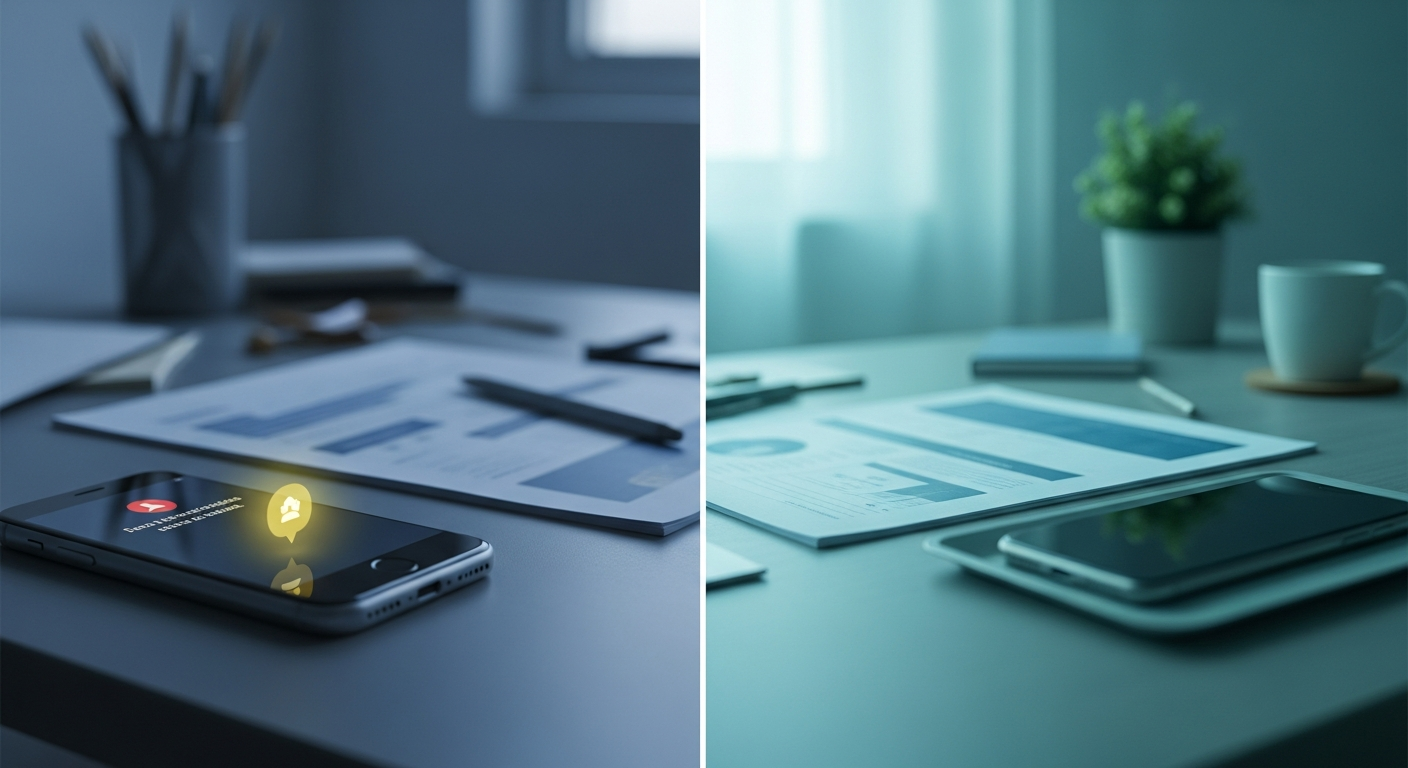
Beyond the Buzz: Understanding Phone Distraction at Work and Its Real Productivity Impact
In the modern professional landscape of 2026, the boundary between our physical workspace and our digital lives has virtually vanished. We sit down to tackle a high-priority project, but within minutes, a notification pings. It’s a harmless text, a social media update, or a news alert. We tell ourselves it will only take ten seconds to check. However, those ten seconds are the gateway to a cognitive rabbit hole that dismantles our focus and erodes our efficiency.
Phone distraction at work is no longer just a minor annoyance; it is a systemic crisis of attention. As we move deeper into an era defined by the “attention economy,” protecting our mental clarity has become the ultimate competitive advantage. For those seeking to reclaim their time and improve their digital wellness, understanding the profound productivity impact of these devices is the first step toward a more intentional life. This article explores the hidden costs of our digital habits and provides a roadmap for shifting from constant distraction to meaningful, deep work.
1. The Hidden Cost of Task-Switching and the “23-Minute Rule”
The most pervasive myth of the digital age is that humans are capable of multitasking. In reality, our brains are not “parallel processors”; they are “serial processors.” When you glance at your phone while drafting a report, you aren’t doing two things at once. Instead, your brain is performing a “context switch.”
Research into cognitive ergonomics has consistently shown that these interruptions carry a heavy price tag known as “switching cost.” A famous study from the University of California, Irvine, revealed that it takes an average of 23 minutes and 15 seconds to return to the original task after an interruption. This isn’t because we are slow, but because our “attentional residue”—the part of our brain still processing the notification we just saw—lingers on the previous stimulus.
By 2026, the complexity of our work has only increased. We are expected to solve intricate problems and innovate under pressure. When we check our phones every 15 minutes, we never actually reach a state of “Flow,” that psychological peak where productivity and creativity soar. We spend our entire workday in the shallow end of the cognitive pool, frustrated by how little we’ve actually accomplished despite being “busy” all day.
2. The Neurobiology of the Ping: Why Our Brains Crave Distraction
To conquer phone addiction, we must understand that the struggle isn’t a lack of willpower; it’s a battle against neurobiology. Every time we receive a notification, our brain releases a small surge of dopamine, the neurotransmitter associated with reward and motivation. This creates an “intermittent reinforcement” loop—the same mechanism that makes slot machines so addictive. We check our phones because we *might* find something exciting, a phenomenon often called “Variable Reward.”
Furthermore, the constant “always-on” nature of 2026 digital culture has led to a rise in “Phantom Vibration Syndrome,” where we perceive our phone vibrating even when it isn’t. This state of hyper-vigilance keeps our nervous system in a low-level “fight or flight” mode. When your brain is constantly scanning the environment for a digital signal, it cannot allocate full resources to the task at hand.
This chronic state of distraction reduces our IQ by more than twice the amount found in those who smoke marijuana, according to some studies on digital interference. We are effectively working while cognitively impaired, all because we cannot resist the siren song of the pocket-sized supercomputer at our side.
3. Quantifying the Productivity Impact: Lost Hours and Quality Erosion
The impact of phone distraction at work is not just psychological; it is quantifiable. If an average employee checks their phone 50 to 80 times a day, and we factor in the “attentional residue” mentioned earlier, we are looking at a loss of two to three hours of peak productivity every single day. Over a work week, that’s nearly a dozen hours lost to the ether.
But the impact goes beyond just time. It affects the *quality* of the work. Phone distractions lead to:
* **Increased Error Rates:** When focus is fragmented, we miss details. In industries like coding, finance, or healthcare, these “small” distractions can lead to catastrophic mistakes.
* **Diminished Creativity:** Creativity requires long periods of uninterrupted thought. The “Aha!” moments usually happen when the mind is allowed to wander deeply into a problem, not when it is being jerked back to reality by a social media comment.
* **Weakened Memory Retention:** We process information more shallowly when we are distracted. This means we forget instructions, struggle to recall meeting details, and fail to learn new skills effectively.
In the competitive landscape of 2026, where AI handles the routine tasks, human workers are valued for their ability to perform deep, creative work. If you are distracted by your phone, you are essentially devaluing your own professional worth.
4. The Psychological Toll: Stress, Burnout, and Digital Wellness
We often turn to our phones as a “break” from work, but the irony is that digital distraction increases stress rather than relieving it. This is a core concept in digital wellness. When we jump from a high-stress email to a polarizing news headline to a social media feed, our brains never actually rest.
This leads to “Technostress”—the anxiety caused by an inability to cope with new computer technologies in a healthy way. The pressure to respond instantly to messages creates a sense of “urgency culture.” We feel guilty if we don’t reply immediately, and that guilt fuels further distraction.
Over time, this constant state of fragmented attention leads to burnout. Burnout isn’t always caused by working too many hours; it’s often caused by working in a state of constant, scattered interruption where nothing ever feels “finished.” By improving our digital wellness and setting firm boundaries with our devices, we aren’t just becoming more productive; we are protecting our mental health and ensuring the longevity of our careers.
5. Practical Strategies for Immediate Impact
Reclaiming your focus doesn’t require a total digital detox. Instead, it requires a series of strategic “friction points” that make distraction harder and focus easier. Here are the most effective methods for 2026:
* **The “Out of Sight, Out of Mind” Rule:** Research shows that the mere presence of a smartphone—even if it is turned off and face down—reduces cognitive capacity. Put your phone in a drawer, a bag, or another room during your most important work blocks.
* **Grayscale Mode:** Much of the phone’s allure is in the bright, candy-colored icons designed to trigger dopamine. Switching your screen to grayscale makes the device significantly less stimulating and “boring” to look at.
* **The 15-Minute Buffer:** Instead of checking your phone the moment a thought pops into your head, write the thought down on a physical notepad. Tell yourself you can check the phone during a dedicated 15-minute window after you finish your current task.
* **Aggressive Notification Management:** In 2026, most apps are designed to steal your attention. Go into your settings and disable all non-human notifications. If it isn’t a direct call or a text from a real person, you don’t need a buzz in your pocket.
* **Use Focus Modes:** Modern operating systems have advanced “Focus Modes” that can be scheduled to trigger automatically during work hours, allowing only emergency contacts to get through.
6. Building a Long-term Culture of Deep Work
While individual strategies are vital, the productivity impact of phone distraction is also a cultural issue. In 2026, forward-thinking companies are beginning to realize that an “always-on” employee is an unproductive employee.
To truly improve digital wellness at scale, we need to foster a culture of “Deep Work,” a term popularized by Cal Newport. This involves:
* **Normalizing “Offline” Time:** Encouraging team members to set “deep work” blocks on their calendars where they are not expected to respond to Slack or emails.
* **Batching Communication:** Instead of a constant trickle of messages, encourage teams to consolidate updates into specific times of the day.
* **Leading by Example:** Managers must stop sending non-urgent messages after hours or during the middle of the workday if they want their teams to remain focused.
When we treat our attention as a finite, precious resource, the entire organization benefits. We see higher morale, better output, and a more engaged workforce that isn’t constantly looking at their laps for the next dopamine hit.
FAQ: Understanding and Managing Digital Distraction
**Q1: How much time does the average person actually lose to phone distraction at work?**
A: Estimates vary, but most studies suggest that between “task-switching” and the actual time spent on the device, the average worker loses 2 to 3 hours of productive time per day. Over a 40-year career, this equates to years of lost potential.
**Q2: Is “digital wellness” just about using my phone less?**
A: No. Digital wellness is about having a healthy, intentional relationship with technology. It means using tools to enhance your life and work rather than allowing the tools to use you. It includes managing screen time, protecting sleep, and maintaining mental boundaries.
**Q3: Can’t I just use my phone for background music or white noise?**
A: While audio can help some people focus, having the device physically near you often leads to “check-looping”—the habit of glancing at the screen even if no notification has arrived. Use a dedicated speaker or a desktop app for music to keep the phone away from your workspace.
**Q4: My job requires me to be on my phone (social media management, sales, etc.). How do I avoid distraction?**
A: This is where “Digital Compartmentalization” is key. Use separate devices for work and personal use if possible. If not, use “Work Profiles” on your phone that hide all personal apps (like Netflix or personal Instagram) during business hours.
**Q5: What is the single most effective way to stop phone addiction at work?**
A: Physical distance. The “friction” of having to get up and walk to another room to check your phone is often enough to break the impulsive urge to check it.
Conclusion: Reclaiming the Future of Work
The productivity impact of phone distraction at work is one of the most significant challenges of our era. As we navigate the complexities of 2026 and beyond, the ability to focus will be the most valuable skill a person can possess. By acknowledging the cognitive costs of task-switching, understanding the neurobiology of our distractions, and implementing practical digital wellness strategies, we can move from being passive consumers of technology to being masters of our own attention.
Reducing phone addiction isn’t about moving backward or rejecting the modern world; it’s about moving forward with intention. It’s about choosing the satisfaction of a job well done over the fleeting hit of a digital notification. Your time, your creativity, and your mental peace are worth the effort. Put the phone away, reclaim your focus, and watch your productivity—and your well-being—transform.