Updated April 2026. Finding the right balance between our personal lives and professional obligations is a constant puzzle, but managing remote work boundaries is the essential piece that brings the picture into focus. When your dining table doubles as a conference room, the lines between clocking in and unwinding blur effortlessly. I frequently speak with professionals who feel tethered to their inboxes long after the sun goes down, trapped in a cycle of perpetual availability that drains their energy and strains their personal connections.
You are not alone if closing the laptop feels harder than opening it. Without the physical commute to sever the workday from evening rest, the brain struggles to switch gears. Cultivating a healthy separation requires intentional systems that protect your time, your physical space, and your cognitive load. We will explore practical, actionable ways to rebuild that separation, ensuring you can show up fully for your career without sacrificing your peace of mind or the relationships that matter most to you.
Why Are Remote Work Limits Essential for Digital Wellness?
Human physiology is not designed for continuous, unbroken alertness. Cortisol, the hormone responsible for our stress response and wakefulness, naturally follows a diurnal rhythm—peaking in the morning and tapering off by late evening to prepare the body for sleep. When you check professional emails from bed at 10:30 PM, the blue light of the screen combined with the cognitive demands of reading work-related content triggers an artificial cortisol spike. The brain interprets this late-night stimulation as an active threat or urgent task, delaying the onset of melatonin production and disrupting sleep architecture.
Consider an employee who receives a notification ping right as they sit down for family dinner. Even if they choose not to reply immediately, the mere anticipation of the message—wondering if a project has derailed or a client is upset—initiates a stress loop. They are physically present at the table but cognitively stranded at the office. Over time, this chronic low-level alertness develops into technostress, a specific psychological strain experienced when individuals are constantly connected to or bombarded by digital tools and expectations.
Data reveals how pervasive this issue has become for modern professionals. According to a comprehensive survey, 22% of remote workers struggle with unplugging after their designated hours (Buffer, 2023) [VERIFICAR FECHA]. That inability to detach is the primary catalyst for digital fatigue and eventual burnout. By enforcing strict cutoff times, you allow your central nervous system the necessary runway to decompress. You give your mind the permission it needs to reset, which is a foundational aspect of disconnecting legally and practically at the end of the day.
Defining and Establishing Work-Life Separation
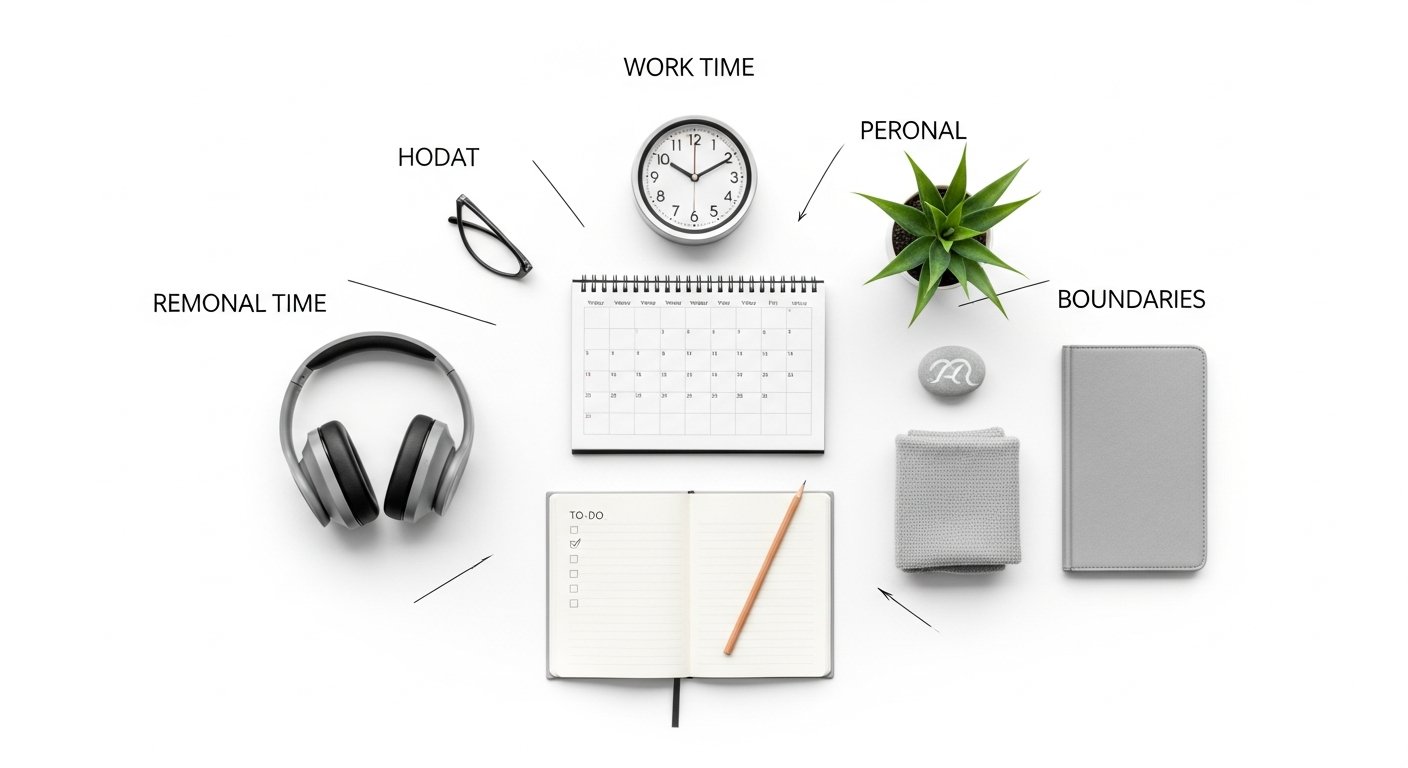
A telecommuting arrangement strips away the natural environmental cues that traditionally signal the beginning and end of a shift. The commute, the swipe-card access, the physical desk—all of these elements rely on context-dependent memory. The brain associates the office environment with high executive function and the home environment with relaxation. When both activities occur on the same living room sofa, those neurological associations collapse, making it incredibly difficult to focus during the day and relax at night.
Creating Spatial Divisions
Rebuilding those lost associations requires deliberate spatial design. Imagine a professional who lives in a small apartment without a spare room. Instead of working from the bed or the center of the kitchen island, they place a small folding desk in a specific corner facing a window. During business hours, that corner is the office. At 5:30 PM, the laptop is closed, placed inside a drawer, and a physical curtain or room divider is pulled across the desk. The visual removal of the work equipment prevents the brain from accidentally re-engaging with professional anxieties during leisure time. A Gallup 2025 workplace report noted that remote workers with defined, physical separation of their workspaces are 43% less likely to experience severe burnout.
Engineering Time Blocks
Time-based guardrails are equally critical. Instead of allowing tasks to bleed into the evening, establishing firm start and end times creates artificial scarcity, which drives efficiency. You can enhance your overall mental well-being by scheduling a “fake commute”—a 20-minute walk around the neighborhood before opening the laptop and another immediately after shutting it down. This physical movement serves as a boundary ritual, mimicking the psychological transition that a train ride or drive used to provide.
[INLINE IMAGE 2: A split-screen illustration showing a cluttered workspace merging with a living room versus a clearly delineated home office setup with physical barriers.]
How Do Professional Borders Impact Interpersonal Connections?
The quality of our personal relationships is directly correlated to the quality of our attention. Continuous partial attention occurs when an individual attempts to monitor multiple sources of information simultaneously—such as listening to a partner recount their day while subconsciously tracking a Slack channel on a secondary screen. Because the brain is rapid-task-switching rather than genuinely multitasking, the emotional nuance of the partner’s story is lost. The partner intuitively senses this lack of presence, which builds resentment over time.
We see this friction frequently when professionals blur their working hours. A spouse asks a simple question about weekend plans, and the remote worker, deep in the middle of a complex spreadsheet, snaps aggressively. The anger isn’t actually directed at the spouse; it is a manifestation of cognitive overload. The interruption shattered a fragile state of concentration. When clear rules of engagement aren’t communicated, family members don’t know when the worker is approachable, leading to constant minor conflicts. A 2026 American Psychological Association study found that couples where one or both partners lacked clear home-office schedules reported a 35% higher rate of daily interpersonal conflict.
This dynamic often leads to accidental phubbing, where an individual inadvertently ignores a physical companion in favor of a digital device tied to their career. Actively incorporating digital etiquette into your daily routine helps prevent this. By communicating your schedule clearly (“I have heads-down focus time until 3 PM, but I’ll come out to the kitchen for a coffee break then”), you eliminate the guesswork for your household. You transform unpredictable availability into reliable connection.
Types of Digital Guardrails and Implementation Strategies
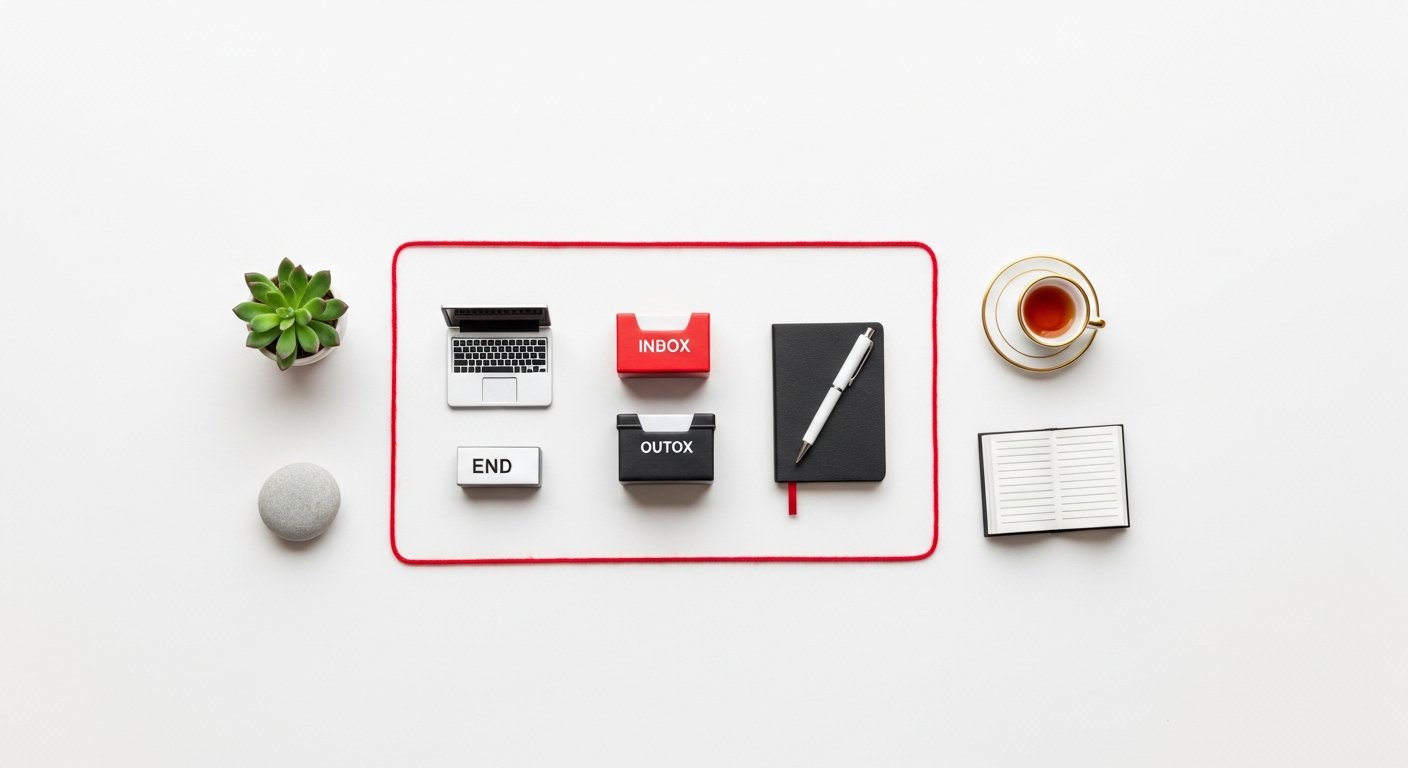
Translating the desire for separation into daily habits requires a structured approach. Successfully managing remote work boundaries hinges on categorizing your limits and applying the right technological or behavioral tool to enforce them. Relying solely on willpower is a losing strategy when the devices designed to facilitate our jobs are also engineered to capture our attention.
Communication Protocols
The most transformative shift a remote team can make is moving toward asynchronous communication. This is an interaction model that does not require all parties to participate at the exact same time, effectively removing the pressure of the immediate reply. Imagine a software developer setting a status message that reads: “Deep Work Block: 9 AM – 12 PM. Will review all messages at noon. Call my cell only if the servers are down.” By defining what constitutes an actual emergency, the developer secures three hours of uninterrupted flow state, while colleagues know exactly when to expect a response.
Tool Consolidation and Scheduling
Technology can be leveraged to restrict its own reach. Utilizing the “Schedule Send” feature for emails drafted late at night ensures you do not pass your own boundary-blurring habits onto a colleague in a different time zone. We can formalize these tactics by looking at establishing firm digital rules in professional settings across several distinct categories.
| Boundary Category | Core Focus | Digital Wellness Benefit | Implementation Example |
|---|---|---|---|
| Temporal (Time-Based) | Protecting start, stop, and break times. | Prevents cognitive fatigue by ensuring scheduled periods of recovery. | Setting an automated out-of-office autoresponder daily at 5:30 PM. |
| Spatial (Physical) | Containing professional tasks to specific physical locations. | Aids the brain in context-switching and entering rest states faster. | Using a dedicated desk rather than the kitchen table; closing the office door. |
| Technological | Restricting access to work platforms on personal devices. | Reduces the anxiety loop caused by unexpected push notifications. | Removing company email and Slack apps from your personal smartphone. |
| Interpersonal | Managing availability expectations with team members and family. | Lowers resentment and minimizes the impact of constant partial attention. | Using calendar blocks for “Do Not Disturb” and communicating them clearly. |
[INLINE IMAGE 4: A detailed infographic flowchart guiding a remote worker through deciding whether to reply immediately or delay communication based on urgency and time of day.]
Overcoming Common Friction Points in Telecommuting Environments
Even with the best intentions, maintaining separation is fraught with psychological traps. The most pervasive hurdle is performance guilt. In a traditional office, an employee’s physical presence at a desk is a visible indicator of their effort. The manager can see them working. In a distributed team, that visual cue is absent. To compensate, many telecommuters fall into the trap of performative responsiveness—replying to emails at 9 PM or working through weekends just to prove their dedication.
Addressing Performance Guilt
This overcompensation creates a toxic baseline. When one team member routinely replies after hours, it implicitly pressures others to do the same, degrading the culture for everyone. Asana’s 2026 Anatomy of Work index highlighted that unstructured communication and the pressure of constant connectivity account for roughly 60% of lost productive time during the workweek. Employees spend more time managing the optics of working than engaging in actual productive output.
Handling the Urgent-vs-Important Trap
Consider the scenario of receiving a direct message from a supervisor on a Friday evening regarding a project due next Wednesday. The message might not explicitly demand an immediate reply, but the power dynamic makes it feel mandatory. The employee drops their evening plans, opens the laptop, and spends an hour drafting a response. The antidote to this is proactive alignment. During a one-on-one meeting, the employee must ask for explicit definitions of urgency: “If you message me after 6 PM, should I assume it requires immediate attention, or is it okay to address it the next morning?” Usually, the supervisor will confirm that next-day replies are perfectly acceptable, instantly dissolving the assumed pressure.
A Path Forward for Sustainable Remote Productivity
Achieving a healthy equilibrium in a distributed workforce is not a one-time setup; it is an ongoing practice of negotiation and refinement. Successfully managing remote work boundaries requires you to treat your personal time with the exact same reverence and structural protection that you apply to your most critical client meetings. When you protect your downtime fiercely, you return to your professional obligations with renewed mental clarity, heightened creativity, and a far lower risk of emotional exhaustion.
Leaders and individual contributors alike must champion these practices to build resilient organizations. A culture that respects the “off switch” is a culture that retains top talent and fosters genuine innovation. To explore how these individual habits integrate into broader organizational strategies, dive deeper into our central resource on [PILLAR LINK: Workplace Wellness & Productivity].
Sources & References
- Buffer. (2023). State of Remote Work. Buffer.com.
- Gallup. (2025). State of the Global Workplace: Reimagining Remote Engagement. Gallup, Inc.
- Asana. (2026). Anatomy of Work Index: Designing the Future of Distributed Teams. Asana, Inc.
- American Psychological Association. (2026). The Psychological Impact of Telecommuting on Family Dynamics. APA Journals.