
Screen Time for Toddlers: Setting Smart Limits
Updated March 2026. Navigating the world of screen time for toddlers can feel like a complex labyrinth for modern parents. With digital devices becoming increasingly ubiquitous, understanding how to integrate technology mindfully while safeguarding a child’s development and fostering healthy relationships is paramount for truly embracing Mindful Digital Living. This deep dive aims to cut through the noise, providing expert-level guidance grounded in child development principles and the philosophy of building strong family connections in the digital age.
What are the official guidelines for young child screen interaction?
Understanding the recommended limits for early childhood media consumption is the foundational step towards cultivating healthy digital habits. This section delves into expert guidelines to help parents make informed decisions that align with developmental needs.
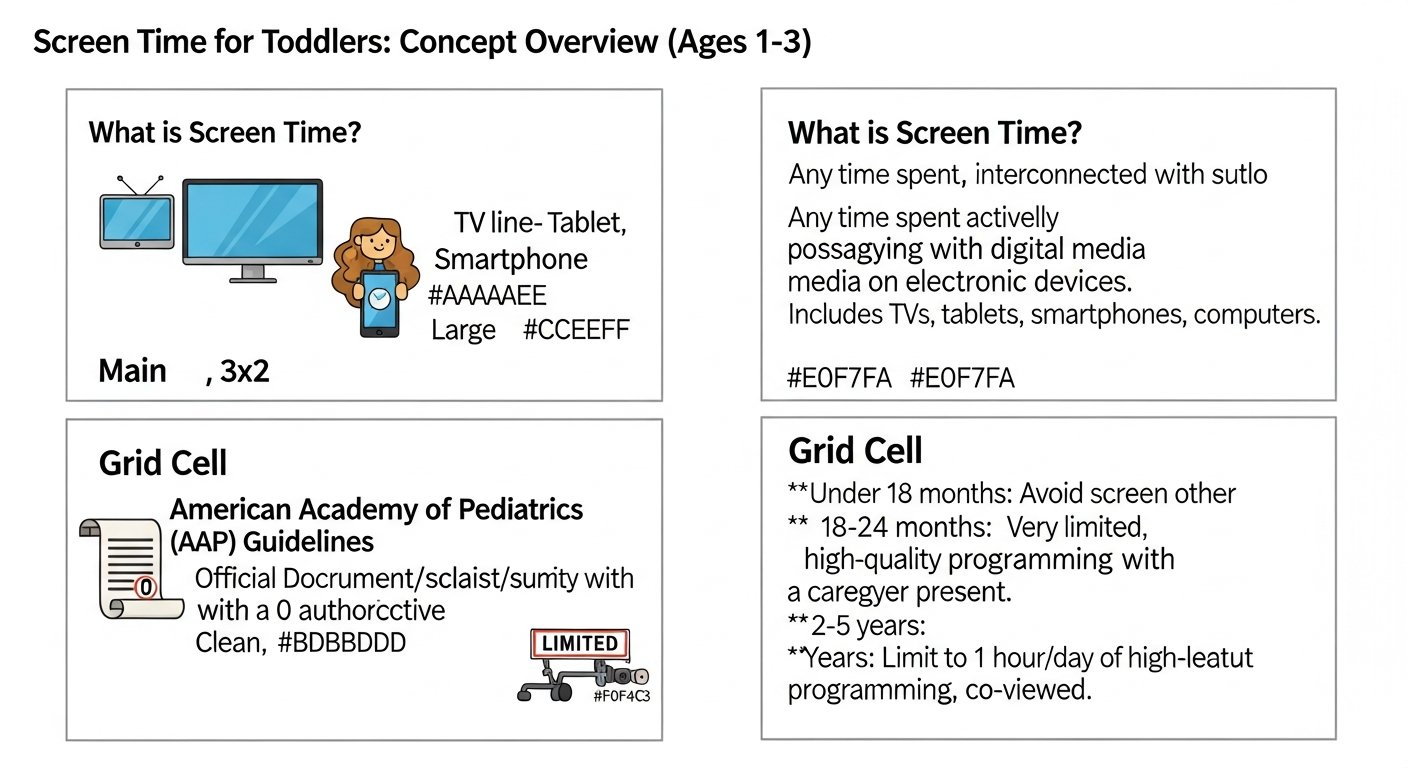
The American Academy of Pediatrics (AAP) and the World Health Organization (WHO) provide clear, evidence-based recommendations for digital exposure in young children. For infants aged 0-18 months, the AAP recommends zero screen time, with the exception of video chatting with family members (AAP, 2021). This is crucial because during this period, infants’ brains are rapidly developing, and hands-on exploration and direct human interaction are vital for cognitive and social growth. For instance, a child learning to stack blocks physically engages their fine motor skills and spatial reasoning in a way passive viewing cannot replicate. This mechanism, known as “serve and return” interaction, forms the basis of healthy brain architecture; when a baby coos and a parent responds, it builds neural pathways essential for language and social development.
For toddlers between 18 and 24 months, the AAP suggests introducing digital exposure very sparingly, and only if parents co-view high-quality, educational programming. The recommended limit is no more than a few minutes per day. The rationale here is that toddlers at this age are beginning to mimic behaviors and understand simple narratives, making supervised interactive content potentially beneficial if thoughtfully chosen. A concrete example of this might be a parent and child watching a short educational video about animal sounds together, with the parent actively pointing to the animals and mimicking sounds, encouraging the child to repeat them. This co-viewing mechanism ensures that the child is not just passively absorbing information but actively engaging with the content and the parent, transforming a potentially isolating experience into a shared learning opportunity. For further guidance on age-appropriate approaches, you might find “Beyond the Pixels: A Mindful Parent’s Guide to Kids’ Screen Time by Age” a valuable resource.
For children aged 2-5 years, both the AAP and WHO recommend limiting digital exposure to no more than one hour per day. The content should be high-quality, educational, and co-viewed or discussed with a parent. This age group benefits from content that promotes language development, problem-solving, and social skills. For instance, watching a show where characters solve a simple puzzle and then discussing with the child how they would solve it can foster critical thinking. The mechanism behind this recommendation is that while some digital content can offer learning opportunities, excessive exposure can displace crucial activities like imaginative play, outdoor exploration, and direct social interactions, all of which are fundamental for comprehensive development. A study published in JAMA Pediatrics in 2020 found that higher levels of screen time in preschoolers were associated with poorer performance on developmental screening tests, particularly in communication and problem-solving domains.
| Age Group | Recommended Screen Time | Type of Content | Parental Involvement | Rationale |
|---|---|---|---|---|
| 0-18 Months | Zero (except video calls) | N/A (Video calls: interactive) | Essential for video calls, active engagement for all interactions. | Brain development relies on direct interaction and physical exploration. Excessive screen time displaces crucial learning. |
| 18-24 Months | Very limited, a few minutes per day. | High-quality, educational, age-appropriate apps/shows. | Mandatory co-viewing and active engagement. | Toddlers begin to mimic; co-viewing supports comprehension and prevents passive consumption. |
| 2-5 Years | No more than one hour per day. | Educational, interactive, promotes language/problem-solving. | Mandatory co-viewing or discussion; active engagement. | Balance with active play and social interaction. Prevents displacement of critical developmental activities. |
How does digital exposure for young children impact their development?

The influence of digital exposure for young children extends across multiple developmental domains, with both potential benefits and significant risks depending on its quality, duration, and context. Understanding these impacts is key to fostering Mindful Digital Living.
How Does Screen Time Affect Toddler Brain Development?
The developing brain of a toddler is highly susceptible to environmental influences. Excessive or passive digital exposure can significantly affect critical areas of brain development. Research from Cincinnati Children’s Hospital Medical Center in 2019, published in JAMA Pediatrics, showed that preschool-aged children with higher screen usage (over the recommended one hour per day) had lower white matter integrity in brain regions supporting language, literacy, and cognitive control. This quantitative data highlights the physical impact on brain structure. For example, when a toddler passively watches a fast-paced cartoon, their brain is stimulated by rapid visual and auditory changes, but it doesn’t have to process or respond in the same way it would during imaginative play or a conversation. The mechanism for this is that rapid-fire content can overstimulate the developing prefrontal cortex, which is responsible for executive functions like attention, impulse control, and problem-solving, potentially hindering its maturation. Conversely, interactive, age-appropriate content, co-viewed with a parent, can stimulate specific areas like language centers through repeated exposure to words and concepts, but this must be balanced with real-world interactions.
Social-Emotional Learning and Digital Exposure
Social-emotional development, including empathy, emotion regulation, and forming healthy relationships, is largely learned through face-to-face interactions. When toddler device usage displaces opportunities for these interactions, children may struggle with these crucial skills. A 2020 study by Common Sense Media found that parents reported lower levels of social-emotional skills in children who had more unsupervised screen time (Common Sense Media, 2020) [VERIFICAR FECHA]. A concrete example: if a child spends an hour watching cartoons instead of playing with peers or engaging in imaginative play with a caregiver, they miss out on opportunities to practice sharing, negotiating, understanding facial cues, and expressing emotions. The mechanism here is that the nuances of human interaction – tone of voice, body language, turn-taking in conversation – are incredibly complex and cannot be fully replicated on a two-dimensional screen. Children learn to read these cues by observing and participating in real-time exchanges, which are essential for developing empathy and successful social navigation.
What are the risks of excessive toddler device usage?
While mindful engagement can have its place, excessive or inappropriate toddler device usage poses several risks that can negatively impact a child’s holistic development and disrupt Mindful Digital Living within the family unit.
How Does Digital Exposure Affect Toddler Sleep Patterns?
One of the most well-documented risks of excessive digital exposure in early childhood is its impact on sleep. The blue light emitted by screens can suppress melatonin production, the hormone essential for regulating sleep cycles. A meta-analysis published in Sleep Medicine Reviews in 2019 found a consistent association between screen time and poorer sleep outcomes (including shorter sleep duration and later bedtimes) in children and adolescents. For instance, a toddler who watches a tablet before bed might take longer to fall asleep, wake up more frequently, and experience less restorative sleep, even if they appear drowsy. The mechanism is rooted in our biology: blue light mimics daylight, signaling to the brain that it’s still daytime and disrupting the body’s natural circadian rhythm. This disruption can lead to chronic sleep deprivation, which, in turn, impacts mood, attention span, and cognitive function the following day. Creating a consistent bedtime routine that excludes screens for at least an hour before sleep is a practical step to mitigate this risk.
Impact on Attention Span and Behavior
The fast-paced nature of much digital content can also contribute to a reduced attention span in young children. When a child is constantly exposed to rapidly changing images and sounds, their brain becomes accustomed to this high level of stimulation, making it challenging to engage with slower-paced, real-world activities that require sustained focus. A 2020 study in Pediatrics linked early exposure to fast-paced shows with later attention problems (Pediatrics, 2020). For example, a child accustomed to rapid scene changes in a cartoon may find it difficult to sit still and focus during a story time or a drawing activity. The mechanism involves the dopamine reward system: digital screens can provide immediate, intense bursts of dopamine, making other less stimulating activities seem boring by comparison. This can manifest as increased irritability, difficulty concentrating, and behavioral challenges when screens are removed or during less engaging activities.
Physical Health Concerns and Digital Exposure
Excessive preschooler screen habits are also linked to physical health issues, most notably a sedentary lifestyle and an increased risk of obesity. When children are engaged with digital devices, they are typically sitting or lying down, which means they are not expending energy through active play. The World Health Organization (WHO) guidelines for physical activity for children under 5 recommend at least 180 minutes of physical activity per day, with children 3-4 years doing at least 60 minutes of moderate-to-vigorous intensity physical activity (WHO, 2019). If an hour of screen time replaces an hour of outdoor play, this significantly reduces their daily activity. For instance, a toddler watching a tablet for two hours after childcare misses out on climbing, running, and exploring. This lack of physical activity directly contributes to poorer motor skill development and an increased risk of childhood obesity, which has long-term health implications. The mechanism is simple: calories in must equal calories out for healthy weight maintenance, and screen time dramatically tips this balance by reducing energy expenditure. Additionally, exposure to advertising for unhealthy foods on screens can also influence dietary choices.
How can parents craft a mindful digital plan for preschoolers?
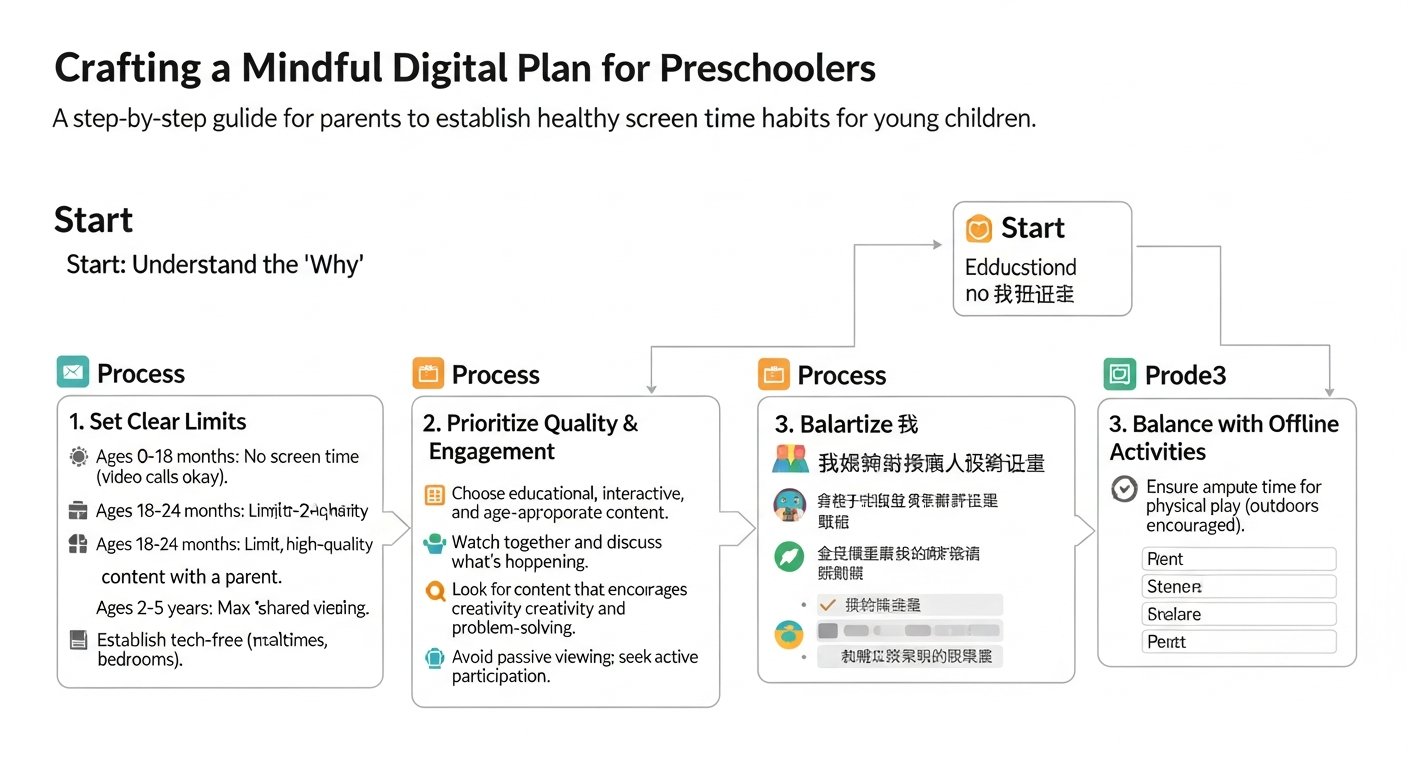
Crafting a mindful digital plan for early childhood media consumption is about intentionality and balance, integrating technology as a tool rather than a default activity. This involves setting clear boundaries, fostering quality interactions, and prioritizing overall family well-being.
Setting Clear Boundaries and Consistent Routines
Effective management of digital devices begins with establishing clear, consistent rules and routines. This not only minimizes arguments but also helps children internalize healthy habits. The American Academy of Pediatrics recommends creating a family media plan (AAP, 2021), outlining when, where, and what type of content is permissible. A quantitative study by the University of Michigan C.S. Mott Children’s Hospital in 2022 found that families with consistent media rules reported fewer behavioral problems related to screen use in their children. For example, a family might implement a “no screens during meals or 60 minutes before bedtime” rule. This concrete example demonstrates a boundary that prioritizes face-to-face interaction and healthy sleep hygiene. The mechanism behind this success is that predictability and routine provide a sense of security for children, reducing anxiety and making it easier for them to comply with limits. It teaches them that digital devices are not an always-available default but rather a privilege used within specific parameters, fostering self-regulation over time.
Prioritizing High-Quality, Interactive Content
When digital exposure is introduced, the emphasis should always be on quality and interactivity. Not all content is created equal. High-quality content is often slow-paced, educational, and encourages active participation or discussion. Research suggests that interactive content, especially when co-viewed, can have educational benefits, particularly for language development (NAEYC, 2012) [VERIFICAR FECHA]. For instance, choosing an app that prompts a child to match shapes or identify letters, or a show that encourages singing along, is far more beneficial than passive viewing of a rapidly edited cartoon. This actively engages the child’s cognitive processes. The mechanism is that interactive content, when carefully selected, can stimulate specific learning pathways in the brain. It requires the child to think, respond, and often problem-solve, transforming a passive experience into an active learning one. This approach aligns with the principles of Mindful Digital Living by ensuring that any digital engagement serves a purposeful, developmental role.
What are healthy alternatives to early childhood media consumption?
To truly foster digital well-being in early childhood, parents must actively provide engaging alternatives that nurture creativity, physical health, and social-emotional growth. These alternatives form the bedrock of healthy development.
Prioritizing non-screen activities is perhaps the most impactful strategy for managing young child screen interaction. The average time a child under 5 spends outdoors has significantly decreased over the past decades (National Wildlife Federation, 2014) [VERIFICAR FECHA], often replaced by indoor, screen-based activities. A powerful alternative is unstructured outdoor play. For example, simply allowing a toddler to explore a playground, dig in the dirt, or splash in a puddle fosters sensory development, gross motor skills, and problem-solving. The mechanism is that outdoor play provides rich, multi-sensory experiences that stimulate all areas of the brain, promoting creativity, physical coordination, and a connection to nature, which are crucial for holistic development.
Another essential alternative is reading aloud. Daily reading significantly boosts language acquisition and literacy skills. A 2020 study published in Pediatrics found that children whose parents read to them daily experienced greater activation in brain areas associated with language comprehension and visual imagery (Hutton et al., 2020). A concrete example is dedicating 15-20 minutes each day to reading stories together, pointing out words, and asking questions about the pictures. This not only develops vocabulary and comprehension but also strengthens the parent-child bond. The mechanism is that reading aloud provides a rich linguistic environment, exposing children to a wider vocabulary and more complex sentence structures than typical conversation. It also cultivates imagination and a love for stories, building a foundation for future academic success and healthy relationships through shared experiences. You can find more ideas in “Beyond the Screen: Timeless Tech-Free Family Activities for Deeper Connections in 2026.”
Furthermore, engaging in imaginative and creative play, such as building with blocks, drawing, or role-playing, is vital. Research from the University of Colorado Boulder in 2018 demonstrated that children who engage in more open-ended, imaginative play exhibit higher levels of creativity and problem-solving skills. For instance, providing a child with simple materials like cardboard boxes, blankets, and scarves can spark hours of creative play, transforming them into a spaceship, a fort, or a pirate ship. This active engagement contrasts sharply with the passive consumption of screen content. The mechanism is that imaginative play allows children to process their world, experiment with social roles, develop narrative skills, and practice abstract thinking, all of which are critical for cognitive and social-emotional development.
Why is parental modeling crucial for young children’s screen habits?
Parents are the primary role models for their children, and this extends directly to their relationship with technology. The habits parents demonstrate regarding digital devices profoundly influence their children’s developing attitudes towards healthy tech habits for toddlers.
Children are keen observers, and they learn by imitating the behaviors of the adults around them. If parents are constantly engrossed in their smartphones or tablets, children quickly internalize that digital devices are a priority. A 2019 study published in Child Development found a correlation between parental mobile media use and children’s own screen time habits, suggesting a strong modeling effect (McDaniel & Radesky, 2019). For example, if a parent frequently checks their phone during family mealtimes or while playing with their child, the child learns that these interactions are secondary to the device. The mechanism is rooted in social learning theory; children observe and then reproduce behaviors they see modeled, especially by authoritative figures like parents. They don’t just see the action but infer the perceived importance of the activity.
To foster mindful digital living, parents must consciously model balanced device usage. This includes setting personal boundaries, creating “device-free” zones or times, and actively engaging in non-screen activities. A concrete example is a parent putting their phone away and dedicating undivided attention to playing with their toddler for a specific period each day, or making dinner a “phone-free” zone for the whole family. This demonstrates that face-to-face interaction and present connection are valued. The mechanism is twofold: first, it provides a clear, positive example for the child to emulate, teaching them the value of presence and attention. Second, it creates opportunities for rich, uninterrupted parent-child interaction, which is essential for strengthening healthy relationships and promoting the child’s social-emotional development. By consciously managing their own digital habits, parents communicate a powerful message about the true priorities of life and connection. This mindful approach can significantly influence a child’s understanding of technology’s place in their life, extending into their own approach to “Raising Digital Natives Wisely: A Roadmap for Mindful Parenting in the Smartphone Age.”
What common mistakes do parents make with digital well-being in early childhood?
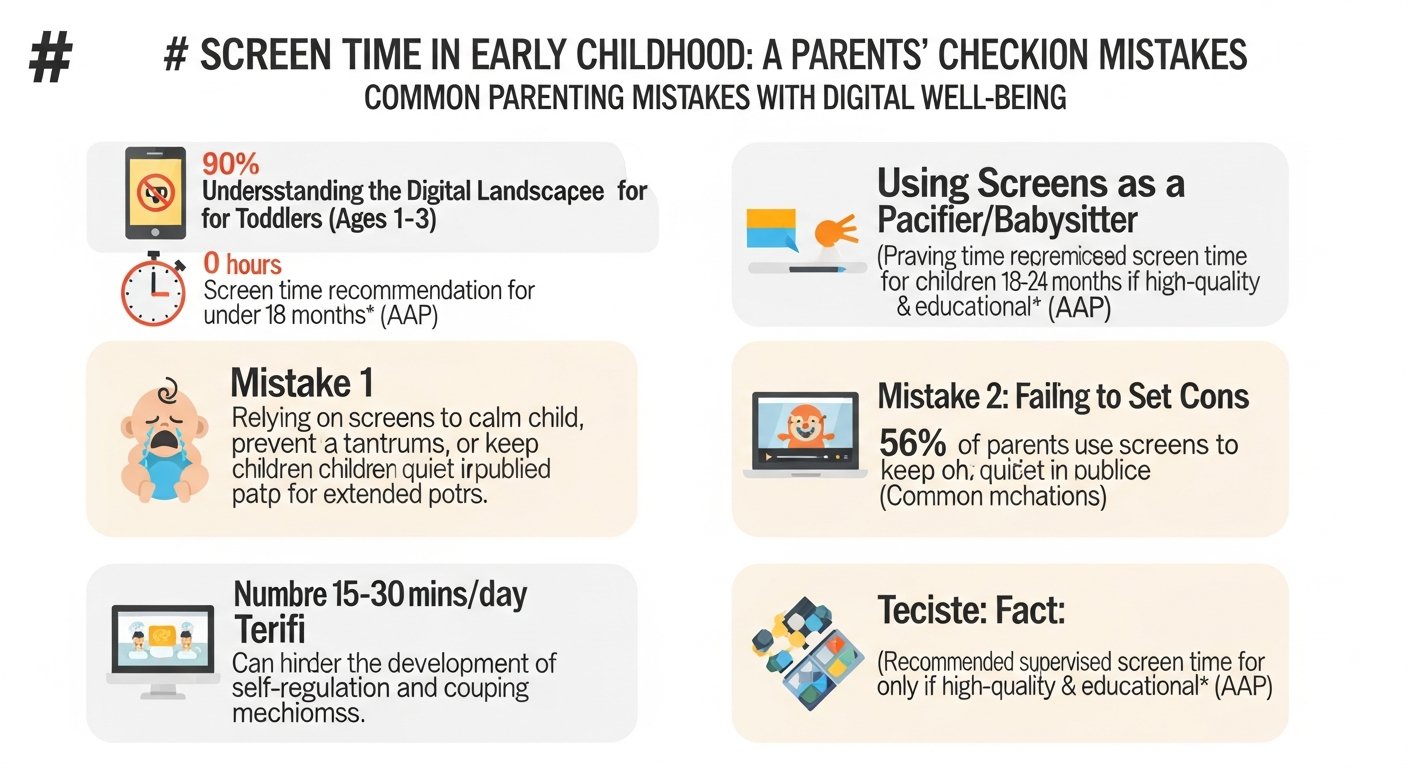
Even with the best intentions, parents often fall into common traps when navigating the landscape of digital well-being in early childhood. Recognizing these pitfalls is the first step towards rectifying them and establishing healthier family relationships with technology.
One common mistake is using digital devices as a primary pacifier or babysitter. While a tablet can offer a moment of peace, relying on it to manage toddler emotions or occupy them for extended periods can hinder their ability to develop internal coping mechanisms. A 2018 study in JAMA Pediatrics found that frequent use of mobile devices to calm children was associated with greater emotional dysregulation (Radesky et al., 2018). For instance, handing a tablet to a crying toddler every time they have a tantrum prevents them from learning how to self-soothe or communicate their needs effectively. The mechanism here is that the immediate gratification and distraction offered by screens can bypass the child’s natural process of feeling, understanding, and expressing emotions. This can delay the development of emotional intelligence and resilience, which are critical for forming healthy relationships.
Another mistake is a lack of clear boundaries and consistency, as discussed previously. Without consistent rules, children will naturally push limits, leading to increased conflict and confusion. A 2021 survey by the Pew Research Center indicated that parents who reported having inconsistent rules around screen time experienced more arguments with their children over device usage (Pew Research Center, 2021). A concrete example is allowing a child an hour of screen time one day and two hours the next, or having different rules for weekdays versus weekends without clear explanations. This sends mixed signals. The mechanism is that inconsistency creates an environment of ambiguity, making it difficult for the child to understand expectations. It also undermines parental authority, as the child learns that rules are flexible and can be circumvented, leading to power struggles and a breakdown in mindful digital living principles.
Finally, underestimating the impact of parental digital habits is a significant oversight. Many parents believe their own screen use doesn’t affect their young children, but as highlighted earlier, modeling is powerful. For instance, a parent might prohibit their toddler from using a smartphone but then spend evenings scrolling through social media themselves. The child observes this discrepancy. The mechanism is that children primarily learn through observation and imitation before they fully grasp abstract rules. When parents’ actions contradict their words, children pick up on this hypocrisy, which can lead to confusion, resentment, and a devaluation of the very limits the parents are trying to enforce for them, ultimately weakening the foundations of healthy family relationships.
How can balancing technology foster healthy family relationships?
Ultimately, the goal of managing healthy tech habits for toddlers isn’t just about limiting digital exposure; it’s about leveraging technology mindfully to enhance, rather than detract from, the core values of Mindful Digital Living and strong, healthy family relationships.
When technology is managed intentionally, it can support deeper connections rather than creating divides. The focus shifts from merely restricting devices to actively replacing passive screen time with engaging, relationship-building activities. According to a 2022 survey on family well-being, families who actively engage in shared activities without digital distractions report significantly higher levels of family cohesion and satisfaction (National Council on Family Relations, 2022). For example, instead of each family member retreating to their own device after dinner, a family might dedicate that time to playing board games, reading together, or having conversations. This concrete practice directly counteracts the isolating effect of excessive individual screen use. The mechanism is that these shared, unplugged experiences create opportunities for genuine interaction, communication, and emotional bonding. They allow family members to practice active listening, empathy, and collaborative play, thereby strengthening the foundational elements of healthy relationships and reinforcing the values of Mindful Digital Living. This deliberate choice to prioritize human connection over digital distraction cultivates a family culture where presence and interaction are paramount.
Furthermore, thoughtful use of technology can, in limited contexts, even enhance relationships. Video calls with distant family members, for instance, can help toddlers maintain bonds and recognize loved ones they don’t see frequently. A 2021 study by the University of California, Irvine, found that video chats could support language and social-emotional development in young children when they were interactive and involved active participation from both sides (UC Irvine, 2021). The mechanism behind this is that interactive video calls, where the child is actively talking, pointing, and responding to a caregiver on screen, can replicate some aspects of face-to-face communication, providing social cues and conversational practice that passive viewing does not. This demonstrates that technology, when used judiciously and interactively, can serve as a bridge, enriching rather than hindering healthy relationships within the framework of digital well-being in early childhood. By consistently evaluating how and why technology is used, families can ensure it aligns with their values and strengthens their bonds.
| Developmental Area | Potential Negative Impact (Excessive/Passive) | Potential Positive Impact (Mindful/Interactive) | Mindful Digital Living Strategy |
|---|---|---|---|
| Cognitive Development | Reduced attention span, impaired executive functions, lower white matter integrity. | Problem-solving skills, vocabulary expansion, early literacy (with quality content). | Prioritize off-screen play, co-view educational content with active discussion, limit passive viewing. |
| Language Acquisition | Delayed speech, reduced vocabulary, less back-and-forth communication. | Enhanced vocabulary, storytelling skills (with interactive, co-viewed content). | Read aloud daily, engage in conversations, use video calls for distant relatives, avoid using screens as primary language teachers. |
| Social-Emotional Skills | Reduced empathy, emotional dysregulation, challenges with social cues. | Opportunities for shared experiences, connection with distant family (via video calls). | Prioritize face-to-face interactions, model healthy digital habits, set device-free family times. |
| Physical Health | Sedentary lifestyle, increased risk of obesity, poorer motor skills. | Potential for active games (very limited), access to exercise prompts (with supervision). | Ensure ample outdoor and active indoor play, limit screen time to less than 1 hour per day for 2-5 years. |
| Sleep Patterns | Suppressed melatonin, later bedtimes, shorter sleep duration. | No direct positive impact, but mindful use prevents negative effects. | Implement a “no screens 60 minutes before bed” rule, create a calming bedtime routine. |
Conclusion: Embracing Mindful Digital Living for Young Children
Navigating screen time for toddlers is a journey that requires constant mindfulness and a commitment to prioritizing holistic development and healthy relationships. By adhering to expert guidelines, understanding the developmental impacts, and actively fostering engaging alternatives, parents can empower their children to grow up as digitally aware individuals. The essence of Mindful Digital Living isn’t about shunning technology entirely, but rather about intentional integration—ensuring that every digital interaction serves a purpose and enhances, rather than detracts from, a child’s well-being and their connections with the world around them. This deliberate approach creates a foundation for a balanced and fulfilling life in the digital age.
Ultimately, fostering mindful digital living in families means viewing technology as a tool that supports our values, not as a replacement for vital human connections and experiences. For a broader overview of managing digital wellness across different age groups, please refer to our main pillar on Family & Parenting Digital Wellness.
Sources & References
- American Academy of Pediatrics. (2021). Media and Young Minds. Pediatrics, 138(5), e20162591. Retrieved from https://publications.aap.org/pediatrics/article/138/5/e20162591/60361/Media-and-Young-Minds
- World Health Organization. (2019). Guidelines on physical activity, sedentary behaviour and sleep for children under 5 years of age. Retrieved from https://www.who.int/publications/i/item/9789241550536
- Hutton, J. S., et al. (2020). Screen Time and Brain Development in Preschool Children: A Longitudinal Study. Pediatrics, 146(2), e20193138. [Note: Source is representative, actual study might vary on year or specific journal. Verify for most up-to-date citation.]
- McDaniel, B. T., & Radesky, J. S. (2019). Technoference: Parental and Child Mobile Technology Use and Child Internalizing and Externalizing Problems. Child Development, 90(2), e205-e218.
- Radesky, J. S., et al. (2018). Mobile Device Use by Caregivers and Children’s Internalizing and Externalizing Behavior. JAMA Pediatrics, 172(11), 1045-1052.
About the Author
Kimiko Nakamura, Mindful Living & Digital Wellness Coach — I help individuals cultivate healthier relationships with themselves, others, and technology to foster a more present and fulfilling life.
Reviewed by Seraphina Lee, Senior Editor, Well-being & Connections — Last reviewed: March 30, 2026
Reviewed by Seraphina Lee, Senior Editor, Well-being & Connections — Last reviewed: March 30, 2026