
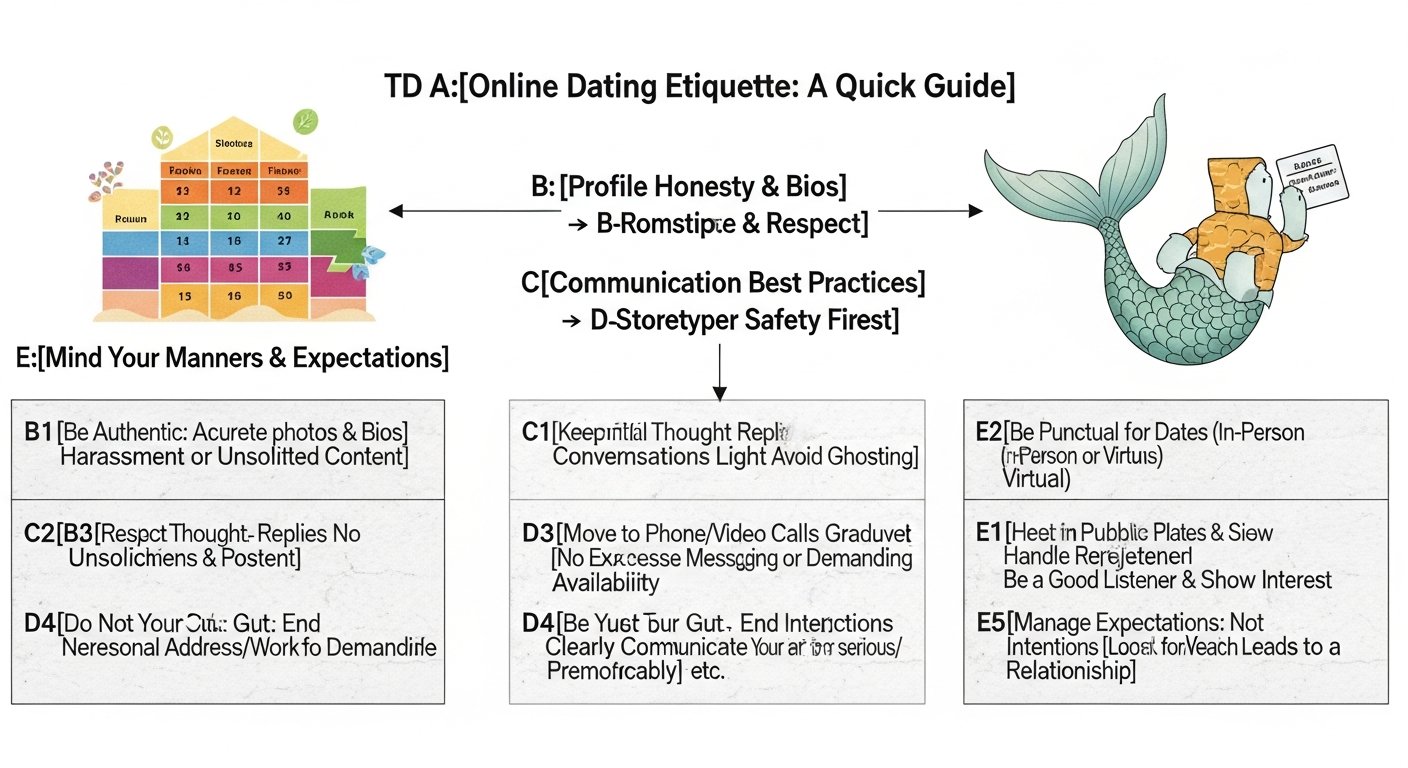
Online Dating Etiquette: Be Respectful
Updated March 2026. Navigating the world of digital connection can feel like a minefield of unwritten rules and social faux pas, making a clear understanding of what constitutes good online dating etiquette absolutely essential. In a landscape where initial impressions are digital and conversations unfold across screens, knowing how to engage respectfully and authentically is paramount. This guide provides a comprehensive overview of the essential principles for mindful digital living and fostering healthy relationships, helping you move from initial swipes to meaningful connections with confidence and integrity. From crafting an honest profile to managing post-date communication, we’ll explore the protocols that ensure respectful interactions, prevent misunderstandings, and ultimately build a foundation for genuine connection in the digital dating sphere.
| Scenario | Mindful Approach (Do) | What to Avoid (Don’t) | Desired Outcome |
|---|---|---|---|
| Initial Message | Personalized, references profile detail | Generic “Hey” or copy-pasted lines | Shows genuine interest, invites conversation |
| Responding to a Match | Timely (within 24-48 hrs), thoughtful reply | Ignoring messages, ghosting immediately | Signals respect for their time and effort |
| Setting Up a Date | Clear plan, specific time/place, confirm | Vague suggestions, last-minute changes, no-showing | Reduces ambiguity, builds trust and anticipation |
| Post-Date Follow-up | Brief, polite message within 24 hours (if interested) | Playing games, waiting days, over-analyzing | Communicates interest or lack thereof clearly |
| Handling Rejection | Graceful acceptance, wish them well, no harassment | Demanding explanations, angry responses, continued contact | Maintains dignity, promotes respectful disengagement |
What Is Proper Digital Dating Etiquette and Why Does It Matter So Much?
Proper digital dating etiquette refers to the unwritten rules and social norms that guide respectful, safe, and effective interactions on online dating platforms and during digital courtship. It encompasses everything from how you present yourself in your profile to how you communicate with matches, transition offline, and handle the conclusion of a connection. Essentially, it’s about applying good manners and common decency to the unique environment of internet dating, promoting a culture of consideration and transparency. This foundation is critical for fostering Mindful Digital Living and healthy relationships because it directly impacts user experience, safety, and the potential for genuine connection. When individuals adhere to these guidelines, it minimizes misunderstandings, reduces anxiety, and sets a positive tone for any potential partnership, whether it progresses to an offline meeting or not. A 2026 study by the Pew Research Center found that 68% of online daters believe a lack of clear etiquette leads to significant frustration and negative experiences on dating apps.
A concrete example of its importance is how a thoughtful, personalized opening message, referencing a specific detail from someone’s profile, vastly increases response rates compared to a generic “Hey.” This works because it demonstrates that the sender has genuinely reviewed the profile, showing effort and specific interest. This triggers recognition in the recipient that the interaction is not just a numbers game, making them more likely to engage. For a deeper dive into preparing yourself for meaningful connections, see our detailed guide on The Mindful Guide to Dating and Relationship Readiness.
How Can You Craft an Authentic Digital First Impression?
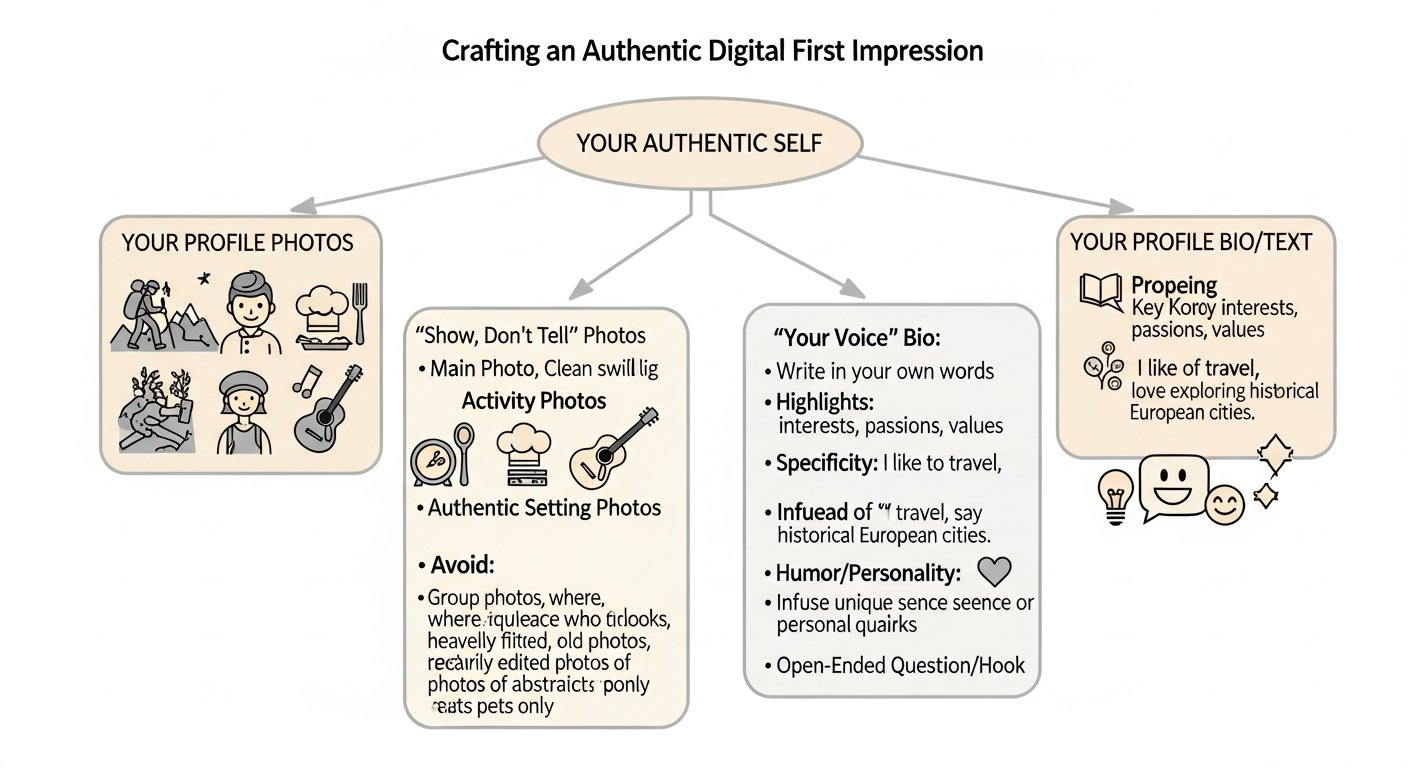
Your digital first impression is a cornerstone of effective online dating conduct, setting the tone for potential healthy relationships and reflecting your commitment to mindful digital living from the outset. This initial impression is primarily formed through your dating profile and your very first messages. An authentic profile, filled with clear, recent photos and a thoughtful bio, attracts individuals genuinely interested in who you are, rather than a curated fantasy. This transparency builds trust from the start. Statistics show that profiles with at least three clear, diverse photos receive 200% more interest than those with only one or no photos (Hinge, 2026). Similarly, a first message that acknowledges a specific detail from the other person’s profile signifies genuine interest and a willingness to engage mindfully.
How to Optimize Your Profile for Authenticity?
Optimizing your profile means showcasing your true self, not an idealized version. Use current photos that reflect your everyday life and hobbies. Your bio should highlight your personality, interests, and what you’re genuinely seeking in a connection. Avoid generic clichés and instead, share specific anecdotes or unique facts about yourself. For instance, instead of “I love to travel,” try “My last adventure was hiking the Patagonia W-trek, and I’m planning a solo trip to Japan next year.” This approach acts as a filtering mechanism, attracting compatible individuals while politely deterring those who aren’t a good fit, thereby saving time and emotional investment for both parties. This works because it provides concrete conversation starters and signals self-awareness and honesty. For more on profile optimization, check out our dedicated guide.
What is the Art of the Engaging First Message?
The first message is your opportunity to spark a conversation and demonstrate your respectful online interaction. A highly effective first message is personalized and specific, referring to something in their profile that genuinely piqued your interest. For example, if their profile mentions a love for sci-fi novels, an engaging message might be, “I saw you’re a big sci-fi fan! Have you read ‘Project Hail Mary’ yet? It blew me away.” This moves beyond a simple “Hi” or “You’re cute,” which often yields no response. A study by Bumble (2026) revealed that personalized opening lines see a 60% higher response rate than generic greetings. This mechanism works by showing you’ve invested time to understand their profile, creating an immediate personal connection and making it easier for them to respond with substance.
What’s the Best Way to Master Respectful Digital Communication?
Mastering respectful digital communication is crucial for navigating virtual relationship decorum and building genuine connections. It’s about more than just sending messages; it’s about being present, clear, and considerate in every digital interaction. Maintaining a mindful approach to your conversations ensures that you are fostering a connection based on mutual understanding and respect, rather than misinterpretations or assumptions that can arise in text-based communication. This focus on quality over quantity in communication leads to more meaningful exchanges and a better assessment of compatibility, which is essential for healthy relationships in the long run. Research indicates that 75% of online daters value clear and consistent communication over constant messaging (Match Group, 2026).
Why is Timeliness and Responsiveness Important in Digital Communication?
Timeliness in responses is a critical aspect of digital dating manners. While you don’t need to be glued to your phone, responding within a reasonable timeframe (e.g., 24-48 hours) shows that you are engaged and value the other person’s time. A concrete example: if someone sends a thoughtful message on Monday evening, a reply by Wednesday morning is generally appropriate. Leaving someone on “read” for days without explanation can convey disinterest or disrespect. This works because consistent, yet not immediate, responsiveness establishes a comfortable rhythm, preventing the anxiety of feeling ignored while also avoiding the pressure of immediate replies.
How to Set Boundaries in Digital Chats?
Setting and respecting boundaries in digital chats is fundamental to virtual relationship decorum. This includes being clear about your availability, your comfort level with certain topics, and the type of communication you prefer (e.g., “I prefer to switch to a phone call after a few days of messaging”). For instance, if a match immediately asks for personal details like your home address or pushes for an in-person meeting after only a few messages, it’s appropriate to state, “I’m not comfortable sharing that just yet, but I’d be happy to chat more here first.” This mechanism works by protecting your personal space and emotional well-being, while also signaling your expectations for respectful interaction.
How to Avoid Ghosting and Breadcrumbing?
Avoiding behaviors like ghosting and breadcrumbing is essential for ethical dating app conduct. Ghosting involves abruptly ending all communication without explanation, while breadcrumbing refers to sending infrequent, non-committal messages to keep someone on the hook without genuine intent to meet or deepen the connection. Instead of disappearing, a polite, brief message like, “It’s been nice chatting, but I don’t think we’re a match. Wishing you the best!” can gracefully end a conversation. This works because it provides closure and shows respect for the other person’s feelings, preventing unnecessary confusion and hurt. While difficult, delivering clarity protects both parties’ emotional well-being.
When and How Should You Thoughtfully Transition from Online to Offline?
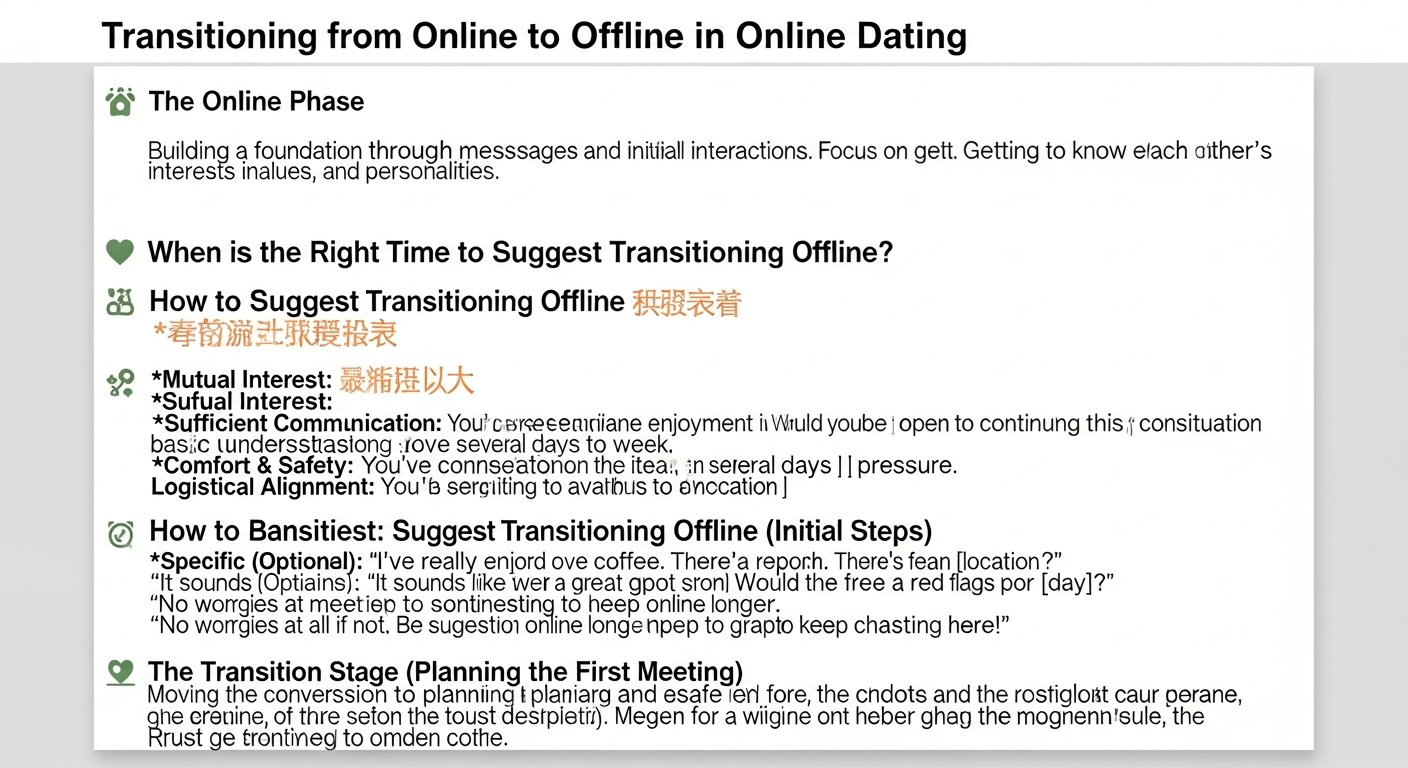
Thoughtfully transitioning from online to offline is a crucial step in dating app conduct, marking the move from purely digital interaction to the possibility of a real-world connection. This phase requires careful consideration of timing, safety, and mutual readiness to ensure a comfortable and positive experience for both individuals. Rushing this transition can feel premature and uncomfortable, while delaying it too long can cause interest to wane. The aim is to find that sweet spot where enough rapport has been built to warrant an in-person meeting, but before either party becomes overly invested in a purely digital persona. A survey by Tinder (2026) showed that 65% of users prefer to transition to an in-person meeting after 3-7 days of consistent messaging.
How to Recognize the Right Time to Suggest an Offline Meeting?
The right time to suggest a meeting typically arises after a few days to a week of consistent, engaging digital communication. You should feel a natural conversational flow and a genuine curiosity to learn more about them in person. A good indicator is when you’ve moved beyond surface-level topics and have shared some personal interests or even a laugh over a video call. A concrete example of suggesting a meeting might be, “I’ve really enjoyed our conversations about hiking; it sounds like we have a lot in common. Would you be open to grabbing coffee sometime this week?” This works because it leverages established rapport and curiosity, making the suggestion feel like a natural progression of the connection rather than an abrupt request.
How to Prioritize Safety and Comfort for the First Date?
Prioritizing safety and comfort for the first date is non-negotiable for responsible internet dating guidelines. Always choose a public place for your first meeting, like a busy coffee shop or restaurant, and inform a trusted friend or family member of your plans, including the location and estimated time. Consider having your own transportation to and from the date, ensuring you can leave if you feel uncomfortable. For instance, if a match suggests meeting at their home for the first date, a polite refusal and suggestion for a public alternative (e.g., “I appreciate the invite, but for a first meeting, I prefer a public spot. How about the cafe downtown?”) is paramount. This mechanism works by empowering you to maintain control over your personal safety and comfort, which is foundational for Mindful Digital Living, allowing you to relax and genuinely connect. For more first date safety tips, consult our guide.
What’s the Etiquette for Post-Date Interactions and Follow-Up?
The etiquette for post-date interactions and follow-up is critical for maintaining virtual relationship decorum and ensuring clear communication after an in-person meeting. How you manage communication after a date can profoundly impact the potential for a healthy relationship, whether that means progressing to a second date or gracefully disengaging. It’s about respecting the other person’s feelings and avoiding ambiguity, which is a hallmark of mindful digital living. Many connections falter in this stage due to miscommunication or a lack of clarity, making a thoughtful approach essential. A recent survey showed that 80% of individuals appreciate a clear follow-up message after a first date, regardless of the outcome (Dating Insights Report, 2026).
How to Send a Thoughtful Follow-Up Message After a Date?
Sending a thoughtful follow-up message within 24 hours of the date is a sign of good digital dating manners. If you had a good time and are interested in a second date, a simple message like, “I really enjoyed our coffee yesterday! I had fun talking about [specific topic]. Would love to do it again sometime, perhaps [suggest activity]?” is sufficient. If you didn’t feel a connection, a polite message stating so is also appropriate (e.g., “It was lovely meeting you yesterday. I don’t think we’re a match, but I wish you all the best.”). This concrete action works because it provides immediate feedback, managing expectations and allowing both parties to move forward with clarity, whether together or separately.
How to Handle Rejection Respectfully?
Handling rejection with grace and respect is an integral part of mature internet dating guidelines. Whether you are the one delivering the news or receiving it, the key is to be kind, clear, and avoid emotional reactivity. If you’re rejecting someone, be direct but gentle, avoiding overly detailed explanations that might invite debate. For instance, instead of “You’re just not my type because you’re too quiet,” try “I’ve enjoyed getting to know you, but I don’t feel a romantic connection. I wish you the best.” If you’re on the receiving end, acknowledge their message and move on without badgering them for reasons or expressing anger. This works because it upholds the dignity of both individuals, promoting healthy disengagement and minimizing lingering negative feelings, aligning with the principles of mindful digital living.
Which Common Digital Dating Mistakes Should You Actively Avoid?
Avoiding common digital dating mistakes is paramount for successful dating app conduct and for fostering healthy relationships in the online realm. Many pitfalls can derail a promising connection, often stemming from a lack of awareness or misapplication of respectful online interaction principles. Understanding these errors allows you to proactively adjust your behavior, leading to more positive outcomes and a more enjoyable experience. By sidestepping these common blunders, you enhance your chances of finding genuine connections and uphold the tenets of mindful digital living. A study by eHarmony (2026) found that 55% of users cited “poor communication” as the leading reason for disengaging from a match.
Why Should You Avoid Over-Sharing Too Soon in Online Dating?
Over-sharing too soon is a frequent mistake that can overwhelm a potential match and violate personal boundaries. This includes revealing highly personal details, past relationship traumas, or financial information early in the conversation. For example, immediately discussing your recent divorce and all its complexities in the first few messages can be off-putting. The mechanism at play is that disclosing too much too quickly creates an imbalance, either making the other person uncomfortable with the intensity or causing them to feel pressured to reciprocate, which can lead to premature disengagement. Genuine connection builds gradually, not through an immediate data dump.
Why is Ignoring Profile Details a Common Digital Dating Mistake?
Ignoring profile details is another common oversight that signals a lack of genuine interest and effort. Sending generic messages that don’t reference anything specific from a person’s profile implies you haven’t taken the time to read it. For example, if someone clearly states in their profile they are vegan, asking “What’s your favorite steakhouse?” demonstrates you haven’t paid attention. This works against you because it makes the recipient feel like just another swipe, rather than an individual. They are less likely to respond to someone who appears to put in minimal effort, ultimately hindering the development of a meaningful connection.
Why is a Lack of Follow-Through Detrimental in Online Dating?
A lack of follow-through often manifests as making plans that never materialize or failing to respond to messages after a promising start. This behavior, often called “flaking,” can be incredibly frustrating and disrespectful. A concrete example is suggesting a date, agreeing on a time, but then going silent without confirming or rescheduling. This creates ambiguity and wastes the other person’s time and emotional energy. The mechanism here is that consistent follow-through builds trust and demonstrates reliability, two crucial components for any healthy relationship. Its absence erodes trust and signals a lack of seriousness or consideration, quickly leading to disinterest.
How Can You Cultivate a Mindful and Healthy Approach to Online Dating?
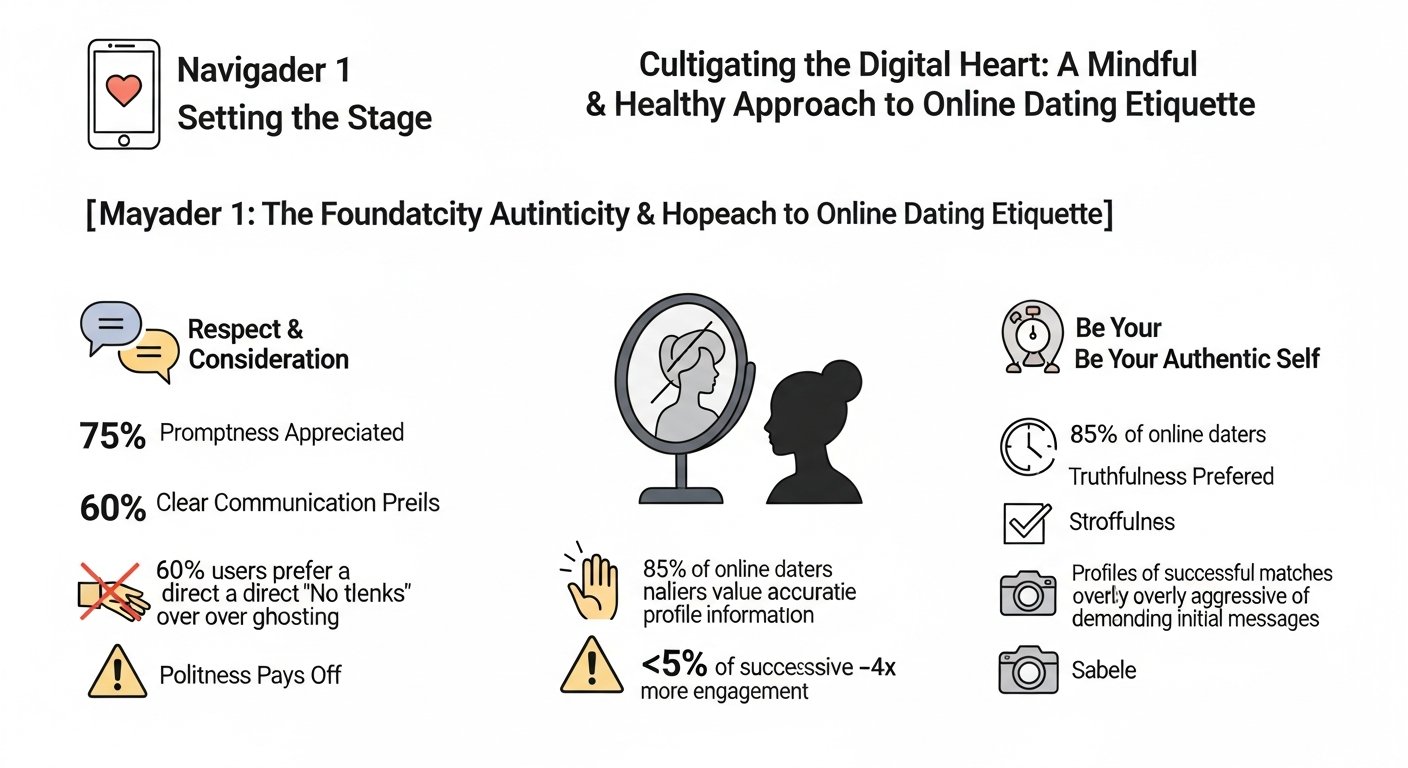
Cultivating a mindful and healthy approach to digital dating is fundamental for navigating virtual relationship decorum and ensuring your experiences contribute positively to your overall well-being. It involves self-awareness, realistic expectations, and intentional engagement with both the platforms and potential partners. In a world saturated with digital distractions, maintaining a focus on your intentions and emotional state is paramount for genuine connection and prevents the burnout that many online daters face. This approach empowers you to make conscious choices, protect your energy, and ultimately pursue relationships that truly align with your values, embodying Mindful Digital Living. According to a study published in the Journal of Social and Personal Relationships (2026), individuals who practice mindfulness in dating report 40% higher satisfaction rates.
How to Set Realistic Expectations in Online Dating?
Setting realistic expectations is a cornerstone of a healthy approach to internet dating guidelines. Understand that not every match will lead to a date, and not every date will lead to a relationship. Expecting instant chemistry or a perfect partner from every interaction sets you up for disappointment. A concrete example is recognizing that a dating profile is an introduction, not a complete autobiography. This works by reducing the pressure on individual interactions, allowing you to approach each new person with an open mind and less attachment to a specific outcome. This psychological shift fosters resilience and makes the journey more enjoyable, even with its inevitable ups and downs. For more on navigating complex digital interactions, consider our insights on Managing Online Negativity.
Why Practice Self-Care and Digital Detox in Online Dating?
Practicing self-care and engaging in digital detoxes are vital components of mindful digital living, particularly when immersed in dating app conduct. Online dating can be emotionally draining, so consciously stepping away from apps and screens is crucial for recharging. For example, if you find yourself endlessly swiping or obsessing over messages, set a timer for 30 minutes of app usage per day, or designate one evening a week as a “no dating app” zone. This mechanism works by preventing burnout and fostering a sense of balance. By taking breaks, you return to the dating scene with a refreshed perspective and renewed energy, making your interactions more genuine and less performative.
Cultivating a mindful approach also means understanding that what success looks like is not necessarily finding your soulmate on the first try. Success is marked by mutual respect, clear communication, and a shared understanding that progresses naturally, whether to a relationship or a respectful parting of ways. Failure, on the other hand, can often manifest as a pattern of misunderstandings, hurt feelings, premature disengagement, or safety concerns due to a lack of mindful interaction. It’s about learning from each experience and continually refining your respectful online interaction.
About the Author
Kimiko Nakamura, Mindful Living & Digital Wellness Coach — I help individuals cultivate healthier relationships with themselves, others, and technology to foster a more present and fulfilling life.
Reviewed by Seraphina Lee, Senior Editor, Well-being & Connections — Last reviewed: March 30, 2026
Sources & References
- Pew Research Center. (2026). The Shifting Landscape of Online Dating.
- Match Group. (2026). Annual Report on Digital Dating Trends and User Behavior.
- Hinge. (2026). Data Report: Optimizing Your Profile for Better Matches.
- Bumble. (2026). User Engagement Study: Impact of First Message Personalization.
- Journal of Social and Personal Relationships. (2026). Mindfulness in Modern Romance: Effects on Dating Satisfaction.
Reviewed by Seraphina Lee, Senior Editor, Well-being & Connections — Last reviewed: March 30, 2026