

Healthy Conflict Resolution Strategies for Couples 2026
Understanding the Roots of Conflict (and Why It’s Normal)
Before we can resolve conflict, we must first understand its nature. Many couples mistakenly believe that a “good” relationship is one free of arguments. This couldn’t be further from the truth. Research, particularly from relationship experts like Dr. John Gottman, consistently shows that all couples, even the happiest ones, experience conflict. What distinguishes thriving relationships is not the absence of disagreements, but the presence of healthy, constructive strategies for addressing them. Conflict, at its core, often stems from unmet needs, differing expectations, or perceived threats to one’s autonomy or values. It can arise from seemingly trivial issues like household chores or much deeper concerns about finances, parenting styles, or intimacy.
Common triggers for conflict often include stress, fatigue, external pressures, and, increasingly, the pervasive influence of digital devices. A partner engrossed in their phone while you’re trying to communicate can inadvertently signal disinterest, leading to feelings of neglect or unimportance. Psychologists emphasize that understanding these underlying dynamics is the first step towards effective resolution. For instance, sometimes a dispute about a messy kitchen isn’t really about the dishes; it might be about feeling unheard, undervalued, or burdened by an unequal division of labor. Recognizing these deeper currents requires introspection and a willingness to look beyond the surface-level argument.
Another crucial aspect is acknowledging individual conflict styles. Some people are “avoiders,” preferring to sidestep confrontation, while others are “engagers,” who feel the need to tackle issues head-on. Neither style is inherently right or wrong, but when they clash without mutual understanding, it can exacerbate tension. For example, an engager might feel frustrated by an avoidant partner’s silence, interpreting it as indifference, while the avoidant partner might feel overwhelmed by the engager’s intensity. Learning about your own and your partner’s default reactions to stress and conflict, perhaps through self-assessment or open discussion, can provide invaluable insight. This self-awareness allows couples to anticipate potential pitfalls and adjust their approaches to be more effective and less damaging.
Furthermore, societal shifts and the digital age introduce new layers of complexity. In 2026, the lines between work and personal life are often blurred by constant connectivity. Notifications, emails, and social media can pull our attention away from our partners, even during critical conversations. This “phubbing” (phone snubbing) can lead to feelings of resentment and disconnection, making it harder to address core issues when they arise. Understanding that conflict is a natural byproduct of two complex individuals coexisting, and that modern life adds unique stressors, helps depersonalize arguments and allows for a more objective, solutions-oriented approach.
The Art of Active Listening in a Digital Age

In a world saturated with information and constant digital chatter, the ability to truly listen has become a precious, often overlooked, skill. Active listening is far more than just hearing words; it’s about fully engaging with your partner, understanding their message, both verbal and non-verbal, and reflecting that understanding back to them. During conflict, this skill is paramount. When we feel heard and understood, even if agreement isn’t immediate, the emotional intensity of the argument often diminishes, paving the way for constructive dialogue.
The first, and perhaps most challenging, step in active listening, especially in 2026, is to put away distractions. This means phones face down, tablets closed, and smartwatches on silent. The mere presence of a device can signal that your attention is divided, even if you believe it isn’t. Research consistently shows that even a phone on the table can decrease the quality of conversation and connection. Giving your partner your undivided attention communicates respect and validates their feelings, creating a safer space for them to express themselves openly. Make eye contact, turn your body towards them, and use open body language to show you are present.
Once physically present, the mental and emotional aspects of active listening come into play. This involves listening to understand, not to respond or rebut. Resist the urge to interrupt, defend yourself, or formulate your counter-argument while your partner is speaking. Instead, focus entirely on what they are saying, trying to grasp their perspective, their feelings, and the underlying needs they are expressing. Ask clarifying questions like, “Can you tell me more about that?” or “What does that feel like for you?” to encourage deeper sharing and ensure you’re accurately interpreting their message.
A key technique in active listening is “reflective listening” or “paraphrasing.” This involves summarizing what you’ve heard in your own words and offering it back to your partner. For example, “So, what I’m hearing is that you feel overwhelmed by the housework and wish I would take more initiative, is that right?” This not only confirms your understanding but also gives your partner an opportunity to correct any misinterpretations. This process, advocated by communication frameworks like Nonviolent Communication (NVC), ensures both parties are on the same page and reduces the likelihood of misunderstandings escalating the conflict.
Furthermore, pay attention to non-verbal cues. Your partner’s tone of voice, facial expressions, and body language can convey as much, if not more, information than their words. A partner might say, “I’m fine,” but their slumped shoulders and averted gaze tell a different story. Acknowledging these cues – “I hear you say you’re fine, but you seem a bit down; is there something else going on?” – demonstrates empathy and a deeper level of engagement. This holistic approach to listening builds trust and signals that you genuinely care about their entire experience, not just the logical content of their message.
Active listening is a skill that requires practice and patience, especially when emotions are high. It’s an investment in your relationship that pays dividends by fostering deeper understanding, reducing defensiveness, and ultimately making conflict resolution a pathway to greater closeness rather than a source of further division. By consciously choosing to be present and truly hear your partner, you lay a robust foundation for navigating disagreements constructively, even amidst the persistent hum of our digital lives.
Expressing Your Needs Without Blame: The “I” Statement Revolution
One of the most destructive patterns in conflict is the tendency to blame. When we feel hurt or upset, it’s natural to point fingers, using “you” statements that accuse, criticize, or shame: “You always leave your clothes on the floor!” or “You never listen to me!” While these statements might accurately describe a behavior, they are incredibly ineffective at resolving conflict. They put the other person on the defensive, triggering a fight-or-flight response that shuts down communication and escalates the argument. This is where the “I” statement revolution comes in, a cornerstone of effective communication frameworks like Nonviolent Communication (NVC) and a vital tool for healthy conflict resolution.
An “I” statement shifts the focus from accusing your partner to expressing your own feelings, needs, and observations. It takes ownership of your emotional experience, rather than projecting it onto your partner. The basic structure is: “I feel [emotion] when [specific, non-judgmental behavior or situation] because [your need or value is impacted].” For example, instead of “You always leave your clothes on the floor and it drives me crazy!” try: “I feel frustrated when I see clothes on the floor because I value a tidy living space, and it makes me feel like my efforts to keep things clean aren’t respected.”
Let’s break down why this structure is so powerful. First, starting with “I feel…” communicates your emotional state directly. Emotions are subjective and undeniable; your partner can’t argue with how you feel. Second, specifying the “non-judgmental behavior or situation” focuses on observable facts rather than interpretations or character assassinations. Instead of “You’re so messy,” it’s “when I see clothes on the floor.” This prevents your partner from feeling personally attacked. Third, explaining “because [your need or value is impacted]” provides context and helps your partner understand the deeper meaning behind your feeling. It connects the behavior to something important to you, fostering empathy rather than defensiveness.
Practicing “I” statements requires a degree of self-awareness. It means taking a moment to identify your own emotions and the underlying needs that aren’t being met. Are you feeling sad, angry, frustrated, lonely, or anxious? What core need is at stake – respect, security, connection, autonomy, fairness? This self-reflection, while challenging in the heat of the moment, is crucial for expressing yourself authentically and constructively. It moves the conversation from a battle of wills to a shared exploration of needs.
Consider the impact of digital distractions on this process. If you’re trying to express your needs, but your partner is intermittently checking their phone, it undermines your message and makes it harder for them to truly absorb what you’re saying. The “I” statement requires an attentive listener to be effective. Similarly, if you yourself are distracted, it’s harder to formulate a clear, non-blaming statement. The discipline of putting devices aside during conflict resolution not only facilitates active listening but also enables more thoughtful and effective self-expression.
The “I” statement revolution is about transforming how you communicate during conflict from a destructive cycle of blame into a constructive dialogue about mutual needs. It empowers you to voice your concerns without alienating your partner, inviting them into a space of understanding and problem-solving. This shift is fundamental to building a resilient relationship where both partners feel safe to express themselves and work collaboratively towards solutions.
Navigating High-Emotion Moments: Taking a Digital Timeout
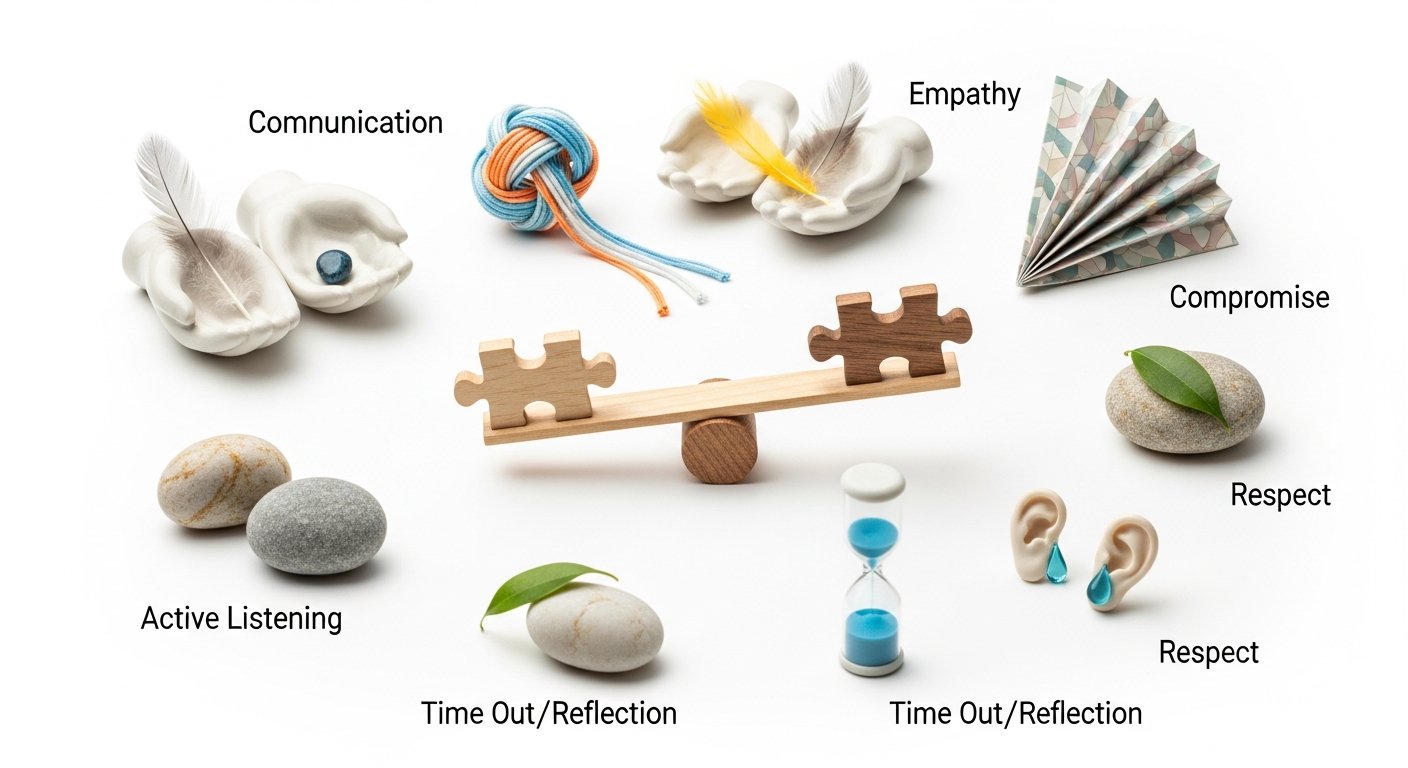
Even with the best intentions and communication strategies, conflicts can sometimes escalate into high-emotion moments. When anger, frustration, or defensiveness reach a boiling point, our ability to think rationally and communicate effectively diminishes significantly. This is when the “fight, flight, or freeze” response kicks in, making constructive dialogue nearly impossible. Recognizing these tipping points and knowing when to call a timeout is a vital healthy conflict resolution strategy, and in 2026, understanding the role of digital devices in these moments is more critical than ever.
Psychological research, particularly from the Gottman Institute, highlights the concept of “flooding,” where one or both partners become so physiologically overwhelmed by negative emotions (increased heart rate, shallow breathing, tunnel vision) that they can no longer process information rationally. During flooding, attempts to continue the discussion are usually futile and often lead to further damage. The goal of a timeout is to de-escalate, self-regulate, and return to the conversation once both partners are calm enough to engage productively.
A digital timeout in this context has two key components: first, agreeing to pause the conversation, and second, intentionally disengaging from both the conflict and potential digital distractions during the break. When you feel emotions rising, either partner can call a timeout using a pre-agreed signal or phrase, such as “I need a break” or “Let’s pause this for 30 minutes.” It’s crucial that this isn’t used as an escape mechanism but as a commitment to return to the discussion. Agree on a specific time to reconvene – for example, “Let’s take 30 minutes and come back to this at 7 PM.”
During the timeout, the focus should be on calming your nervous system. This is where digital wellness plays a dual role. On one hand, mindlessly scrolling social media or diving into an addictive game can prevent true self-regulation, merely delaying the emotional processing. It can also make your partner feel ignored or that you’re avoiding the issue. On the other hand, technology can be a tool for calming. Consider using mindfulness or meditation apps, listening to calming music, or engaging in a brief, non-stimulating digital activity that genuinely helps you de-stress, like a short guided breathing exercise. The key is intentionality and choosing activities that truly help you regulate, rather than distract you from the underlying emotions.
Equally important is what you *don’t* do during a timeout. Avoid ruminating on the argument, rehearsing your next comeback, or talking to others about the conflict. The purpose is to cool down, not to fuel the fire or gather ammunition. Engage in activities that are genuinely soothing and solitary: take a walk, read a book, listen to a podcast, or practice deep breathing. The physical separation during a timeout also allows both partners to gain perspective and return with a clearer head.
When the agreed-upon time arrives, commit to re-engaging. Start by checking in with each other: “Are you ready to talk now?” or “How are you feeling?” If one partner still feels overwhelmed, it’s okay to extend the break, but always with a renewed commitment to return. Navigating high-emotion moments with intentional timeouts, free from the pitfalls of digital distractions, transforms potential relationship damage into an opportunity for self-regulation and a more productive return to conflict resolution.
Collaborative Problem-Solving: Finding Win-Win Solutions
Once emotions have settled and both partners have had a chance to express their needs using “I” statements and active listening, the next crucial step is collaborative problem-solving. This isn’t about compromise, where each person gives up something to meet in the middle, but rather about working together to find a “win-win” solution that addresses the core needs of both individuals. It’s a creative process that requires empathy, flexibility, and a shared commitment to the well-being of the relationship, a process that can be hindered or helped by our digital habits in 2026.
The foundation of collaborative problem-solving lies in clearly articulating the underlying needs, not just the surface-level desires. For example, if the conflict is about spending habits, one partner might want to save more, while the other wants to enjoy experiences. The surface-level desire is “save money” vs. “spend money.” The deeper needs might be “financial security and peace of mind” versus “joy, connection, and creating memories.” Once these deeper needs are identified, the conversation shifts from a positional battle to a shared quest for solutions that honor both sets of needs.
The process typically involves several steps. First, clearly define the problem from both perspectives. Use the insights gained from active listening and “I” statements. For instance, “The problem is that I feel anxious about our savings (my need for security), and you feel restricted in enjoying life (your need for joy and experience).” Second, brainstorm a wide range of possible solutions without judgment. Encourage wild ideas, no matter how outlandish they seem initially. The goal here is quantity over quality. This is a great time to put away phones and dedicate full mental energy to the task. Digital tools can sometimes assist here – a shared note-taking app or a whiteboard app if you’re brainstorming remotely – but direct, focused interaction is usually best.
Third, evaluate the brainstormed solutions against both partners’ needs. Which options best meet both sets of needs? Which are practical? Which might require further discussion or adjustment? For instance, for the spending conflict, solutions might include: setting up an automatic savings transfer, allocating a specific “fun money” budget for experiences, exploring free or low-cost activities, or finding ways to earn extra income to cover both savings and experiences. The goal is to find solutions that genuinely feel good to both partners, rather than leaving one feeling resentful or unheard.
Fourth, choose the best solution (or combination of solutions) and create an action plan. Who will do what, by when? How will you track progress? This step is crucial for turning intentions into tangible changes. For digital wellness, this might involve agreeing on specific “no-phone zones” or times during the day to ensure quality connection time, thereby preventing future conflicts related to digital distraction. The collaborative nature of this process ensures buy-in from both sides, increasing the likelihood of successful implementation.
Finally, commit to revisiting the solution periodically. Relationships evolve, and what works today might need tweaking tomorrow. Collaborative problem-solving is an ongoing process, not a one-time event. This iterative approach fosters flexibility and demonstrates a shared commitment to the relationship’s health. By engaging in this structured, empathetic approach, couples can transform conflicts into opportunities for creative solutions that strengthen their bond and ensure both partners feel valued and understood.
Reconnecting After the Storm: Repair and Digital Detox
The resolution of a conflict doesn’t end when a solution is found; it extends into the crucial phase of repair and reconnection. This stage is about healing any lingering emotional wounds, rebuilding trust, and ensuring that both partners feel loved, secure, and understood. Without intentional repair, unresolved negative feelings can fester, eroding the foundation of the relationship over time. In our increasingly digital world of 2026, the temptation to retreat into individual digital bubbles after a disagreement can inadvertently sabotage this vital reconnection process.
Repair begins with acknowledging the impact of the conflict, even if it was resolved constructively. This might involve an apology, not necessarily for being “wrong,” but for any pain or discomfort caused. Simple statements like, “I’m sorry if my tone upset you,” or “I regret that our discussion escalated,” can go a long way in validating your partner’s experience and showing empathy. It’s about taking responsibility for your part in the dynamic, however small, and demonstrating a desire to soothe any lingering hurt. This act of humility strengthens the bond and signals a commitment to emotional safety.
Following an apology, it’s essential to actively reconnect. This means shifting focus from the problem to the relationship itself. Engage in activities that bring you closer, reminding yourselves of your shared love and affection. This is where a conscious “digital detox” becomes particularly powerful. Instead of immediately reaching for your phone to scroll social media, check emails, or play games – activities that often serve as escape mechanisms – choose to connect with your partner in a present, intentional way. Go for a walk together, cook a meal, watch a movie while snuggled on the couch, or simply sit and talk about something unrelated to the conflict.
Physical affection is another potent repair mechanism. A hug, holding hands, or a gentle touch can release oxytocin, the “love hormone,” which helps reduce stress and foster feelings of bonding and security. After a stressful period of conflict, these small gestures can powerfully communicate love and reassurance, helping to restore emotional equilibrium. The absence of digital distractions during these moments ensures that the focus remains entirely on each other, maximizing the impact of these connecting gestures.
Furthermore, discuss what you learned from the conflict. This isn’t about rehashing the argument, but about reflecting on insights gained. “I realized that I tend to shut down when I feel attacked,” or “I learned that I need to ask for breaks more often.” This meta-communication reinforces a growth mindset and reinforces the idea that conflict can be a learning opportunity. This shared reflection, free from the fragmented attention caused by digital interruptions, solidifies the lessons learned and prevents similar conflicts from arising in the future.
Finally, rebuild trust by following through on any agreed-upon solutions. Actions speak louder than words, and demonstrating a commitment to change reinforces your sincerity. Repair and reconnection are ongoing processes that require consistent effort and a shared commitment to prioritizing the relationship over individual digital escapes. By intentionally disengaging from the digital world and re-engaging with each other, couples can transform the aftermath of conflict into a powerful catalyst for deeper intimacy and resilience.
Conflict Resolution Checklist for Couples
| Strategy | Yes/No/N/A | Notes/Action Steps |
|---|---|---|
| Did we establish a safe space for discussion? | Choose a calm time & place, minimize interruptions. | |
| Did we put away all digital distractions? | Phones silent & out of sight, no TV. | |
| Did we practice active listening? | Paraphrased, asked clarifying questions, listened to understand. | |
| Did we use “I” statements to express needs? | Focused on feelings & needs, avoided blame/accusations. | |
| Did we take a timeout if emotions ran high? | Agreed to pause, self-regulated, committed to reconvene. | |
| Did we brainstorm multiple solutions collaboratively? | Focused on win-win, met underlying needs. | |
| Did we agree on a concrete action plan? | Who, what, when, how to implement. | |
| Did we engage in repair and reconnection afterward? | Apologized, affirmed love, spent quality time. | |
| Did we reflect on what was learned from the conflict? | Discussed insights for future interactions. |